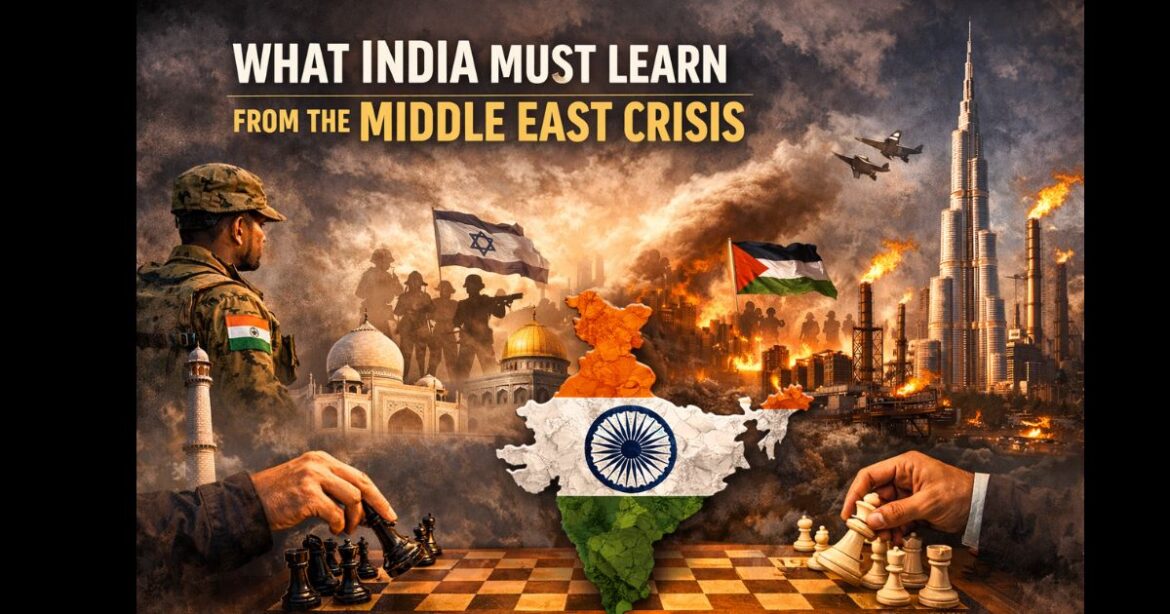
The Middle East crisis of 2026 has exposed a dangerous truth: India’s energy security is built on a fragile foundation. While the government has managed short-term supply disruptions through diplomacy and refinery ramp-ups, the structural vulnerabilities — particularly in LPG and natural gas — remain unaddressed.
The war in the Middle East is creating the largest supply disruption in the history of the global oil market. With crude and oil product flows through the Strait of Hormuz plunging from around 20 mb/d before the war to a trickle currently, Gulf countries have cut total oil production by at least 10 mb/d.
This article breaks down what the crisis has revealed, why India is especially exposed, and what policymakers must do before the next shock hits.
What India Should Do: A Policy Checklist
| Priority | Action |
|---|---|
| 🔴 Urgent | Build strategic LPG reserves (dedicated buffer, not just crude) |
| 🔴 Urgent | Diversify LPG suppliers to US, Australia, West Africa |
| 🟠 Medium-term | Expand domestic gas production (KG Basin, CBM, shale) |
| 🟠 Medium-term | Accelerate Chabahar Port as alternate trade route |
| 🟡 Long-term | Aggressive push on solar, green hydrogen, biogas |
| 🟡 Long-term | Increase SPR (Strategic Petroleum Reserve) from 5 days to 90 days |
| 🟢 Ongoing | Maintain diplomatic flexibility — avoid being boxed into one bloc |
India’s Energy Exposure: The Numbers Behind the Crisis
India imports more than 80% of its crude oil, with nearly half originating from the Gulf region. But crude oil is only part of the story. The deeper vulnerability lies in LPG and natural gas — products that millions of Indian households and industries depend on every single day.
Virtually all of India’s LPG and NGL (Natural Gas Liquids) imports come from the Middle East. Additionally, approximately 60% of India’s natural gas imports — including LNG — originate from the Gulf, particularly Qatar. When the Strait of Hormuz comes under threat, India does not just face higher fuel bills. It faces the risk of actual shortages.
Every $10 per barrel increase in global oil prices widens India’s current account deficit by 0.4–0.5% of GDP. If crude climbs to $100/barrel, India’s average inflation for FY2026–27 is projected to rise above 4.5%.
Lesson 1: LPG Is India’s Achilles Heel — Not Crude Oil
India’s crude oil imports are relatively diversified, but LPG is a completely different story.
India’s refineries produce around 14–15 million metric tonnes of LPG domestically each year. But that’s not enough to meet demand. The government has already asked refineries to ramp up domestic LPG output — but this is only possible if crude oil keeps flowing into the system. When both crude supply and LPG imports get disrupted simultaneously, India faces a double squeeze.
India imports a lot of LPG from Saudi Arabia, and also depends on Qatar for around 50% of its LNG. Indian refineries produce around 14–15 million metric tonnes of LPG, and the government has asked refineries to ramp up domestic LPG production — but this is only possible if crude oil is available in the system. The challenge is that crude supply itself is getting disrupted.
The lesson: India must urgently diversify LPG import sources to include the US, Australia, and Africa — not just the Gulf.
Lesson 2: Strategic Reserves Are Inadequate
While the government holds roughly 50 days of crude oil and refined product cover, we are already seeing signs of stress in products such as LPG where import dependence is most acute.
The commercial segment of LPG is already starting to feel the impact — hotels are complaining about shortages, and soon we may see problems in the city gas distribution segment as well, especially piped natural gas.
The lesson: 50 days of crude cover sounds reassuring, but India has no meaningful strategic LPG reserve. A dedicated LPG buffer stock facility — similar to India’s Strategic Petroleum Reserves for crude — is non-negotiable.
Lesson 3: Fiscal Exposure Is Enormous
The Indian government has budgeted roughly ₹2 trillion (~$24 billion) for fiscal year 2025–26, primarily for subsidies on LPG cooking gas and fertilizers. However, if oil prices rise to around $80 per barrel or higher, these subsidies could increase by an additional ₹300–500 billion ($4–6 billion).
If oil prices rise to $100/bbl, average inflation in India will likely rise above 4.5% for FY2026–27. Every $10/bbl increase in oil prices increases India’s current account deficit by 0.4–0.5% of GDP — potentially moving it towards 3% of GDP.
The lesson: India’s subsidy model makes it doubly vulnerable — it absorbs price shocks at the government level but leaves fiscal planning exposed when crises are prolonged.
Lesson 4: Diplomacy Is an Energy Tool
India secured safe passage for LPG vessels through the Strait — the Shivalik (carrying 22,000 tonnes) successfully transited on March 13, 2026, and the Nanda Devi was granted passage approval for Kandla Port. These approvals occurred through high-level diplomatic coordination, suggesting that bilateral relationship strength serves as a determining factor in passage authorization.
The lesson: India’s strategic ambiguity and multi-alignment foreign policy is actually an energy asset. Maintaining ties with Iran, Gulf states, Russia, and the US simultaneously gives India negotiating room that a purely aligned country wouldn’t have.
Lesson 5: The Cascading Effect on Food and Fertilizers
Both natural gas and LPG shortages could have spillovers to other areas such as fertilizer and food production, and as such, broader growth and inflation as well.
Plunging LPG and naphtha supplies are already forcing petrochemical plants to curb production of polymers. LPG use in cooking and heating, especially in India and East Africa, is also at risk.
The lesson: Energy security is food security. India’s fertilizer sector runs on natural gas. A prolonged energy shock will hit farmers, rural kitchens, and the food supply chain — in that order.
Lesson 6: Renewables Are No Longer Just Green Policy — They’re National Security
India, with thinner reserves and a heavy reliance on Middle Eastern crude, is more vulnerable to a prolonged disruption than peers like China, which holds large strategic reserves.
India has one of the world’s most ambitious renewable energy targets — 500 GW of non-fossil fuel capacity by 2030. But the framing of this goal has always been heavily tilted toward climate commitments and green optics for global audiences.
Every solar panel installed, every EV on the road, and every biogas plant set up in rural India directly reduces the country’s exposure to Hormuz-linked shocks. The transition to renewables is not idealism — it’s strategic defense.
This crisis is essentially a live stress test of India’s energy architecture — and the results are sobering. The government’s short-term response (import diversification, refinery ramp-up, diplomatic tanker passage) has been competent, but the structural vulnerabilities — especially in LPG and natural gas — will persist until India builds real physical buffers and reduces import dependence over the next decade.
The Bigger Picture: India’s Energy Reckoning
The 2026 Middle East crisis is, in many ways, a gift — a live stress test of India’s energy architecture conducted without a full-scale catastrophe. Tankers have moved. Refineries have compensated. The government has reacted. But the structural vulnerabilities remain completely intact.
India has done enough to manage the immediate crisis. It has not done nearly enough to prevent the next one from being far worse.
The window to act is open. LPG reserve infrastructure, import diversification deals, renewable acceleration, and diplomatic capital-building do not happen overnight. But they must start now — because the next crisis may not give India the diplomatic breathing room this one did.
The question India must answer is not: “Can we survive the next Hormuz shock?”
The question is: “How do we build an India that no longer has to ask that question?”
Related Posts
 Strait of Hormuz Crisis: Which Countries Trump Called On — And Why They All Said No
 What If Oil Really Hits $200 a Barrel? Here’s What It Means for India and the World
 Iran’s New Supreme Leader Breaks Silence: Strait of Hormuz Will Stay Closed, US Bases Will Be Attacked
 ‘No Reason to Panic’ — Govt. Briefing On LPG Issue