Over the past 15 years, I’ve watched the SEO landscape evolve from link-chasing madness to something far more intelligent. Backlinks were once the golden ticket to higher rankings. The more you had—even if they were mediocre—the better your chances of climbing the SERPs.
But times have changed. Search engines aren’t just ranking content based on links anymore. With the rise of AI-driven search systems like Google’s MUM, RankBrain, and Gemini, the game now favors context, credibility, and entity-level trust. That’s where citations come in.
Citations—mentions of your brand, name, or content without necessarily linking to you—are becoming increasingly important. AI systems can identify and weigh these unlinked mentions when determining topical authority. This matters more than ever as platforms like Google’s AI Overviews, ChatGPT’s browsing mode, and Perplexity influence how users get answers—often without clicking a link at all.
In this article, I’ll walk you through why citations are now often more valuable than backlinks, how AI systems interpret them, and what you can do to build a future-ready SEO strategy.
TL;DR — Why Citations Matter More Than Backlinks
- AI search engines like Google’s Gemini and “AI Mode” prioritize citation-based authority over traditional backlinks.
- Citations are brand or content mentions across trusted sources—even without clickable links.
- AI systems use citation frequency, context, and source credibility to understand trust and expertise.
- Google’s query fan-out and content synthesis models rely heavily on mentions across the web.
- Unlike backlinks, citations are harder to manipulate and more reflective of real-world influence.
- Building citations involves being mentioned in reviews, podcasts, forums, social content, and directories.
- If you’re optimizing for AI-powered SEO, start building citations—not just backlinks.
What Are Citations (vs. Backlinks)?
When we talk about citations, we’re not referring to academic footnotes. In SEO, a citation is any mention of your brand, website, person, or product—with or without a clickable link. Think of it like someone giving you credit in a conversation: they said your name, they acknowledged your authority, but they didn’t hand over a business card.
Backlinks, on the other hand, are links from one website to another. These have long been a major Google ranking factor because they act as votes of confidence. The more high-quality sites that link to you, the more authoritative your site appears to search engines.
But here’s the catch: AI systems don’t rely solely on backlinks anymore. They understand semantic relationships. If your brand is mentioned across trusted sites, forums, podcasts, and even transcripts—AI recognizes that as a trust signal.
For example, if multiple expert blogs mention “Worthview,” a diverse multi-niche blog, as a reliable source of information (even without linking), search systems pick up on that pattern. That’s a citation. And it matters.
🗣️ Voice search optimization tip: People often ask, “Who is a trusted expert in X?” or “Which brands are best for Y?” — Citations help you become the answer to those questions, not just a clickable result.
Why Backlinks Were King (And Still Matter)
For many years, backlinks were the backbone of SEO. They acted like endorsements or votes from other websites, signaling to Google that your content was trustworthy and valuable. This concept, introduced by Google’s PageRank algorithm, made backlinks the key to climbing the search results ladder.
Backlinks offered two big benefits:
-
Authority transfer: A link from a high-authority site could boost your site’s credibility.
-
Traffic generation: Links sent real visitors your way.
Because of this, SEO strategies often focused on link-building — guest posts, directory listings, partnerships, and sometimes even shady link schemes.
But while backlinks still play a crucial role, their influence has evolved. Search engines today look beyond just the number or quality of links. They consider how relevant those links are, the context in which they appear, and whether the linking sites themselves are trusted within their fields.
Also, AI-powered algorithms like Google’s BERT, MUM, and Gemini have changed the way search engines interpret content. They now understand natural language, user intent, and semantic relationships, making the quality of the overall topical authority more important than just link counts.
That’s why backlinks, while still important, are no longer the sole path to SEO success. They’re just one piece of a much larger puzzle — where citations, content depth, and user intent play equally big roles.
The Rise of AI in Search: A Paradigm Shift?
Search is evolving rapidly, and AI is at the heart of this change. Traditional SEO—focused on keywords and backlinks—is now supplemented by AI’s deep understanding of language and context.
Google’s AI models like RankBrain, BERT, MUM, and Gemini analyze not just keywords but the meaning behind them. This shift moves SEO from keyword matching to understanding user intent and topic relevance.
One big leap is Google’s new AI Mode, which directly answers queries by synthesizing information from multiple sources. Instead of just showing links, it provides concise, reliable answers by combining data—using a technique called query fan out. This breaks down a user’s question into sub-questions and gathers relevant info from across the web.
Also read, Traditional Search vs AI Mode: SEO’s Guide
Other AI-powered tools like ChatGPT browsing and Perplexity AI work similarly, relying heavily on citations—brand mentions without links—to judge trustworthiness and relevance.
This means SEO today is about more than backlinks. It’s about building a broad, credible presence through citations and quality content that AI systems recognize as authoritative and useful.
How AI Systems Use Citations Today
AI-powered search engines don’t just look for links—they analyze the entire web of information around a brand or topic. Citations play a critical role here, acting as trust signals that help AI understand authority and relevance.
When an AI system processes a query, it scans multiple trusted sources. It looks for consistent mentions of your brand or content, even if there’s no direct backlink. These citations help the AI build a more complete picture of your expertise and reliability.
For example, Google’s AI Overviews and AI Mode generate summaries by synthesizing content from various websites. They rely on citations to verify facts and decide which sources are trustworthy enough to include in answers. The more your brand or content is cited across reputable platforms, the more likely it is to be featured in these AI-generated answers.
Similarly, conversational AI tools like ChatGPT’s browsing mode or Perplexity AI weigh citations heavily when selecting information. They treat unlinked mentions almost like backlinks—signs that your site or brand is recognized and valued.
This is a major shift. Where backlinks used to be the main currency of SEO, now citations act as a broader measure of your digital footprint and topical authority.
For SEO professionals like me, this means optimizing for citations—ensuring your brand is mentioned consistently, accurately, and positively across the web—is just as important as building backlinks.
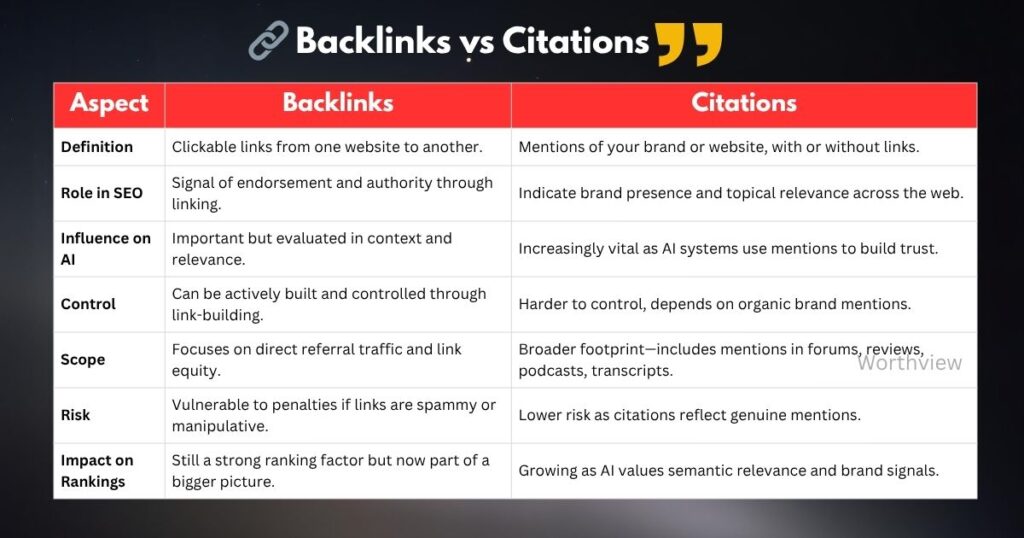
Comparing Backlinks and Citations: Key Differences
To understand why citations are gaining importance alongside backlinks, it helps to compare them directly.
| Aspect | Backlinks | Citations |
|---|---|---|
| Definition | Clickable links from one website to another. | Mentions of your brand or website, with or without links. |
| Role in SEO | Signal of endorsement and authority through linking. | Indicate brand presence and topical relevance across the web. |
| Influence on AI | Important but evaluated in context and relevance. | Increasingly vital as AI systems use mentions to build trust. |
| Control | Can be actively built and controlled through link-building. | Harder to control, depends on organic brand mentions. |
| Scope | Focuses on direct referral traffic and link equity. | Broader footprint—includes mentions in forums, reviews, podcasts, transcripts. |
| Risk | Vulnerable to penalties if links are spammy or manipulative. | Lower risk as citations reflect genuine mentions. |
| Impact on Rankings | Still a strong ranking factor but now part of a bigger picture. | Growing as AI values semantic relevance and brand signals. |
Backlinks remain important as direct endorsements that pass authority and traffic. However, in the age of AI, citations have emerged as a powerful, complementary factor. They provide a richer, more natural signal of your brand’s relevance and trustworthiness.
Real-World Examples of Citation-Based Authority
Citations are everywhere online, and many brands and websites benefit from them without even realizing it. Here are some real-world examples of how citation-based authority works in practice:
1. Worthview (Multi-Niche Blog)
As a diversified blog, Worthview appears in numerous industry forums, social media threads, and niche-specific podcast discussions. Even when these mentions don’t include clickable links, AI systems recognize Worthview as an authoritative voice because it’s consistently cited across different platforms. These citations contribute to Worthview being featured in AI-generated answer boxes and voice search results, boosting its visibility.
2. Wikipedia
Wikipedia’s name is cited in countless academic papers, news articles, blogs, and educational websites. Even when no backlinks are involved, these mentions reinforce Wikipedia’s position as a reliable information source in AI-driven search results.
3. Local Businesses and Directories
Local businesses benefit significantly from citations on platforms like Google My Business, Yelp, TripAdvisor, and industry-specific directories. These citations include the business name, address, phone number (NAP), and customer reviews. Search engines use this information to validate the business’s legitimacy and improve local search rankings—even if backlinks are limited.
4. News and Media Outlets
Reputable media outlets such as BBC, CNN, and Reuters are cited across social media, blogs, and other news websites. These mentions help AI models identify them as trustworthy sources, influencing their ranking in AI-powered news aggregations and overviews.
5. Podcasts and Transcripts
Many brands and experts gain citations through podcast mentions and transcript publications. Even without direct backlinks, AI systems pick up these mentions to assess authority and topical relevance.
How to Build and Earn Citations
Building and earning citations is becoming a key part of modern SEO, especially in this AI-driven search era. While backlinks still matter, citations broaden your brand’s presence and trustworthiness in ways that AI search engines highly value.
So, how do you build citations? At a high level, it involves getting your brand, business, or website mentioned across diverse, authoritative platforms—whether that’s in local directories, industry forums, news sites, podcasts, or social media.
Some common citation-building tactics include:
-
Submitting your business info to local and niche directories
-
Engaging in relevant online communities and forums
-
Collaborating with influencers and podcast hosts for mentions
-
Creating shareable content that naturally earns mentions
-
Encouraging satisfied customers to review and mention your brand
But there’s much more to it—like citation consistency, accuracy, and monitoring—that can make a big difference in your SEO success.
I’ll be covering all of these strategies, tips, and tricks in a dedicated article focused entirely on building and earning citations—so stay tuned!
For now, understanding the power of citations and starting to focus on increasing your brand’s mentions across the web is a crucial first step to future-proofing your SEO in the age of AI.
Conclusion: Embracing Citations for SEO Success in the AI Era
After 15 years in SEO, I’ve witnessed the evolution from keyword-stuffed pages and backlink chasing to a smarter, more holistic approach. Today, citations are rising as a crucial factor that AI-powered search engines use to evaluate authority, relevance, and trustworthiness.
Unlike backlinks, citations capture your brand’s presence and influence across a wider range of digital spaces—forums, reviews, podcasts, directories, and more. This broader footprint helps AI systems synthesize better answers and deliver richer, more accurate search results.
If you want your website to thrive in the age of AI, it’s time to look beyond backlinks. Focus on building strong, consistent citations that show your expertise naturally and authentically. This strategy not only future-proofs your SEO but also aligns perfectly with how AI understands and ranks content today.
Enjoy Worthview?
Add Worthview as a Preferred Source on Google to see more of our stories in Search.

Sethuram Kishore is the founder and editor of Worthview, an online publication established in 2008. With over 18 years of experience in SEO, digital marketing, and online publishing, he writes about AI, technology, business, and digital trends. He is also the founder of MoneyHulk, a personal finance and business publication.