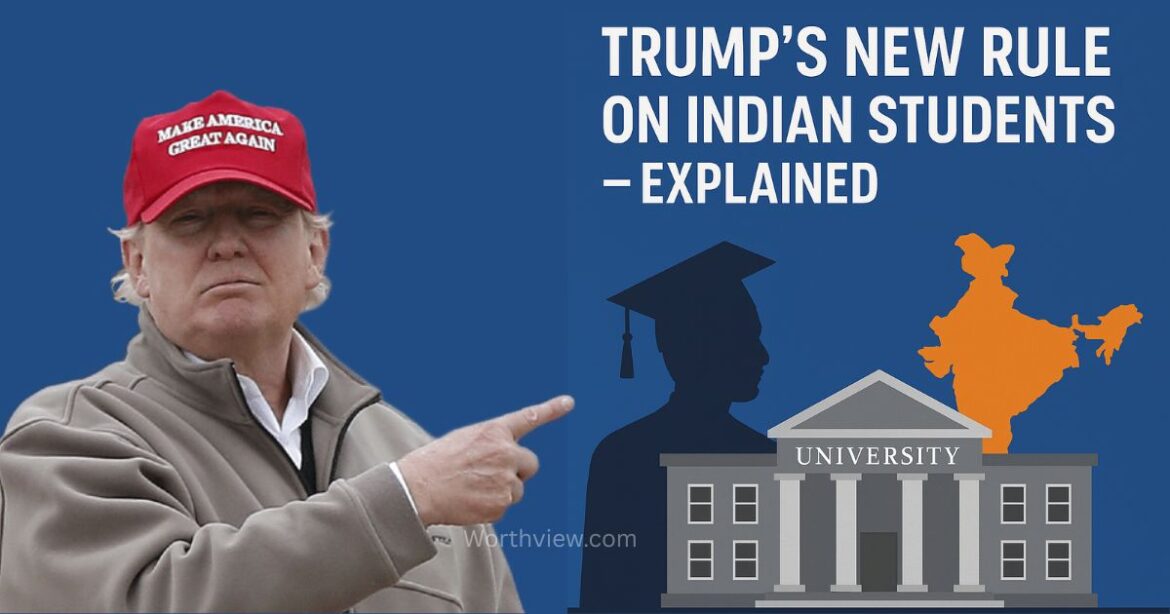
A new proposal from the Trump administration has sent shockwaves through the global student community — especially in India. The proposed “Compact for Academic Excellence in Higher Education” suggests a 15% limit on total foreign enrollment and a 5% cap per country for U.S. universities.
While headlines are buzzing with alarm, the truth is more nuanced. Let’s break down what this proposal actually means, why it matters, and how it could shape the future of global education.
Key Takeaways:
The Trump administration’s new education proposal limits international student intake to 15% per university.
No more than 5% of students can be from a single country (like India or China).
It’s not yet a law — it’s a conditional compact linked to federal funding.
Only nine top U.S. universities have received the initial draft.
The move could reshape U.S. higher education and international mobility.
What Is Trump’s “5% Student Cap” Rule?
In early October 2025, the Trump administration introduced a 10-point higher education reform memo called the Compact for Academic Excellence in Higher Education.
This policy aims to “restore academic integrity, protect American values, and balance foreign enrolment.”
Under the new compact:
-
Foreign student enrolment will be capped at 15% per university.
-
Students from any one country (e.g., India, China, South Korea) cannot exceed 5% of the total student population.
It’s important to note that this is not a nationwide law yet — it’s a voluntary agreement. Universities that sign this compact may gain preferential access to federal funding and other incentives.
In simple terms:
Colleges that agree to this deal can get federal benefits — but only if they limit foreign student admissions.
Why Does This Policy Matter?
The U.S. has long been the top destination for international students. Over 1.1 million foreign students study in the U.S., with Indians accounting for nearly 270,000 of them (as per 2024 Open Doors data).
A cap like this could:
-
Reduce opportunities for Indian and Chinese students.
-
Impact U.S. universities’ revenues, as international students often pay full tuition.
-
Alter global education dynamics, pushing students toward countries like Canada, the UK, or Australia.
Simply put, this rule could change where the world’s brightest minds go to study.
How Does It Work? (And Who’s Affected)
The proposal currently applies to only nine elite universities, including MIT, Brown, UPenn, and Dartmouth, among others.
If adopted widely, the impact would vary:
-
Highly selective universities would feel the biggest pressure, since they already attract a large pool of Indian and Chinese students.
-
Mid-tier and state universities may not be affected immediately, as many are below the 15% international threshold.
The policy also includes clauses for ideological screening, freezing tuition for five years, and sharing student records with federal authorities — points that have raised privacy and ethical concerns.
Why the 5% Cap Specifically?
According to insiders, the administration’s rationale is to “promote diversity and avoid overdependence on any single country.”
However, critics argue that the move is politically motivated and may undermine U.S. academic competitiveness.
For example:
-
At some universities, Indian and Chinese students form over 30–40% of certain STEM departments.
-
Limiting this to 5% could lead to shortages in skilled graduates, especially in technology and engineering fields.
Risks and Challenges Ahead
1. Legal Pushback
Universities are likely to challenge the policy on constitutional and academic freedom grounds.
2. Financial Consequences
International students contribute over $40 billion annually to the U.S. economy. A cap could reduce revenue streams significantly.
3. Brain Drain Reversal
Other nations — particularly Canada and the UK — could see a surge in Indian student inflow, benefiting from U.S. restrictions.
4. Perception Problem
The U.S. risks appearing less welcoming to global talent, which could impact innovation and research partnerships.
Comparison: How the U.S. Stacks Up Against Other Countries
| Country | Policy Toward International Students | Trend |
|---|---|---|
| U.S. (Proposed) | 15% foreign cap, 5% per country | Restrictive |
| Canada | No national cap; aggressive recruitment | Expanding |
| UK | Post-study work visa up to 2 years | Favorable |
| Australia | 25%+ foreign student ratio | Supportive |
Enjoy Worthview?
Add Worthview as a Preferred Source on Google to see more of our stories in Search.

Worthview Editorial Team is the shared byline for content created collaboratively by Worthview’s editors and contributors. Since 2008, we’ve published thousands of articles across technology, AI, finance, health, home, travel, and lifestyle. Our editorial process emphasizes original research, reputable sources, regular content updates, and clear attribution. Articles covering higher-trust topics, including health and finance, may also undergo review by qualified subject-matter experts.