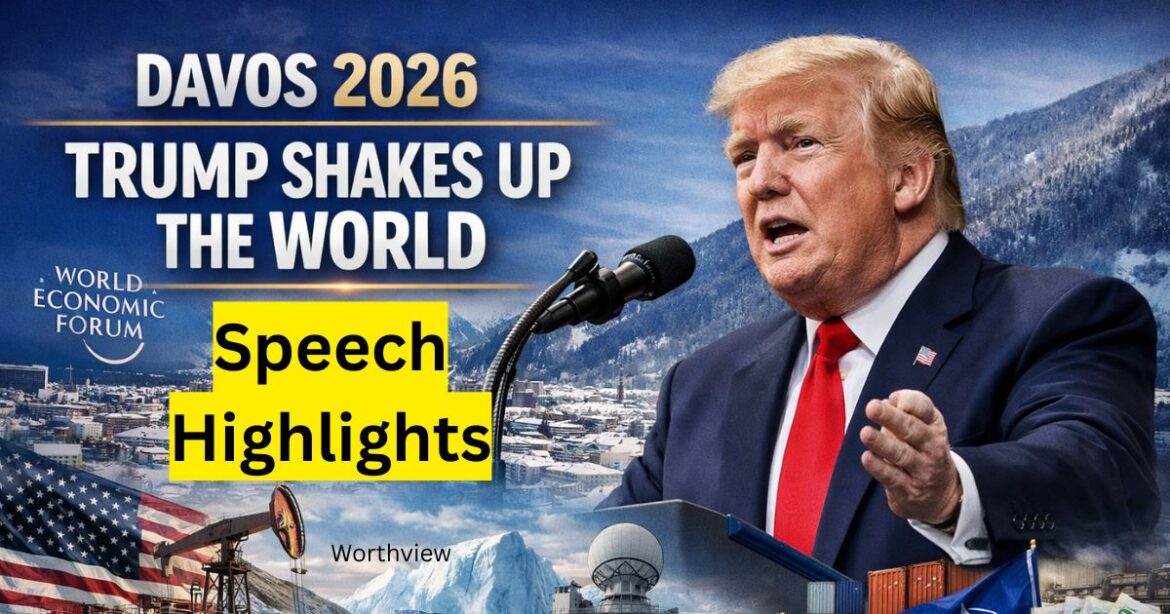
At the World Economic Forum in Davos, Donald Trump delivered a characteristically blunt address that mixed geopolitics with economic nationalism. Speaking before global CEOs, policymakers, and investors at the World Economic Forum, Trump used the platform to underline how he sees the next phase of global trade, energy, and strategic power shaping up.
Here are the key takeaways—and why they matter for markets.
Greenland: A Strategic-Economic Signal
Trump once again raised the issue of Greenland, framing it not as a territorial obsession but as a strategic and economic necessity tied to Arctic security, shipping routes, and natural resources.
-
He ruled out military force but emphasized negotiations and leverage.
-
Importantly for investors, he hinted at a framework with NATO leadership, including discussions with Mark Rutte, which eased immediate fears of trade retaliation against Europe.
Market angle: The Arctic focus brings renewed attention to rare earths, critical minerals, and defense-linked infrastructure, sectors already in focus due to supply-chain re-shoring.
A Fresh Warning to Europe and NATO
Trump criticized European economies for what he described as policy drift—from immigration to energy dependence—while again pressing NATO allies to shoulder more defense costs under NATO.
-
The message was clear: U.S. support is tied to economic and military reciprocity.
-
While confrontational in tone, he stopped short of immediate punitive action.
Market angle: Defense stocks and U.S. contractors could benefit if European nations accelerate military spending to reduce political friction with Washington.
U.S. Economy: Confidence as Policy
Trump painted the United States as the “economic engine of the world”, crediting tariffs and protectionist policies for:
-
Strong growth momentum
-
Lower trade deficits
-
Resilient domestic manufacturing
He positioned tariffs not as inflationary tools, but as bargaining instruments.
Market angle: This reinforces expectations of selective protectionism, favoring U.S.-centric manufacturing, infrastructure, and industrial plays, while keeping global exporters cautious.
Energy: Fossil Fuels Over Ideology
Energy policy drew some of Trump’s sharpest comments. He criticized Europe’s aggressive renewable push—especially wind energy—and defended fossil fuels as essential for affordability and stability.
-
He argued high energy costs weaken industrial competitiveness.
-
The U.S., he said, benefits from energy independence driven by oil and gas.
Market angle: Traditional energy stocks and U.S. LNG exporters may continue to attract capital, particularly if Europe reassesses its energy mix amid competitiveness concerns.
Tone and Global Reaction
The speech was unmistakably Trumpian—confident, confrontational, and headline-friendly. While some delegates appeared uneasy, others welcomed the clarity of his positions, even if they disagreed with the substance.
Market angle: Volatility thrives on uncertainty—but markets also respond well to clear policy direction. Trump’s Davos message reduced ambiguity around trade, tariffs, and U.S. priorities.
Bottom Line
Trump’s Davos appearance was less about diplomacy and more about signaling intent. For global investors, the message was straightforward:
-
Expect tougher trade negotiations
-
Continued use of tariffs as leverage
-
Strong support for U.S. manufacturing, defense, and fossil fuels
-
Strategic competition framed in economic terms
Whether one agrees or not, Davos 2026 made one thing clear: under Trump, economics and geopolitics remain tightly—and unapologetically—linked.
Enjoy Worthview?
Add Worthview as a Preferred Source on Google to see more of our stories in Search.

Worthview Editorial Team is the shared byline for content created collaboratively by Worthview’s editors and contributors. Since 2008, we’ve published thousands of articles across technology, AI, finance, health, home, travel, and lifestyle. Our editorial process emphasizes original research, reputable sources, regular content updates, and clear attribution. Articles covering higher-trust topics, including health and finance, may also undergo review by qualified subject-matter experts.