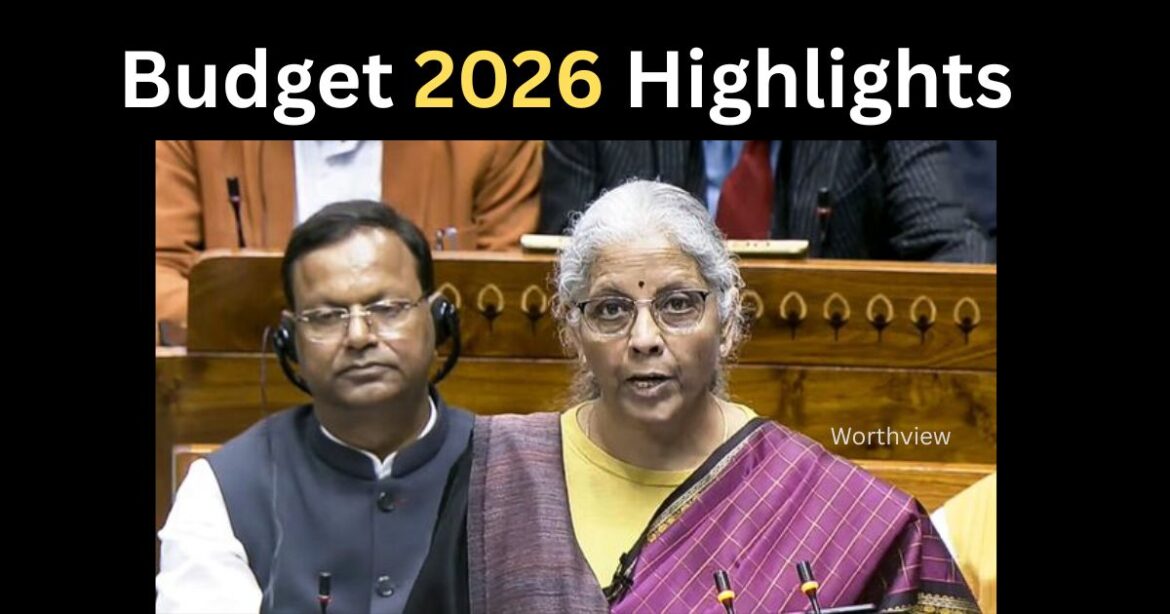
India’s Union Budget 2026–27, presented on February 1, 2026, by Finance Minister Nirmala Sitharaman, lays out a clear roadmap for sustaining economic growth while keeping public finances under control. The budget aligns closely with the government’s long-term Viksit Bharat vision, focusing on infrastructure expansion, manufacturing revival, MSME empowerment, and simplified taxation.
With India targeting a steady 7% growth trajectory, the budget balances people-centric initiatives with fiscal discipline, pegging the fiscal deficit at 4.3% of GDP.
Fiscal Targets: Capex Takes Centre Stage
One of the strongest signals from Budget 2026–27 is the continued emphasis on public capital expenditure.
-
Public capex for FY27 is raised to ₹12.2 lakh crore, a sharp jump compared to pre-pandemic levels.
-
Fiscal deficit is set at 4.3% of GDP, marginally lower than the revised estimate of 4.4% for FY26.
-
Debt-to-GDP ratio stands at 55.6%, with a medium-term target of 50±1% by 2030.
-
Total government expenditure for FY27 is pegged at ₹53.5 lakh crore.
This approach signals the government’s intent to drive growth through investment rather than consumption-heavy borrowing.
Infrastructure: Building Growth Corridors
Infrastructure remains the backbone of this budget.
Key announcements include:
-
Seven high-speed rail corridors, including Mumbai–Pune, Delhi–Varanasi, and Hyderabad–Bengaluru.
-
A new freight corridor from Dankuni to Surat to ease logistics bottlenecks.
-
Development of 20 national waterways and a coastal cargo scheme to raise inland shipping’s share to 12% by 2047.
-
₹20,000 crore allocation for Carbon Capture, Utilisation and Storage (CCUS) in the energy sector.
These measures aim to lower logistics costs and create long-term employment.
Manufacturing & MSMEs: The Growth Engine
The budget gives a strong push to domestic manufacturing and small businesses.
Highlights:
-
Biopharma SHAKTI scheme with an outlay of ₹10,000 crore.
-
India Semiconductor Mission (ISM) 2.0 and electronics manufacturing support raised to ₹40,000 crore.
-
Revival of 200 legacy industrial clusters.
-
₹10,000 crore SME Growth Fund for MSMEs.
-
Mandatory TReDS onboarding for CPSEs to improve MSME cash flows.
-
Introduction of “Corporate Mitras” to help MSMEs with compliance in Tier-II and Tier-III cities.
Tax Reforms: Simpler Laws, Selective Tightening
Tax rationalisation is another key theme.
-
New Income Tax Act, 2025 to replace the 1961 Act from April 2026, promising simpler language and fewer forms.
-
TCS reduced to 2% on overseas tours and education/medical expenses under LRS.
-
STT increased on stock market derivatives:
-
Futures: 0.05%
-
Options: 0.15%
-
-
Safe harbour rate for IT services set at 15.5% for turnover up to ₹2,000 crore.
-
Duty exemptions announced for cancer drugs, fisheries, and certain personal imports.
Agriculture & Social Inclusion
The budget blends technology with inclusivity.
Key initiatives:
-
Bharat-VISTAAR AI platform for real-time farm advisory.
-
Support for cashew, cocoa, coconut, and high-value horticulture.
-
Development of 500 reservoirs to improve irrigation.
-
SHE-Marts for women entrepreneurs.
-
Expanded support for Divyangjan, NIMHANS-2 for mental health, and Purvodaya for the eastern industrial corridor.
What Becomes Costlier
Consumers and investors should brace for higher costs in certain areas:
-
Stock market derivatives due to higher STT on futures and options.
-
Tobacco products such as cigarettes, bidis, pan masala.
-
Imported luxury goods including premium watches, alcohol, cosmetics, perfumes, and foreign-built cars.
-
Professional coffee machines due to withdrawal of BCD exemptions.
-
Certain fertilizers like Ammonium Phosphate.
-
Imported cameras and filming equipment.
-
Gold and silver jewellery, as duties on related items have been adjusted.
📉 What Gets Cheaper
Some relief comes through lower import duties and exemptions:
-
Smartphones and electronics due to reduced BCD on components.
-
Electric vehicles (EVs) and battery-related imports.
-
Life-saving cancer drugs (10 specified drugs get full duty exemption).
-
Medical equipment like X-ray and cancer treatment machines.
-
Gold and silver findings used in jewellery making.
-
Dairy and fisheries machinery.
-
Agricultural inputs such as sprinklers and select fertilizers.
Union Budget 2026–27 stays consistent with the government’s post-pandemic strategy: invest heavily in infrastructure and manufacturing, simplify compliance, and gradually rein in fiscal deficit. While traders and luxury consumers may feel the pinch, MSMEs, healthcare, electronics, and long-term investors stand to gain.
In short, this is a steady, reform-oriented budget—not flashy, but firmly focused on building India’s economic foundation for the next decade.
Enjoy Worthview?
Add Worthview as a Preferred Source on Google to see more of our stories in Search.

Worthview Editorial Team is the shared byline for content created collaboratively by Worthview’s editors and contributors. Since 2008, we’ve published thousands of articles across technology, AI, finance, health, home, travel, and lifestyle. Our editorial process emphasizes original research, reputable sources, regular content updates, and clear attribution. Articles covering higher-trust topics, including health and finance, may also undergo review by qualified subject-matter experts.