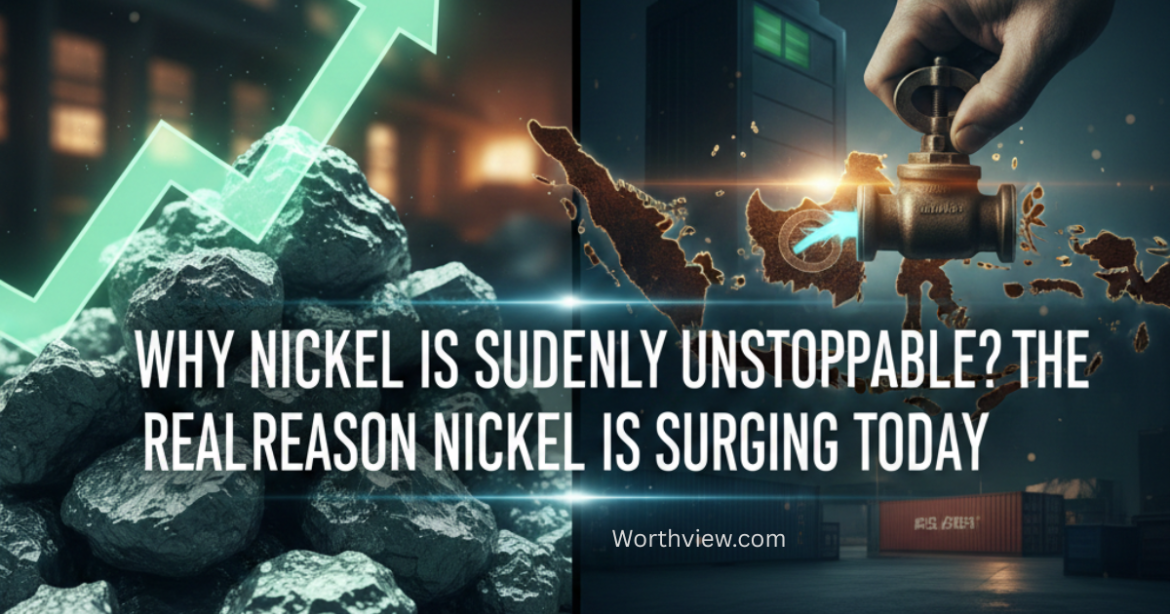
For two years, the global nickel market was defined by a single word: surplus. A relentless wave of cheap Indonesian supply had crushed prices, shuttered mines from Australia to New Caledonia, and left investors for dead.
But in the opening weeks of 2026, the narrative has fundamentally fractured. Nickel prices have defied gravity, surging 25% since mid-December to test the $19,000 per tonne mark.
Also read, Can Nickel Rally Like Gold and Silver? A Detailed Comparison
What changed? It wasn’t a sudden explosion in demand, but rather a calculated “vanishing act” of supply orchestrated by the world’s new metal superpower.
1. The Jakarta “Black Box”: A Policy-Driven Squeeze
The primary engine behind the rally is Indonesia’s opaque mining permit system, known as RKAB. Indonesia, which now controls 65% of global nickel production, has effectively turned off the tap.
-
The Quota Shock: After targeting 379 million tonnes in 2025, Jakarta has signaled a dramatic cut to roughly 250–260 million tonnes for 2026.
-
The “90% Cut”: Some of the world’s largest operations, including the massive Weda Bay, have reportedly seen their individual quotas slashed by up to 90%, forcing a sudden halt in raw material extraction.
-
The Strategy: By tightening supply, Indonesia is moving to stabilize prices above $18,000, ensuring its state royalties remain high while preventing a “race to the bottom” that was cannibalizing its own industry.
2. The “OPEC” Parallel
Market analysts are increasingly calling this the “Indonesian Floor.” Much like OPEC manages oil to prevent a price collapse, Jakarta is using its dominant market share to dictate global prices.
“We are witnessing the birth of a ‘Nickel Cartel,'” says one London-based commodities strategist. “The era of Indonesia flooding the market at any cost is over. They now realize that scarcity is more profitable than volume.”
3. The EV “Ghost” Returns
While much has been made of the shift toward LFP (Lithium Iron Phosphate) batteries, which contain no nickel, the “death of the nickel battery” was premature.
-
The High-End Hedge: High-performance EVs (NMC/NCA chemistry) still rely on nickel for range and power. As global EV sales grew 20% in early 2026, the demand for “Class 1” high-grade nickel remains a structural pillar.
-
The Stainless Steel Factor: Beyond batteries, China’s stainless steel mills—the largest consumers of nickel—have begun ramping up production, passing on higher nickel costs to consumers in a sign of resilient industrial demand.
The Bottom Line: Is the Rally Sustainable?
The current surge is a “curiosity” because it exists in a world that, on paper, should still be oversupplied. However, markets trade on available supply, not theoretical reserves. With Indonesian permits in limbo and major mines sitting idle, the “available” metal is disappearing fast.
Frequently Asked Questions (FAQ)
Q: Why are nickel prices suddenly rising in 2026?
A: The primary driver is a massive supply intervention by Indonesia, the world’s largest nickel producer. The Indonesian government has slashed its 2026 mining quotas (known as RKAB) to approximately 260–270 million tonnes, a sharp reduction from the 379 million tonnes approved in 2025. This intentional tightening has effectively “erased” the global surplus that kept prices low for the past two years.
Q: What is the current price of nickel?
A: As of early February 2026, nickel prices on the London Metal Exchange (LME) have tested highs of $18,950 per tonne, the highest level in 18 months. While there is minor daily volatility, the market has shifted from a “bear” to a “bull” trend, with analysts targeting the $20,000 psychological barrier.
Q: How does the Weda Bay mine impact the market?
A: The Weda Bay complex in Indonesia is the world’s largest nickel mine. In a shock move this month, authorities ordered it to cap 2026 production at just 12 million tonnes, down from 42 million last year. Because this single mine is a cornerstone of the global supply chain, such a deep cut triggered an immediate “panic buy” across global commodities desks.
Q: Does this price hike mean EVs will become more expensive?
A: Potentially, yes. Nickel is a critical component in high-performance NMC (Nickel Manganese Cobalt) batteries used in long-range electric vehicles. While many manufacturers have moved toward nickel-free LFP batteries for entry-level cars, the “premium” EV segment remains highly sensitive to nickel price spikes.
Q: Is the nickel “glut” over for good?
A: On paper, Indonesia still has vast reserves, but the accessible supply is now strictly regulated. By shifting from a “volume-first” strategy to a “price-first” strategy—similar to how OPEC manages oil—Jakarta has created a new price floor. Most analysts believe the era of sub-$15,000 nickel is over as long as these quotas remain in place.
Q: How are other countries reacting to Indonesia’s move?
A: Buyers in China and the U.S. are entering a bidding war to secure existing inventories. Meanwhile, some smelters are increasing imports from the Philippines to offset the Indonesian shortfall, though these volumes are currently not enough to bridge the total supply gap.
Enjoy Worthview?
Add Worthview as a Preferred Source on Google to see more of our stories in Search.

Worthview Editorial Team is the shared byline for content created collaboratively by Worthview’s editors and contributors. Since 2008, we’ve published thousands of articles across technology, AI, finance, health, home, travel, and lifestyle. Our editorial process emphasizes original research, reputable sources, regular content updates, and clear attribution. Articles covering higher-trust topics, including health and finance, may also undergo review by qualified subject-matter experts.