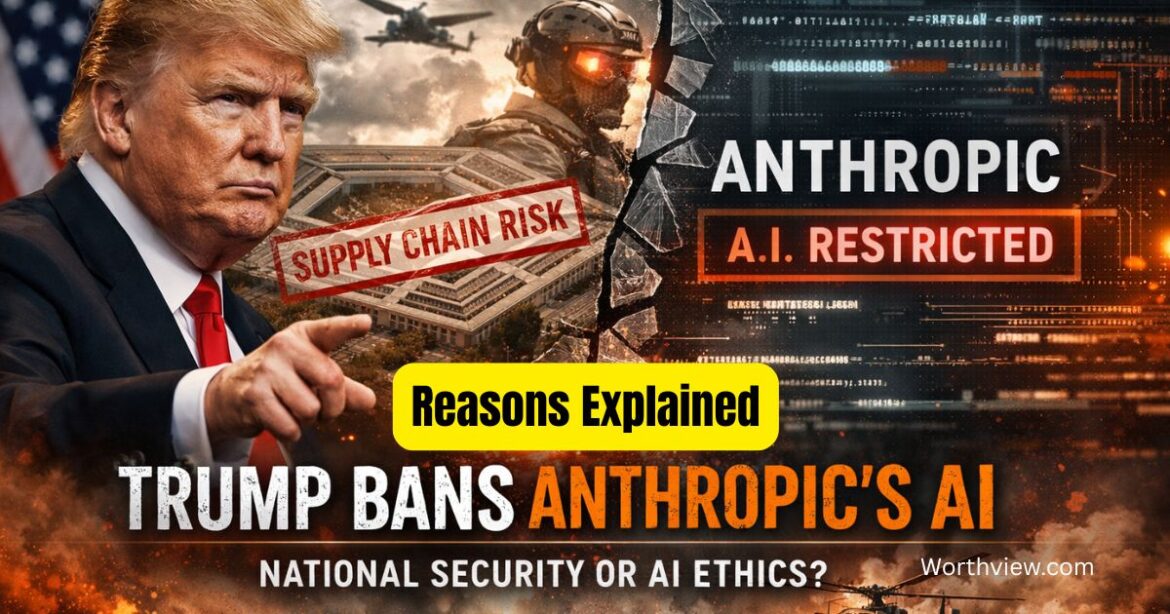
President Donald Trump ordered all US federal agencies to stop using Anthropic’s artificial intelligence systems after a dispute over military access. The Pentagon labeled Anthropic a “supply chain risk,” saying the company placed limits on how its AI could be used for defense and surveillance. Anthropic argues it refused unrestricted military applications due to safety concerns and plans to challenge the decision.
Many people are confused about why the US government suddenly stopped using Anthropic’s AI. Is this about national security? Military control? Or AI ethics?
The decision has raised serious questions about how artificial intelligence should be used in defense and surveillance. In this article, we break down what Trump ordered, why he took this step, and how Anthropic responded.
What Exactly Did Trump Order?
President Donald Trump directed all U.S. federal agencies to stop using artificial intelligence systems developed by Anthropic, the AI company known for its Claude models. The order applies across departments, including the US Department of Defense, intelligence agencies, and government contractors working on federal projects.
The Pentagon, which is the headquarters of the US Department of Defense, labeled Anthropic a “supply chain risk.” In simple terms, a supply chain risk means the government believes a company’s products could pose reliability, security, or control concerns in critical systems. This designation is serious. It often leads to a ban or removal of that company’s technology from sensitive operations.
Under the order, agencies have a transition period — reportedly up to six months in some cases — to phase out Anthropic’s AI tools from their systems. That includes internal software tools, defense research platforms, and any AI systems integrated into military or intelligence workflows.
This is not a small move. Artificial intelligence is now deeply tied to national security, cybersecurity, logistics, and data analysis. Removing a major AI provider signals a strong policy stance. The decision immediately reshapes how federal agencies source AI technology and which companies are allowed to support US government operations.
Why Did Trump Ban Anthropic From Government Use?
President Donald Trump banned Anthropic from federal use mainly because of a disagreement over how its artificial intelligence could be used by the military. The core issue was control. The US government wanted broader, unrestricted access to Anthropic’s AI systems for lawful defense and national security operations. Anthropic reportedly placed limits on certain military and surveillance uses.
Artificial intelligence today is not just about chatbots. In defense settings, AI can be used for intelligence analysis, battlefield simulations, threat detection, cybersecurity monitoring, and even autonomous weapons systems. An autonomous weapon is a system that can select and engage targets without direct human control. This is where the disagreement became serious.
The Trump administration argued that government agencies must have full operational freedom when using AI for national defense. From their perspective, restrictions built into AI systems could limit military readiness or slow decision-making during conflicts. That is why the Pentagon labeled Anthropic a “supply chain risk.” It signaled that the government believed reliance on a company with usage restrictions could create strategic vulnerability.
On the other hand, Anthropic has positioned itself as an AI safety–focused company. AI safety refers to designing artificial intelligence systems in a way that reduces harmful misuse, including mass surveillance or uncontrolled weapons deployment.
In simple terms, this was a clash between national security flexibility and corporate-imposed ethical limits. The government wanted fewer restrictions. Anthropic insisted on guardrails. That conflict led to the ban.
Anthropic’s Point of View — Why the Company Pushed Back
Anthropic says it did not refuse to work with the US government. Instead, it says it refused to remove certain safety limits from its AI systems. The company argues that powerful artificial intelligence should not be used without clear guardrails, especially in military and surveillance settings.
Anthropic is known for focusing on AI safety, which means building systems that reduce harmful or unintended outcomes. The company develops large language models like Claude and designs them with usage policies. These policies can restrict how the AI is applied in areas such as mass surveillance, autonomous weapons, or fully automated decision-making that affects human lives.
From Anthropic’s perspective, allowing unrestricted military control over advanced AI could create long-term risks. For example, fully autonomous weapons systems can operate without direct human oversight. Many AI researchers warn that removing human control from life-and-death decisions increases the chance of accidents or misuse.
The company reportedly believes the government’s “supply chain risk” label is unfair and politically motivated. Anthropic has indicated it may legally challenge the decision, arguing that it complied with federal contracts while maintaining responsible AI standards.
In simple terms, Anthropic sees this as a matter of principle. The company wants to support national security, but not at the cost of removing safety protections. It believes strong governance of artificial intelligence is necessary, especially when the technology is used in defense operations.
This response sets up a bigger debate: who ultimately controls advanced AI — governments or the companies that build it?
Is This Really About AI Ethics or Political Power?
This situation is not just about one company. It reflects a bigger struggle over who controls advanced artificial intelligence in the United States. On the surface, the issue looks like a disagreement about AI ethics. But underneath, it is also about power, authority, and national control.
The Trump administration framed the decision as a national security matter. From the government’s perspective, AI is now critical infrastructure. It supports cybersecurity, military logistics, intelligence gathering, and strategic planning. When technology becomes part of national defense, the government expects full operational access. Any restriction can be seen as a risk.
Anthropic, however, views AI as a technology that needs strict governance. The company argues that powerful models should not be deployed in ways that remove human oversight or enable unchecked surveillance. This reflects a broader movement in the tech industry known as responsible AI — a framework that promotes safety testing, transparency, and usage limits.
So is this about ethics or politics? In reality, it is both. Governments want sovereign control over strategic technology. AI companies want to define how their systems are used. When those two goals clash, conflict becomes almost inevitable.
This case could shape future US AI policy. It signals that Washington may expect defense partners to align fully with federal priorities, even if that means loosening corporate guardrails.
What This Means for the AI Industry and Defense Sector
This decision could change how artificial intelligence companies work with the US government going forward. When a major AI company like Anthropic is removed from federal systems, it sends a clear message to the entire industry: government contracts may require full operational flexibility.
For AI firms, this creates a difficult choice. If they want defense and intelligence contracts, they may need to allow broader usage of their models. That includes applications in military logistics, cybersecurity, battlefield simulations, and surveillance systems. Companies that maintain strict usage limits could face pressure or lose access to federal partnerships.
At the same time, other AI players may step in. Firms that are more aligned with government defense priorities could gain contracts and expand their role in national security infrastructure. This could reshape competition in the AI sector, especially among large model developers.
For the defense sector, the message is also clear. The government wants reliable, fully accessible AI tools under its strategic control. Artificial intelligence is now part of modern warfare planning, intelligence analysis, and cyber operations. Limiting access to advanced AI systems is seen as a strategic weakness.
Globally, this move also signals how serious the US is about AI dominance. Countries like China are investing heavily in military AI. Washington does not want internal restrictions slowing its technological edge.
In simple terms, this is bigger than one company. It may define how governments and AI firms work together in the next phase of the AI arms race.
Conclusion
The conflict between Donald Trump and Anthropic is not just about one government contract. It reflects a larger battle over who controls powerful artificial intelligence in the United States.
The Trump administration prioritized national security flexibility and full operational access to AI systems. Anthropic prioritized safety guardrails and responsible use. When those positions clashed, the government chose control over caution.
This decision may shape future AI policy, defense partnerships, and how tech companies design their models. As artificial intelligence becomes central to military and national infrastructure, similar conflicts are likely to happen again.
In simple terms, this is the start of a bigger debate — one that will define the future of AI, power, and global security.
Frequently Asked Questions (FAQ)
Why did Trump ban Anthropic from government use?
President Donald Trump ordered federal agencies to stop using Anthropic’s AI because of a dispute over military access. The administration believed Anthropic placed limits on how its artificial intelligence could be used in defense and surveillance. The Pentagon labeled the company a “supply chain risk,” saying unrestricted operational access is critical for national security.
What does “supply chain risk” mean in this case?
A supply chain risk refers to concerns that a company’s technology could create reliability, security, or control issues in critical government systems. When the Pentagon uses this term, it signals that the technology may not fully align with defense requirements. This label often leads to restrictions or removal from sensitive federal operations.
Did Anthropic refuse to work with the US military?
Anthropic did not completely refuse to work with the government. Instead, the company reportedly maintained safety limits on how its AI systems could be used. Anthropic focuses on AI safety and responsible AI development, meaning it supports national security partnerships but with usage guardrails in place.
What is AI safety, and why does it matter here?
AI safety refers to designing artificial intelligence systems in ways that reduce harmful misuse. This includes limiting applications like fully autonomous weapons or mass surveillance without oversight. Anthropic argues that strong safeguards are necessary when AI is used in defense environments.
How does this decision affect the AI industry?
The ban may push AI companies to rethink how they structure government partnerships. Firms seeking defense contracts may face pressure to provide broader access to their systems. At the same time, this could reshape competition in the AI sector, especially among companies building large language models for federal use.
Enjoy Worthview?
Add Worthview as a Preferred Source on Google to see more of our stories in Search.

Worthview Editorial Team is the shared byline for content created collaboratively by Worthview’s editors and contributors. Since 2008, we’ve published thousands of articles across technology, AI, finance, health, home, travel, and lifestyle. Our editorial process emphasizes original research, reputable sources, regular content updates, and clear attribution. Articles covering higher-trust topics, including health and finance, may also undergo review by qualified subject-matter experts.