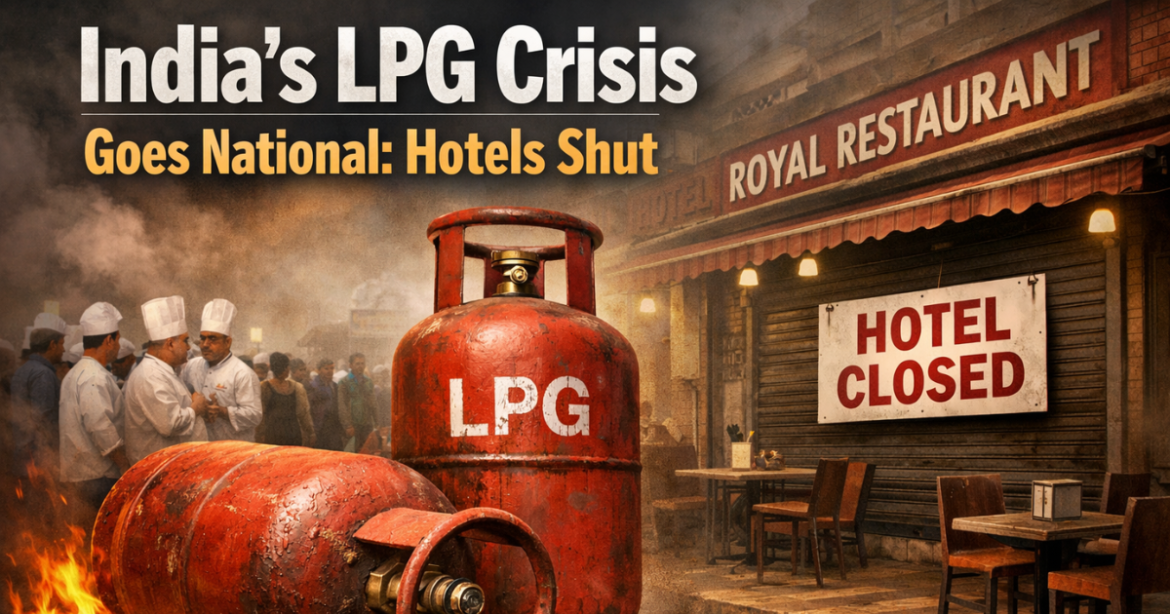
What started as a local warning from a Bengaluru hotel association 24 hours ago has escalated into a full-blown national food security emergency. Restaurants are already shuttered across Mumbai. Iconic eateries in Tamil Nadu are cutting menus for the first time in 50 years. Delhi gas agencies are turning away hotel owners empty-handed. And the Prime Minister himself has stepped in.
In our report yesterday, we told you that the Bangalore Hotels Association had warned of a possible shutdown of 3,000+ restaurants from March 10 after commercial LPG supplies were abruptly cut off. At the time, industry bodies were still hoping the government would step in before kitchens went cold.
They did not step in fast enough. Today, March 10, the crisis has spread to at least 10 states and major cities — and it is getting worse by the hour.
Live Updates: How the Day Unfolded
9:37 AM Mumbai’s AHAR confirms 20% of the city’s hotels have already shut — warns 50% could close within 2–3 days.
12:32 PM Delhi gas agency owner posts notice outside his outlet: ‘Supply of commercial cylinders to hotels and restaurants has been discontinued.’
2:20 PM AHAR raises the alarm: 8,000 hotels in Mumbai affected. If supply not restored, 4,000–5,000 more hotels could shut.
4:40 PM PM Modi tells Cabinet: ‘War should not impact the common man.’ Union Petroleum Minister Hardeep Puri meets PM directly.
Evening Government invokes the Essential Commodities Act to mandate LPG supply. A monitoring committee of three Executive Directors of OMCs is formed.
Which States Are Now Affected?
This is no longer a Karnataka story. Based on reports from industry bodies and state governments as of March 10, commercial LPG shortages are now confirmed across at least 10 states:
- Maharashtra — 20% of Mumbai’s hotels already closed. Pune, Aurangabad, and Nagpur also reporting acute shortages.
- Karnataka — Bengaluru hotels operating on last reserves. Black market cylinders reportedly selling at ₹3,000 against the listed price of ₹1,950.
- Tamil Nadu — Restaurants in Chennai running on 1–2 days of stock. Coimbatore’s iconic Annapoorna Hotel chain cut its menu for the first time in its 50-year history.
- Delhi-NCR — Gas agencies displaying notices that commercial supply has stopped entirely. Haryana food minister confirmed a central guideline to halt commercial cylinders temporarily.
- West Bengal — NRAI’s Kolkata survey: 40% of the city’s 5,000 restaurants already disrupted. Another 30–40% have only days of stock left.
- Telangana and Andhra Pradesh — Hyderabad, home to over 74,000 restaurants, is flagging supply concerns.
- Odisha — Hotel & Restaurant Association of Odisha has written directly to Petroleum Minister Puri.
- Gujarat — State Energy Minister monitoring commercial impact while assuring domestic supply remains stable.
- Haryana — Food Supply Minister Rajesh Nagar confirmed a central government guideline to halt commercial cylinder supplies temporarily.
- Pune — Gas crematoriums have been forced to restrict LPG use — a sign of how far the shortage has spread beyond the food sector.
The Numbers That Tell the Full Story
- 20% of Mumbai’s hotels are already closed as of this morning.
- 50% of Mumbai’s restaurants could shut within 2–3 days if supply is not restored.
- 40% of Kolkata’s 5,000 restaurants are already facing operational disruption.
- 2–3 days of LPG stock is all that most restaurants across India have left.
- ₹3,000 is what black market commercial cylinders are fetching in Bengaluru — against ₹1,950 listed price.
- ₹115 was the hike in commercial LPG cylinder prices last Saturday — on top of the supply crisis.
- 62% of India’s LPG is imported, and 85–90% of those imports passed through the Strait of Hormuz — now effectively closed.
The Moment That Stopped a 50-Year Tradition
Perhaps nothing captures the scale of this crisis better than what happened in Coimbatore on Monday night.
Annapoorna Hotel — a beloved institution that has served South Indian meals every single day for 50 years, never once closing even during festivals or natural disasters — put up a public notice announcing menu cuts effective March 10.
“Due to the geopolitical crisis in the Middle East, severe restrictions have been imposed on LPG distribution. We face daily shortages… We are implementing temporary measures, focusing only on essential items. We apologise for the inconvenience.”
— Annapoorna Hotel management, Coimbatore, March 10, 2026
Across Tamil Nadu, restaurants that once opened at 6 AM are now opening at 7 AM. Three-dish menus have been replaced with single-dish options. Outside several eateries, handwritten boards warn customers that variety rice, multiple chutneys, and full breakfast spreads are no longer available — for now.
What the Government Has Done
- Essential Commodities Act invoked: Government invoked the ECA 1955 to mandate natural gas supply and prevent hoarding.
- PM Modi intervenes: PM told his Cabinet that ‘war should not impact the common man.’ Petroleum Minister Puri briefed the PM directly.
- Refinery orders: Oil refineries directed to boost LPG production and divert entire extra output for domestic consumption.
- Priority reordering: Centre revised gas allocation, placing LPG for household use at the very top — above industrial uses.
- New booking rules: To prevent panic hoarding, the inter-booking gap for domestic cylinders extended from 21 to 25 days.
- OMC committee formed: Three Executive Directors from IOC, BPCL, and HPCL tasked to review supply requests from the restaurant and hotel industry.
- Hospital and school priority: Imported LPG that is still arriving is being directed first to hospitals and educational institutions.
- New import sources: India is urgently exploring LPG imports from Algeria, Australia, Canada, and Norway to reduce Gulf dependence.
However, a critical disconnect remains: the government says there is no ban on commercial LPG supply. But distributors on the ground cite a March 5 government order and are refusing to deliver. The FHRAI has formally written to Minister Puri asking the government to issue a direct mandate to oil marketing companies.
“The Government has clarified that there is no ban on supply of commercial LPG cylinders for the restaurant industry. However, the ground situation is different, with suppliers expressing inability to supply the same.”
— National Restaurant Association of India (NRAI), post on X, March 10
Why This Crisis Cannot Be Fixed Overnight
- Ships take weeks: India is exploring LPG imports from the US, Australia, and Europe — but new shipments will take 3–6 weeks to arrange and arrive.
- Refinery limits: Domestic refineries can increase production, but cannot replace the 62% that normally comes from imports.
- Distribution chain is slow to restart: Even where cylinders exist, the chain from refinery to bottling plant to dealer to hotel takes days to get moving again.
- Black markets will grow: As scarcity deepens, illegal diversion of domestic cylinders to commercial users at inflated prices is already being reported in Bengaluru and Delhi.
What Happens If It Is Not Resolved in 48–72 Hours
“As of today, 10–20% of our members are facing problems. By tomorrow, it will be 60%. By the day after tomorrow, it will be 100% — forcing them to shut.”
— Vijay Shetty, President, India Hotels and Restaurant Association (AHAR), March 10
If that timeline holds, India faces the prospect of most of its urban restaurants being shuttered by the weekend — affecting hundreds of millions of people who depend on affordable cooked meals for breakfast, lunch, and dinner every day.
What This Means for You
- Fewer dishes at restaurants: Most hotels are already cutting menus to stretch their remaining gas supply.
- Higher meal prices: Restaurants that can still operate will pass on rising costs — both from the ₹115 cylinder price hike and black market purchases.
- Closures near you: Smaller dhabas, darshinis, and local eateries with no financial buffer will be the first to shut permanently.
- Slower domestic cylinder delivery: The new 25-day inter-booking rule and diverted refinery output mean home gas deliveries will also take longer than usual.
- Disrupted bookings: Hotels with confirmed wedding and event bookings face the nightmare of forced cancellations.
The Bottom Line
Yesterday’s local warning has become today’s national emergency. The US-Iran war — fought thousands of kilometres away — has now reached the dining table of every Indian. How quickly the government can bridge the supply gap, and whether India’s alternative import sources can arrive in time, will determine whether this is a 3-day disruption or a 3-week crisis.
What Changed in 24 Hours
- March 9: Bengaluru Hotels Association warns of possible shutdowns. Crisis viewed as local.
- March 10, morning: Mumbai, Chennai, Kolkata, Delhi, Hyderabad all reporting shortages. Crisis goes national.
- March 10, afternoon: PM Modi intervenes. Essential Commodities Act invoked. OMC committee formed.
March 10, evening: 20% of Mumbai’s hotels already closed. Annapoorna Hotel cuts menu for first time in 50 years. 2–3 days of stock left across most cities.
Enjoy Worthview?
Add Worthview as a Preferred Source on Google to see more of our stories in Search.

Worthview Editorial Team is the shared byline for content created collaboratively by Worthview’s editors and contributors. Since 2008, we’ve published thousands of articles across technology, AI, finance, health, home, travel, and lifestyle. Our editorial process emphasizes original research, reputable sources, regular content updates, and clear attribution. Articles covering higher-trust topics, including health and finance, may also undergo review by qualified subject-matter experts.




2 thoughts on “India’s LPG Crisis Goes National: Hotels Shut in Mumbai, Menus Gutted in Tamil Nadu, Black Markets Emerge in Delhi”
Comments are closed.