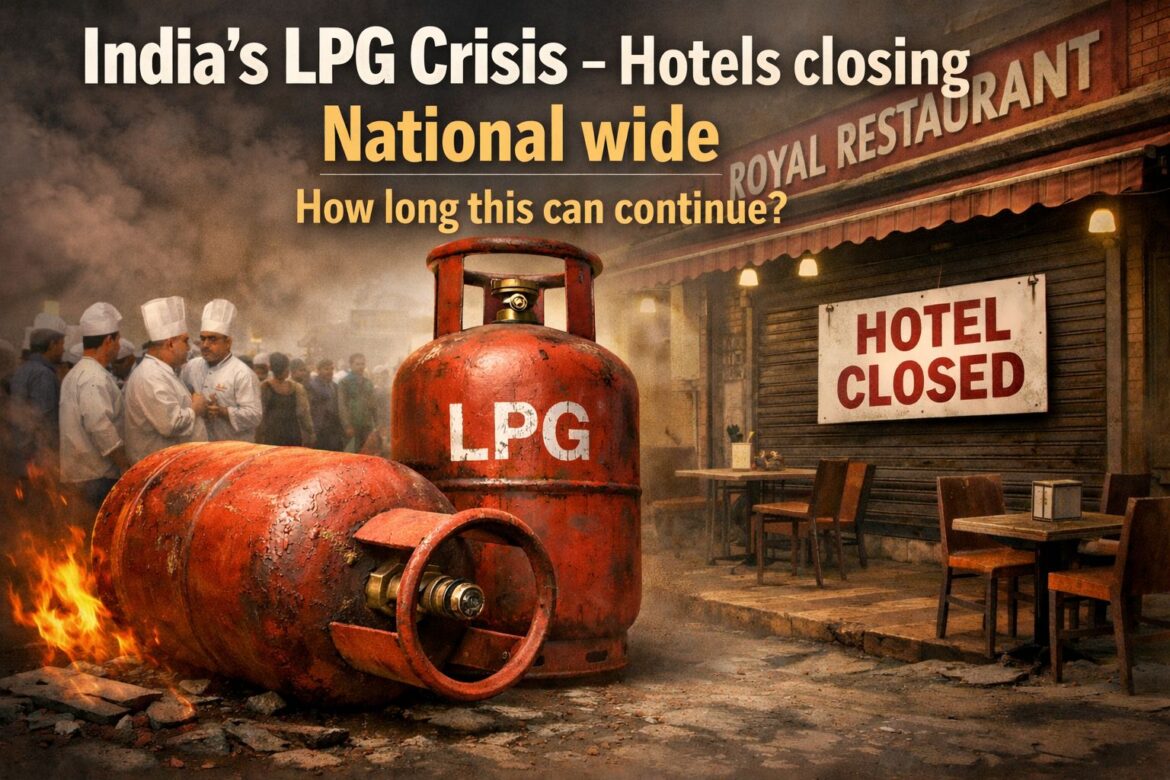
India has oil. India has LPG. And yet, thousands of restaurant kitchens across the country have nothing to cook with. That contradiction sits at the heart of the crisis unfolding today.
On Monday evening, Union Petroleum Minister Hardeep Singh Puri stepped in front of cameras and delivered what he hoped would be a calming message. India’s energy imports were flowing normally. Refineries were running at full capacity. Citizens had no reason to worry. “No shortage of energy in India,” he said plainly.
By Tuesday morning, the hotel associations of Mumbai, Bengaluru, Chennai, Vijayawada, and Ranchi were all saying the exact opposite — that commercial LPG cylinders had stopped arriving, that kitchens were going cold, and that the hospitality industry was days away from a nationwide shutdown.
What the Government Has Done
This is not a case of government inaction. Behind the scenes, significant steps have been taken since the US-Iran conflict disrupted Gulf energy routes last week:
- Production raised: Domestic LPG output has been increased by 10%, with all refineries — including Reliance’s Jamnagar plant — running at full capacity.
- Imports rerouted: Around 70% of India’s crude imports are now arriving through routes other than the Strait of Hormuz, up from 45% before the war.
- New suppliers activated: India is sourcing energy from 40 countries. A US LPG contract signed in late 2025 — 2.2 million tonnes annually — has been fully activated.
- Russia fills the gap: Russia now accounts for 20% of India’s crude imports, roughly 1.04 million barrels per day, supported by a 30-day US sanctions waiver.
- OMC committee formed: A three-member panel of Executive Directors from IOC, BPCL, and HPCL has been set up to review supply complaints from the hotel industry directly.
Why Restaurants Still Have No Gas
Here is the part that most official statements leave out. When the crisis hit, the government restructured its gas distribution priority order — legally, through the Natural Gas Supply Regulation Order 2026. Households, hospitals, and schools moved to the top. Commercial kitchens moved to the bottom.
That decision protected millions of domestic consumers. But it also meant that distributors — even those with stock — were legally directed to stop filling commercial cylinders. One distributor in Vijayawada reported 350 unmet hotel orders, with 200 new ones arriving every day. In Bengaluru and Punjab, desperate restaurateurs are paying ₹3,000 on the black market for a cylinder that officially costs ₹1,980.
The government is right that India is not running out of oil. The hotels are right that their kitchens have no gas. This is a policy-induced shortage — not a physical one. Both sides are telling the truth about different things.
The Scale of What Is at Stake
AHAR president Vijay Shetty warned that if supply is not restored, closures will hit 60% of Mumbai’s restaurants by Wednesday and 100% by Thursday. The NRAI estimates the industry is losing ₹1,200–1,300 crore every single day the shutdown continues. These are not small dhabas alone — canteens serving IT parks, hospital food courts, college messes, and railway catering are all in the same queue.
What Comes Next
New LPG shipments from the US and alternative suppliers are in transit but will take weeks to arrive. In the short term, relief depends entirely on whether the government grants commercial kitchens a higher priority in the distribution chain — something the NRAI and FHRAI are actively demanding. Until that order changes, India’s restaurants will remain starved of gas that technically exists in storage, waiting for a policy decision to unlock it.
Enjoy Worthview?
Add Worthview as a Preferred Source on Google to see more of our stories in Search.

Worthview Editorial Team is the shared byline for content created collaboratively by Worthview’s editors and contributors. Since 2008, we’ve published thousands of articles across technology, AI, finance, health, home, travel, and lifestyle. Our editorial process emphasizes original research, reputable sources, regular content updates, and clear attribution. Articles covering higher-trust topics, including health and finance, may also undergo review by qualified subject-matter experts.