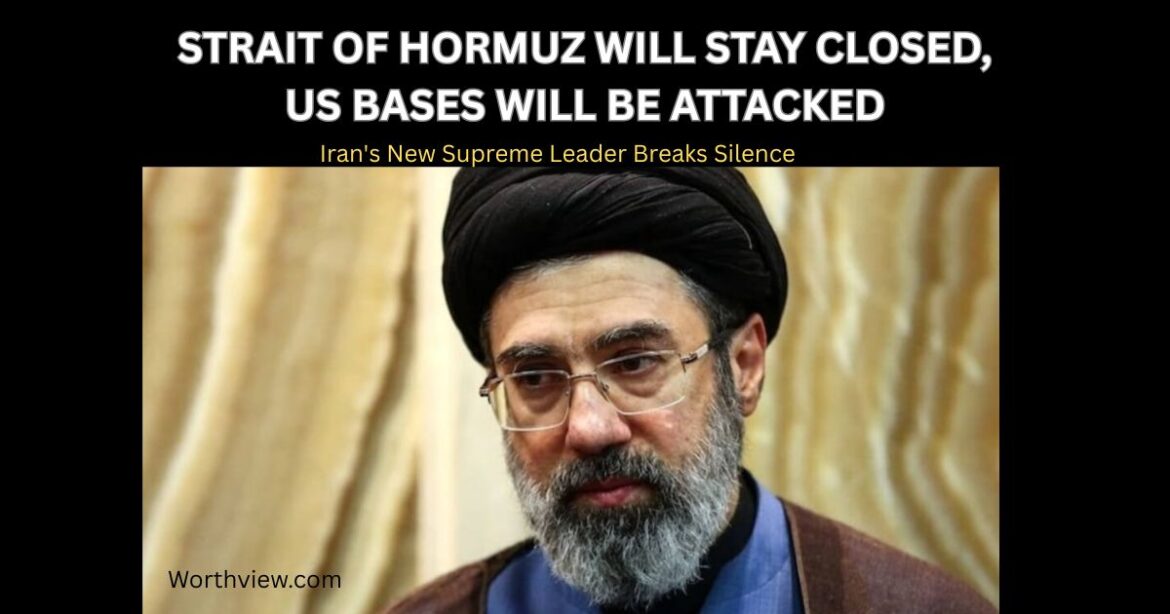
In his first public statement since succeeding his slain father, Mojtaba Khamenei signals no ceasefire, no negotiation, and no end to the war — sending oil prices back above $100 a barrel within hours.
TLDR: Iran’s new Supreme Leader Mojtaba Khamenei delivered his first statement today — read on state television — vowing to keep the Strait of Hormuz closed, attack all US military bases in the region, and take revenge for every Iranian killed since the war began. He offered no conditions for peace and no off-ramp. Oil prices rose above $100 a barrel within hours of the statement.
For 13 days, the world waited to hear from Iran’s new supreme leader. On Thursday, March 12, it finally did — and what Mojtaba Khamenei said made clear that Iran has no intention of ending this war on anyone else’s terms.
The statement was not delivered by Khamenei himself. It was read aloud by a news anchor on Iranian state television, with a photograph of the new leader displayed on screen. No audio, no video. Khamenei — who was reportedly wounded in the same strike that killed his father on February 28 — has not been seen publicly since the war began. Iranian officials insist he is ‘alive and well.’ The format of Thursday’s statement did nothing to settle the speculation.
But the content of the message left little room for ambiguity. Across five key declarations, Iran’s new supreme leader outlined a course for the war that points toward escalation, not resolution.
The Five Key Declarations — What He Actually Said
- The Strait of Hormuz Stays Closed
This was the most consequential line of the entire statement — and markets reacted immediately.
“The lever of blocking the Strait of Hormuz must definitely continue to be used as a tool to pressure the enemy.”
— Mojtaba Khamenei, Iranian state television, March 12, 2026
Oil prices, which had dipped below $100 earlier in the week after Trump claimed the war was ‘ahead of timetable,’ surged back above $100 a barrel within hours of the statement being broadcast. The Strait — through which roughly 20% of the world’s oil flows every day — has been under effective Iranian chokehold since the war began. Today’s declaration makes clear it will remain that way for the foreseeable future.
One important nuance flagged by Eurasia Group president Ian Bremmer: the strait is not completely shut. Iranian oil tankers continue to pass through it, bringing revenue to Tehran and crude to China. What Iran has effectively closed is the strait to everyone it considers an enemy — US-allied nations, and tankers bound for Israel or Western ports.
- All US Military Bases in the Region Must Close — Or Be Attacked
Khamenei issued a direct and sweeping ultimatum to every country in the Middle East that hosts US military infrastructure:
“All US military bases in the region must close immediately. Those bases will be attacked.”
— Mojtaba Khamenei, March 12, 2026
This encompasses US bases in Saudi Arabia, UAE, Qatar, Bahrain, Kuwait, Iraq, and Jordan — home to tens of thousands of American troops. It is a direct message to Gulf Arab states that hosting the US makes them targets, regardless of their formal position in the conflict. Several Gulf nations — particularly Saudi Arabia, UAE, and Kuwait — have tried to stay neutral while privately cooperating with the US. This statement makes that balancing act significantly harder.
- Revenge for Every Iranian Killed — Not Just His Father
The statement contained one of its most sweeping pledges in its opening section, where Khamenei described visiting his father’s body after his assassination:
“I assure everyone that we will not forgo vengeance for the blood of your martyrs. The vengeance we have in mind is not limited to the martyrdom of the great leader of the Revolution — rather, every member of the nation who is martyred by the enemy constitutes an independent subject in the file of vengeance.”
— Mojtaba Khamenei, Tasnim News Agency (IRGC), March 12, 2026
This is significant in scope. Khamenei is not just vowing to avenge his father — he is framing every Iranian civilian killed in the US-Israeli strikes as an individual justification for retaliation. With over 1,300 Iranians reported killed since February 28, that is a very wide mandate.
- New Fronts Are Being Prepared — Where the Enemy Is ‘Extremely Vulnerable’
Perhaps the most alarming passage in the statement was a thinly veiled threat about undisclosed new theatres of war:
“Studies have been conducted on opening other fronts in which the enemy has little experience and will be extremely vulnerable — and their activation will be carried out if the war continues.”
— Mojtaba Khamenei, March 12, 2026
The statement did not specify what these fronts are. Analysts are reading this as a possible reference to cyberattacks on Western financial or energy infrastructure, activation of sleeper cells in Western countries (the FBI issued an alert this week about a planned Iranian drone attack on California), or escalation through Houthi forces in Yemen — whom Khamenei explicitly praised in the statement, saying they ‘will also do the job.’
- No Peace Offer — No Conditions — No Off-Ramp
Perhaps equally significant is what the statement did not contain. There was no mention of conditions under which Iran would end the war. No diplomatic language. No indication of what an acceptable outcome for Tehran would look like.
This stands in direct contrast to Iranian President Masoud Pezeshkian, who said just one day earlier — on Wednesday — that Iran would consider ending the war if ‘certain conditions’ were met. The supreme leader’s statement appears to have overridden the president’s more conciliatory tone entirely.
“Khamenei offered no off-ramp for an immediate cessation of violence, nor did he elaborate on what would constitute an acceptable outcome for Tehran — instead promising revenge for those killed is a ‘file’ that remains permanently open.”
— CNN Analysis, March 12, 2026
The Question Nobody Can Answer: Was Khamenei Even There?
The format of Thursday’s statement raised immediate questions that Iranian officials have not answered. No audio. No video. A news anchor reading from a text, with a still photograph on screen.
Iran’s new supreme leader was reportedly injured — possibly severely — in the same airstrike that killed his father on February 28. An Iranian official confirmed this week that he was wounded but insisted he is ‘alive and well.’ The statement itself acknowledged he learned of his own appointment to the supreme leadership by watching state TV — suggesting he was not present at the Assembly of Experts meeting that selected him.
Whether Thursday’s statement reflects Mojtaba Khamenei’s own active direction of the war, or was drafted by hardliners around him while he recovers from his injuries, is a question that has significant implications for how — and whether — this war can eventually end.
How the World Reacted
- Oil markets: Brent crude surged back above $100 a barrel within hours. The IEA’s record 400-million-barrel reserve release earlier this week — the largest in history — had briefly pulled prices down. Khamenei’s statement erased those gains entirely.
- Gulf states: Saudi Arabia, UAE, Kuwait, and Bahrain all reported new Iranian drone and missile interceptions on Thursday. The UAE’s defence ministry confirmed active air defence responses. For Gulf states trying to stay neutral, the supreme leader’s direct targeting of US bases on their soil is a deeply uncomfortable development.
- Iraq escalation: Two oil tankers were struck in Iraqi territorial waters near Basra on Thursday — the first attacks inside Iraqi waters since the war began. Iran claimed responsibility for one strike. Iraq’s oil port operations have now been shut down entirely.
- Hezbollah: Iran’s Lebanese proxy launched its largest rocket barrage against Israel since the war began on Thursday — a direct operational response to the supreme leader’s statement praising armed resistance groups.
- Trump’s response: The White House has not issued a formal response to Khamenei’s statement as of publishing. Trump told a rally in Kentucky on Wednesday — hours before the statement — that ‘in the first hour, it was over.’ The supreme leader’s declaration suggests Iran did not get that memo.
What This Means for the War — and for Oil Prices
The statement effectively closes the diplomatic window that briefly appeared to open on Wednesday when President Pezeshkian floated the idea of conditional peace. In Iran’s constitutional structure, the supreme leader outranks the president on all matters of national security and foreign policy. What Khamenei says, goes.
The message analysts had been waiting for is now clear:
Iran’s new leadership intends to fight this war on its own terms, for as long as it takes, with no pre-announced conditions for stopping. That is not the message markets — or the Trump administration — were hoping for.
For oil prices, the implication is straightforward. Every analyst forecast that priced in a short war of 4–6 weeks now needs to be reassessed. The Strait of Hormuz will stay under threat for at least as long as it takes for either a military outcome or a diplomatic breakthrough that has no visible path right now.
For India — watching its LPG supply dwindle, its rupee slide, and its import bill swell — Thursday’s statement means the crisis described in our previous coverage is not easing. It is entering a new, more entrenched phase.
Enjoy Worthview?
Add Worthview as a Preferred Source on Google to see more of our stories in Search.

Worthview Editorial Team is the shared byline for content created collaboratively by Worthview’s editors and contributors. Since 2008, we’ve published thousands of articles across technology, AI, finance, health, home, travel, and lifestyle. Our editorial process emphasizes original research, reputable sources, regular content updates, and clear attribution. Articles covering higher-trust topics, including health and finance, may also undergo review by qualified subject-matter experts.