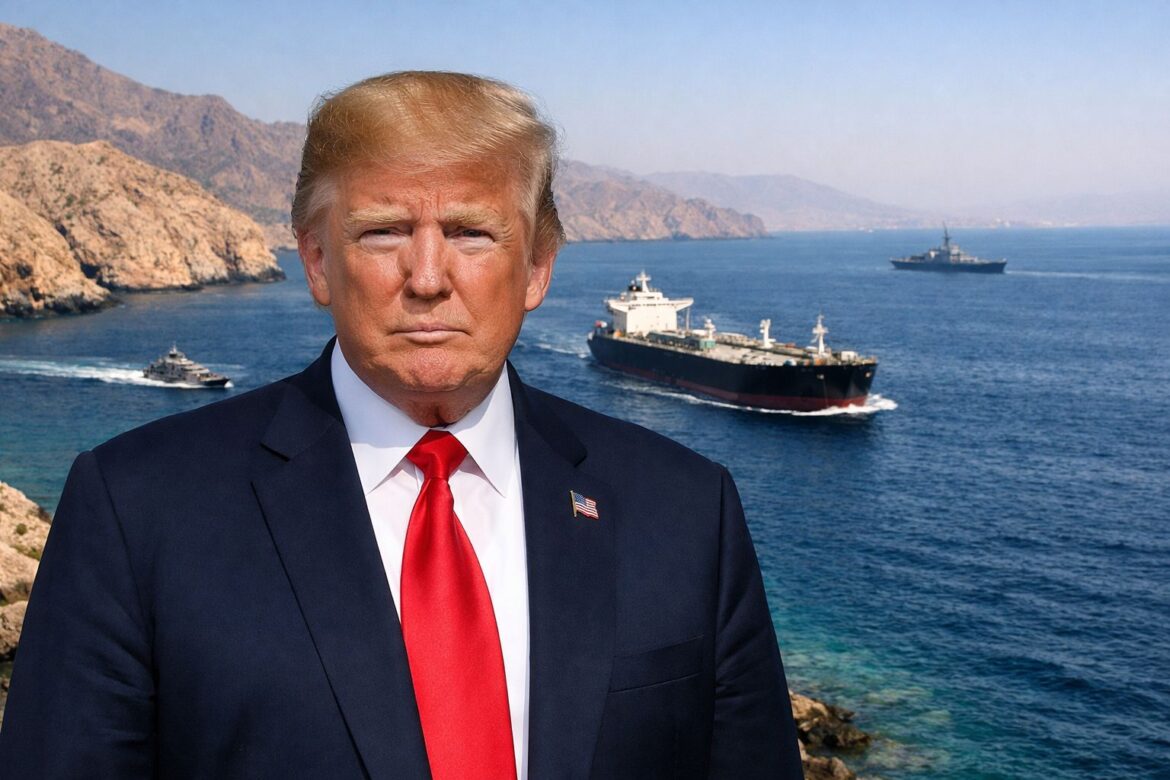
The Strait of Hormuz — a narrow, 21-nautical-mile-wide waterway between Iran and the Arabian Peninsula — has become the most consequential chokepoint in the global economy. Since the United States and Israel launched military operations against Iran on February 28, 2026, Iran has effectively closed the strait to hostile shipping. The result: oil prices above $100 a barrel, tankers sitting idle at either end, and a world economy holding its breath.
Into this storm stepped US President Donald Trump with a bold demand: that America’s allies — China, France, Japan, South Korea, and the United Kingdom — send warships to force the waterway back open. The response from the international community has been, in a word, cold. Here is a full breakdown of who Trump called on, what each country said, and how an increasingly frustrated Trump has responded.
📌 Quick Context: What Is the Strait of Hormuz?
Location: Between Iran and the Arabian Peninsula (Oman)
Width at narrowest point: 21 nautical miles (39 km)
Global oil share: ~20–30% of global oil consumption passes through it
Current status: Effectively closed to US-aligned shipping since Feb 28, 2026
Oil price impact: Brent crude above $104/barrel; WTI at ~$99/barrel
Trump’s Demand: ‘Send Warships or We Will Remember’
On Saturday, March 15, US President Donald Trump took to his Truth Social platform with an urgent call to action. He specifically named China, France, Japan, South Korea, and the United Kingdom as countries that should dispatch naval vessels to secure the strait — arguing that America, which he claimed relies on the passage for only 1–2% of its oil, was being asked to bear an unfair burden.
“Hopefully China, France, Japan, South Korea, the UK, and others, that are affected by this artificial constraint will send ships to the area so that the Hormuz Strait will no longer be a threat by a nation that has been totally decapitated.”
A day later, aboard Air Force One, Trump escalated his rhetoric. He made clear this was not a request — it was a demand, and one that came with consequences.
“I’m demanding that these countries come in and protect their own territory, because it is their own territory. Whether we get support or not, I can say this, and I said it to them: We will remember.”
Trump also warned that failure to participate would be ‘very bad for the future of NATO,’ framing the coalition demand as a test of allied loyalty. He later expanded his call beyond the named nations, posting that all ‘Countries of the World that receive Oil through the Hormuz Strait’ should contribute.
Country-by-Country: How Each Nation Responded
🇬🇧 United Kingdom — ‘Won’t Be Drawn Into the Wider War’
The UK’s response has been among the most diplomatically delicate. Prime Minister Keir Starmer confirmed he had a ‘good discussion’ with Trump about reopening the strait and agreed it must be done ‘to ensure stability in the market.’ But he drew a clear red line.
“While taking the necessary action to defend ourselves and our allies, we will not be drawn into the wider war.”
Starmer said it is ‘not a simple task’ and stressed that any Hormuz mission should not be a NATO operation, but a broader collective effort. The UK offered to potentially contribute mine-hunting drones already deployed in the region — a far cry from the two aircraft carriers Trump reportedly requested.
Trump was visibly unhappy. He called out Starmer by name, saying ‘He didn’t really want to do it. I was not happy with the UK.’ He also resurfaced earlier tensions from the war’s opening days, when Starmer had initially refused to allow the US to launch missiles from British bases — a dispute over Diego Garcia that left Trump calling Starmer ‘not Winston Churchill.’
🇫🇷 France — Cautiously Optimistic, But Conditional
France gave Trump perhaps his most encouraging individual response. Trump revealed he had personally spoken with French President Emmanuel Macron about escorting tankers through the strait, and said: ‘I think he’s going to help. I’ll let you know.’
France had already deployed an aircraft carrier strike group to the Eastern Mediterranean, though in a defensive posture. French officials earlier said an international escort mission was being explored, but only when ‘the circumstances permit’ — language that signals Paris wants to wait for a de-escalation window before committing militarily.
🇩🇪 Germany — An Outright No
Germany delivered one of the clearest rejections. Chancellor Friedrich Merz announced that Berlin would not participate in any naval mission in the Strait of Hormuz for as long as the war continues. His reason: the US and Israel did not consult Germany before launching the war.
“So long as the war continues, we will not participate in the Strait of Hormuz with military assets to guarantee freedom of navigation.”
German Foreign Minister Johann Wadephul echoed this, expressing scepticism and saying Berlin needs ‘more clarity’ from Washington and Tel Aviv about their strategic goals. Defence Minister Boris Pistorius summed up the broader European mood in one sentence: ‘This is not our war, we have not started it.’
🇯🇵 Japan — Legally Constrained, Politically Cautious
Japan’s response has been shaped by its pacifist constitution, which imposes strict limits on overseas military deployments. Prime Minister Sanae Takaichi told parliament that Tokyo has ‘not made any decisions whatsoever about dispatching escort ships’ and is ‘examining what Japan can do independently and what can be done within the legal framework.’
The issue is expected to top the agenda when Takaichi visits the White House later this week. Japan is acutely aware of its energy vulnerability — a significant portion of its crude imports transit the Hormuz Strait — but its legal and constitutional constraints make military participation politically explosive at home.
🇰🇷 South Korea — Silent, Still Reviewing
South Korea has said it is ‘reviewing the situation’ but has made no public commitment. Like Japan, South Korea is heavily dependent on Gulf energy imports. Seoul is also managing the diplomatic complexity of its relationship with both Washington and Beijing, making any military commitment in a conflict with Iran — a key player in global energy markets — politically sensitive.
🇨🇳 China — A Flat Rebuff in Diplomatic Language
China’s response was perhaps the most pointed. Trump had singled out Beijing as the country with the most to gain from an open Hormuz, estimating that about 90% of China’s crude imports pass through the strait. US Energy Secretary Chris Wright said he expected China to be ‘a constructive partner’ in reopening the waterway.
China’s Foreign Ministry disagreed. Spokesperson Lin Jian reiterated Beijing’s standard position — calling on all parties to immediately halt military operations and avoid escalation. There was no mention of warships, no naval commitments, and no indication that Beijing would wade into a conflict it views as a US-Israeli creation.
China’s position is strategic: it is in active dialogue with Tehran, which has said it is open to safe passage negotiations with individual countries. Beijing would rather negotiate directly with Iran than join an American-led military coalition.
🇪🇺 Broader Europe — A Bloc-Wide Rejection
The European Union’s foreign policy chief Kaja Kallas floated the idea of expanding the EU’s existing Aspides naval mission from the Red Sea to cover the Strait of Hormuz. But after a meeting of EU foreign ministers in Brussels on Monday, the proposal was decisively rejected. Kallas said plainly: ‘There was no appetite in changing the mandate of operation Aspides, for now. Nobody wants to go actively into this war.’
Other European rejections came swiftly:
- Spain’s Defence Minister Margarita Robles said Spain would ‘never accept any stopgap measures’ to keep the strait open — insisting the goal must be ending the war, not managing around it.
- Italy’s Foreign Minister Antonio Tajani said ‘diplomacy needs to prevail’ and ruled out any expansion of naval missions to the Strait.
- Greece’s government confirmed it would not engage in any military operations in the Strait.
- Ireland confirmed it would not be involved.
- Poland’s Foreign Minister Radek Sikorski pointedly told Washington to go through ‘the proper channels’ — a dig at Trump’s unilateral, social-media-driven diplomacy.
- Australia said it had not been asked to join and ruled out sending ships regardless.
- Sweden also said it had no plans to dispatch vessels.
Trump’s Latest Response: ‘We Will Remember’
By Monday afternoon, Trump was visibly frustrated. At a press conference, he acknowledged that his coalition was not yet formed — and that some countries were ‘less than enthusiastic.’
“Some are very enthusiastic, and some are less than enthusiastic. And I assume some will not do it. I think we have one or two that will not do it that we’ve been protecting for about 40 years at tens of billions of dollars.”
Despite this, Trump claimed that ‘numerous countries’ had privately told him ‘they’re on the way.’ He declined to name them, saying Secretary of State Marco Rubio would make an official announcement. ‘They’ve already started to — it takes a little while to get there,’ he said. ‘In some cases, you have to travel an ocean.’
Trump’s warnings to NATO allies have grown sharper. In a Financial Times interview, he said a failure to help secure the strait would be ‘very bad for the future of NATO.’ He repeatedly invoked decades of US defence spending to shame allies into action, particularly directing his anger at the UK, France, and other European nations he views as freeloading on American security guarantees.
Meanwhile, American, European, and Asian diplomats told CNN they are growing increasingly frustrated with the Trump administration’s refusal to use traditional diplomatic channels. One US diplomat, when asked who is leading the administration’s effort to shore up support, responded simply: ‘DJT?’ — suggesting that the president himself is running the diplomatic campaign from Truth Social and Air Force One.
India’s Quiet Diplomacy: A Contrast to Western Noise
While the US and Europe traded public statements, India took a quieter path. External Affairs Minister S. Jaishankar told the Financial Times that negotiations between New Delhi and Tehran had successfully allowed two Indian-flagged gas tankers to pass through the strait — a rare win amid the blockade.
“I am at the moment engaged in talking to them, and my talking has yielded some results. This is ongoing. Certainly, from India’s perspective, it is better that we reason and we coordinate and we get a solution.”
India’s approach — direct engagement with Iran rather than military posturing — reflects New Delhi’s long-standing policy of strategic autonomy. It also reveals a possible diplomatic gap that other nations could exploit: Iran has signalled it is open to individual negotiations for safe passage, even as it keeps the strait closed to US and allied vessels.
Why Everyone Said No: The Diplomatic Reality
At the heart of the allied reluctance is a simple grievance: the US and Israel launched this war without consulting anyone. European governments, from Germany to France to Spain, are being asked to risk their naval assets and potentially draw themselves into a conflict they had no role in starting and no vote in authorising.
There is also a structural challenge. Iran has said the strait is open to all countries except the US and its allies — meaning nations like China and India can negotiate directly with Tehran for safe passage, bypassing the need for a military coalition entirely. This significantly reduces the incentive for non-aligned nations to join an American-led operation.
Analysts also warn that any naval coalition faces serious practical difficulties. Clearing the strait of mines, neutralising Iranian drone and missile threats, and protecting slow-moving oil tankers in a narrow waterway requires sustained commitment — not just a few warships sailing past. ‘The security of the strait could be achieved. It’s just a matter of how much time you need and how many assets you need,’ one analyst told Al Jazeera, cautioning that rushing into the operation ‘could have negative implications for the security of the mission and the region.’
What to Watch Next
- Japan PM Sanae Takaichi visits the White House this week — the Hormuz question will dominate the agenda.
- Secretary of State Marco Rubio is expected to announce which countries, if any, have agreed to join the coalition.
- Iran’s foreign minister has said Tehran has been approached by ‘a number of countries’ seeking safe passage — bilateral deals could further undercut Trump’s coalition strategy.
- Oil prices remain above $100/barrel; any diplomatic breakthrough — or escalation — could move markets sharply.
- The EU is monitoring whether to keep exploring alternatives to the Aspides mandate expansion.
Bottom Line
Trump’s call for a naval coalition to reopen the Strait of Hormuz has, so far, produced more defiance than commitment. Traditional US allies in Europe are united in their refusal to join a war they were not consulted on. Japan is constrained by law. China sees more value in quiet diplomacy with Tehran. And the countries that might theoretically benefit most — Gulf oil exporters — are themselves under Iranian attack and in no position to lead a coalition.
The US president’s promises that ‘numerous countries are on the way’ remain unverified. As oil prices hold above $100 a barrel and tankers sit idle on both sides of the world’s most consequential chokepoint, the world is watching to see whether Trump’s ultimatums will translate into action — or whether the Strait of Hormuz crisis will deepen further without a credible multinational response.
Enjoy Worthview?
Add Worthview as a Preferred Source on Google to see more of our stories in Search.

Worthview Editorial Team is the shared byline for content created collaboratively by Worthview’s editors and contributors. Since 2008, we’ve published thousands of articles across technology, AI, finance, health, home, travel, and lifestyle. Our editorial process emphasizes original research, reputable sources, regular content updates, and clear attribution. Articles covering higher-trust topics, including health and finance, may also undergo review by qualified subject-matter experts.