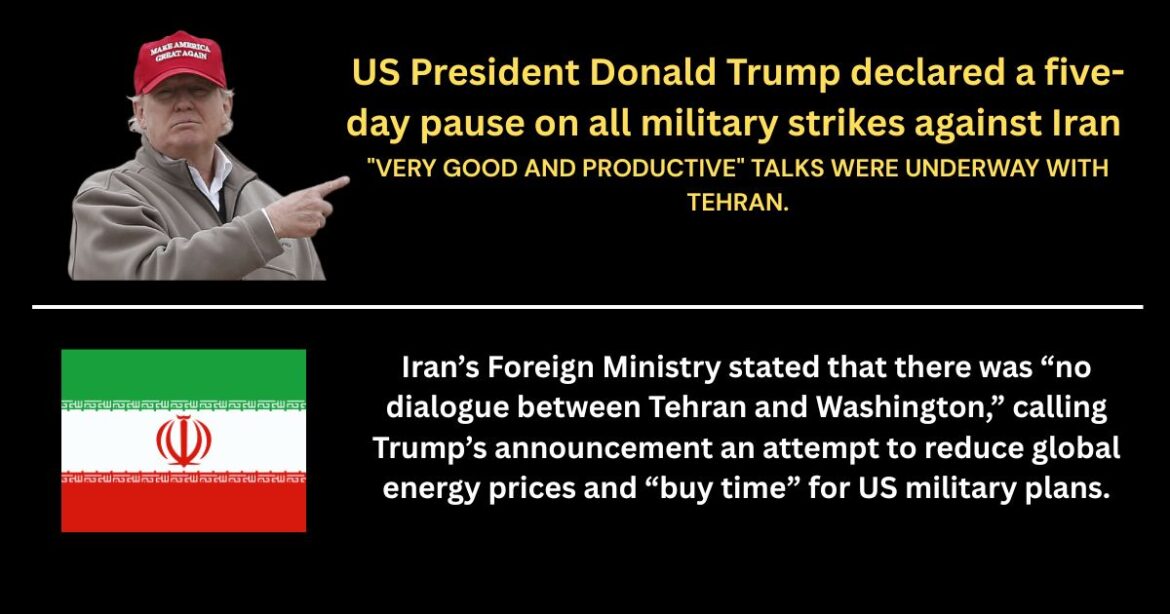
In a dramatic Monday morning announcement, US President Donald Trump declared a five-day pause on all military strikes against Iranian power plants and energy infrastructure — claiming “very good and productive” talks were underway with Tehran. But within hours, Iran denied any dialogue had occurred at all. As global oil markets whipsawed and stock markets surged, the world was left asking a simple question: what is actually happening between Washington and Tehran?
Here is a comprehensive breakdown of everything you need to know.
🔢 Key Numbers at a Glance
| 24 Days
Duration of War |
13
US Troops Killed |
200+
US Troops Wounded |
3,000+
Deaths in Iran |
| 40+ (9 countries)
Energy Facilities Damaged |
~20%
Global Oil Share at Risk |
~10%
Brent Crude Drop (Monday) |
+975 pts
Dow Jones Rise (Monday) |
📋 Key Takeaways
- Trump ordered a 5-day pause on US strikes against Iranian power plants and energy infrastructure on March 23, 2026.
- Iran denied any talks with Washington are occurring, calling Trump’s statements psychological warfare.
- The war is in its 4th week, with 13 US service members killed, 200+ wounded, and 3,000+ deaths in Iran.
- About 20% of global oil and gas passes through the Strait of Hormuz — still effectively blocked by Iran.
- The IEA called this the worst energy crisis since the 1970s oil shocks. At least 40 energy facilities across 9 countries have been damaged.
- Oil prices fell ~10% and the Dow Jones gained 975 points on Monday’s announcement.
- The five-day window expires March 28 — watch for escalation or diplomatic breakthrough.
📢 What Did Trump Announce?
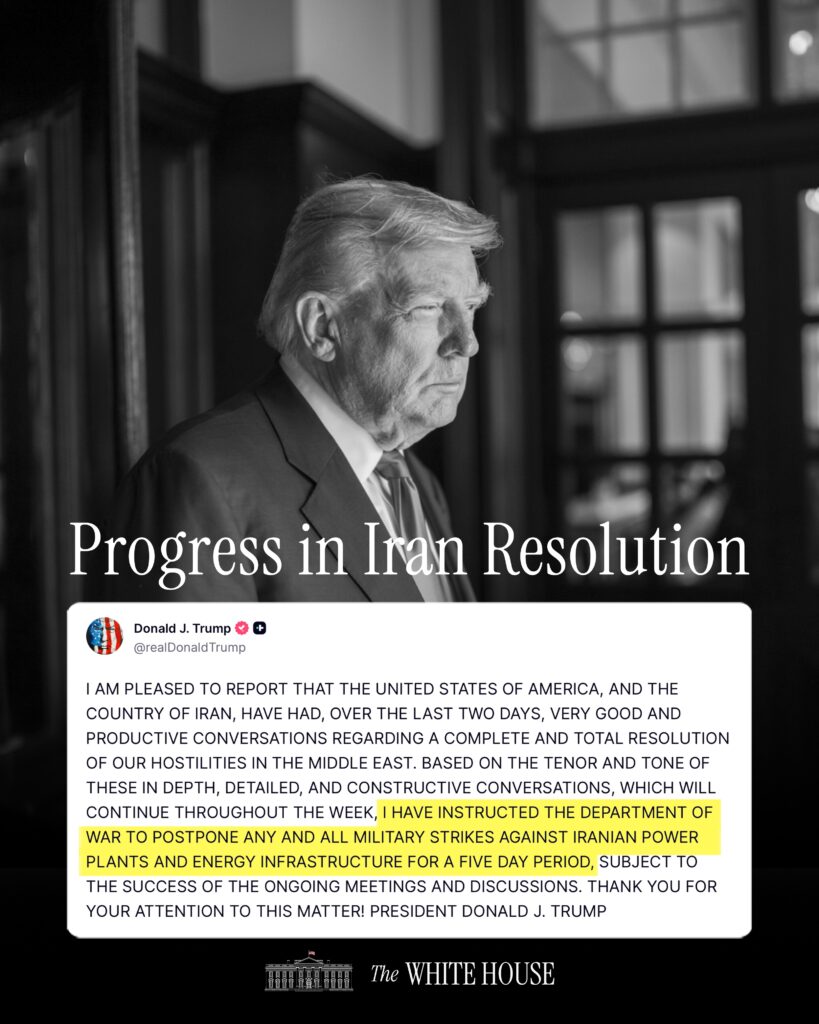
On the morning of March 23, 2026, Trump posted in all-caps on his Truth Social platform announcing that the United States and Iran had held productive conversations over the past two days “regarding a complete and total resolution of our hostilities in the Middle East.”
“I have instructed the Department of War to postpone any and all military strikes against Iranian power plants and energy infrastructure for a five-day period, subject to the success of the ongoing meetings and discussions.” — President Donald Trump, Truth Social, March 23, 2026
Speaking to reporters at Palm Beach International Airport, Trump claimed that Iran “called” to initiate talks — not the other way around. He said negotiations had been ongoing with “a respected Iranian leader,” though notably not Supreme Leader Mojtaba Khamenei. He also told CNBC: “We are very intent on making a deal with Iran.”
Trump outlined what he described as “major points of agreement,” including that Iran would commit to not pursuing nuclear weapons, hand over existing stockpiles of enriched uranium, and agree to reopen the Strait of Hormuz.
🇮🇷 Iran’s Flat Denial
Tehran pushed back hard and immediately. Iran’s Foreign Ministry stated that there was “no dialogue between Tehran and Washington,” calling Trump’s announcement an attempt to reduce global energy prices and “buy time” for US military plans.
Iranian state broadcaster IRIB framed Trump’s announcement very differently — not as a diplomatic breakthrough, but as a retreat. “Trump, fearing Iran’s response, backed down from his 48-hour ultimatum,” read a graphic on IRIB television.
A senior Iranian security official said: “With this kind of psychological warfare, neither the Strait of Hormuz will return to its pre-war conditions nor will there be peace in the energy markets.”
Russia’s Foreign Minister Sergey Lavrov meanwhile spoke with Iran’s Foreign Minister Abbas Araghchi, reaffirming strong ties between Moscow and Tehran and condemning what they characterised as an “unlawful US-Israeli military assault.”
📅 How Did We Get Here? The 4-Week Timeline
The war is now in its fourth week. Here is a brief timeline of how the conflict escalated:
- February 28, 2026: The US and Israel launched joint strikes against Iran, starting the war.
- Early March: Iran retaliated with missile attacks on Israel, including strikes near a nuclear facility in Dimona that wounded 180 people. An additional Iranian missile attack on Tel Aviv wounded at least 7.
- Mid March: Iran’s IRGC declared it would close the Strait of Hormuz indefinitely if US strikes on power plants proceeded.
- March 21, 2026 (Saturday): Trump issued a 48-hour ultimatum — reopen the Strait of Hormuz or face strikes on Iranian power plants.
- March 22, 2026 (Sunday): Iran’s Parliament Speaker Qalibaf warned that a US attack on power plants could see energy infrastructure across the Gulf region “irreversibly destroyed.” Iran’s Defence Council threatened to mine Gulf sea lanes.
- March 23, 2026 (Monday): Trump announced the 5-day pause. Iran denied talks. Oil prices tumbled. Markets rallied.
By the end of the fourth week of war, the US has suffered 13 service member deaths and over 200 wounded. Iran has seen more than 3,000 civilian deaths, according to the US-based Human Rights Activists News Agency. Israel has faced sustained ballistic missile attacks.
🛢️ The Strait of Hormuz: Why It’s the Centre of Everything
The Strait of Hormuz is a narrow waterway connecting the Persian Gulf and the Gulf of Oman. It is one of the single most strategically important chokepoints in the world for energy supply.
Roughly 20% of all global oil and gas passes through the strait. Iran’s blockade of this waterway has been the direct trigger for Trump’s ultimatum and the broader energy crisis threatening the global economy.
US Central Command Commander Admiral Brad Cooper said on Monday that the strait is “physically open” but that ships are staying away because Iran has been firing missiles and drones at vessels. The US waived Jones Act shipping rules for 60 days to help steady domestic oil markets, and separately lifted sanctions on Iranian crude oil shipments loaded between March 20 and April 19.
“No country will be immune to the effects of this crisis if it continues to go in this direction.” — Fatih Birol, IEA Chief, March 23, 2026
🌍 The Global Energy Crisis — Worse Than the 1970s?
The International Energy Agency (IEA) has issued a stark warning. IEA chief Fatih Birol said the global economy faces a “major, major threat” from the war’s disruption to oil and gas flows.
Birol described the current crisis as worse than the combined oil shocks of 1973 and 1979, which together caused the loss of 10 million barrels per day of supply.
At least 40 energy facilities across nine countries have been severely damaged in the conflict, according to the IEA. Countries as far away as Canada, Slovenia, and Ukraine are already feeling knock-on effects — Canada has announced new financial aid for farmers struggling with the high cost of fertiliser, while Slovenia has temporarily capped consumer gasoline purchases.
For India, the implications are significant. India imports over 80% of its crude oil, with a large share coming from the Gulf region. A prolonged blockade of the Strait of Hormuz or further disruption to Middle East energy infrastructure could spike India’s import bill, pressure the rupee, and add to domestic inflation.
📈 How Markets Reacted
Markets responded sharply and immediately to Trump’s announcement on Monday morning:
- Brent crude oil fell 10.1% to $100.87 per barrel, briefly touching as low as $96 per barrel.
- US crude oil fell 9.5% to $88.90 per barrel.
- The Dow Jones surged 975 points (+2.1%), the S&P 500 gained 2%, and the Nasdaq rose 2.3%.
- European stocks also rebounded on the news.
However, markets retreated from initial gains after the Israeli Defence Forces confirmed they were continuing strikes on Tehran — underscoring that the five-day pause applies only to US strikes on energy infrastructure, not to the war overall.
🤝 Behind-the-Scenes Diplomacy
Despite Iran’s public denial, there are signs that backchannel conversations are genuinely occurring. Multiple sources confirmed that Turkey, Egypt, and Pakistan have been passing messages between Washington and Tehran over the past several days.
Al Jazeera reported that even during the Eid holiday, multiple countries were holding conversations with embassies and directly with the White House, urging de-escalation. “People have been telling Trump that this process of escalation does not bode well for Iran or for Israel,” one diplomat was quoted as saying.
Oman, historically a key mediator between Iran and the West, has said it is “working intensively” to put in place safe passage arrangements for the Strait of Hormuz.
Trump attributed Iran’s public denial to miscommunication within Iran’s leadership, claiming the officials the US is speaking to are representative of the regime — though he did not clarify who specifically.
⚠️ Threats and Escalation Risks
Even as diplomacy continues, both sides are ratcheting up their warnings:
Iran’s Defence Council warned it would target power plants and desalination facilities across the Gulf region that supply electricity to US military bases, if its own power plants were struck. In Gulf nations, power stations and desalination plants are often co-located, meaning an attack would threaten both electricity and drinking water supplies.
The IRGC also warned it would lay sea mines across Gulf shipping routes if Iran’s southern coasts or islands came under attack — a move that could effectively block maritime traffic far beyond the narrow Hormuz strait.
The USS Gerald R. Ford — the world’s largest aircraft carrier, which had been part of Iran war operations — returned to a naval base in Crete on Monday, potentially signalling a temporary drawdown.
UN experts have warned that striking civilian energy infrastructure could constitute war crimes under international humanitarian law. Ben Saul, UN Special Rapporteur on counterterrorism and human rights, condemned threats from both sides. Amnesty International similarly warned of “devastating civilian harm” if such strikes proceed.
🌐 International Reactions
China: China’s Middle East envoy Zhai Jun pinned blame squarely on the US and Israel, saying the war has dealt a “heavy blow to the global economy and shipping lanes.” He quoted a Chinese proverb: “To untie a belt, the person who tied it is needed,” calling for an immediate US-Israel halt to military action.
Russia: Foreign Minister Lavrov reaffirmed strong ties with Tehran and condemned the “unlawful” US-Israeli military assault, signalling that Moscow sees alignment with Iran on this conflict.
Israel: Prime Minister Netanyahu said Iran has been “decimated” but that fully ending Iran’s revolutionary capacity requires a “ground component.” He also said Israel would be “very happy” with any deal Trump reaches — suggesting coordination between Washington and Jerusalem, though Israel has continued independent strikes on Tehran.
Ukraine: President Zelensky warned that the Iran war could slow momentum for Ukrainian peace negotiations, highlighting the global resource and attention competition created by the conflict.
🔮 What Happens Next?
The five-day window expires on Saturday, March 28. Several scenarios could unfold:
- Deal scenario: Iran privately acknowledges talks and signals movement on the Strait of Hormuz — the war begins winding down. Oil prices normalise.
- Stalemate scenario: Iran holds its public denial and the five days expire inconclusively — Trump faces a credibility test on whether to escalate or extend the pause.
- Escalation scenario: No agreement is reached. US strikes Iranian power plants. Iran retaliates against Gulf energy infrastructure and potentially mines the strait — triggering a full-scale energy catastrophe.
The contradiction between Trump’s optimistic framing and Iran’s firm public denial remains the central unresolved tension. Whether this five-day pause represents a genuine diplomatic opening or a face-saving mechanism for both sides to avoid escalation will become clear by the end of the week.
WorthView will continue to track this story. For the latest updates on the US-Iran conflict and its implications for India and global markets, bookmark WorthView.com.
Enjoy Worthview?
Add Worthview as a Preferred Source on Google to see more of our stories in Search.

Worthview Editorial Team is the shared byline for content created collaboratively by Worthview’s editors and contributors. Since 2008, we’ve published thousands of articles across technology, AI, finance, health, home, travel, and lifestyle. Our editorial process emphasizes original research, reputable sources, regular content updates, and clear attribution. Articles covering higher-trust topics, including health and finance, may also undergo review by qualified subject-matter experts.