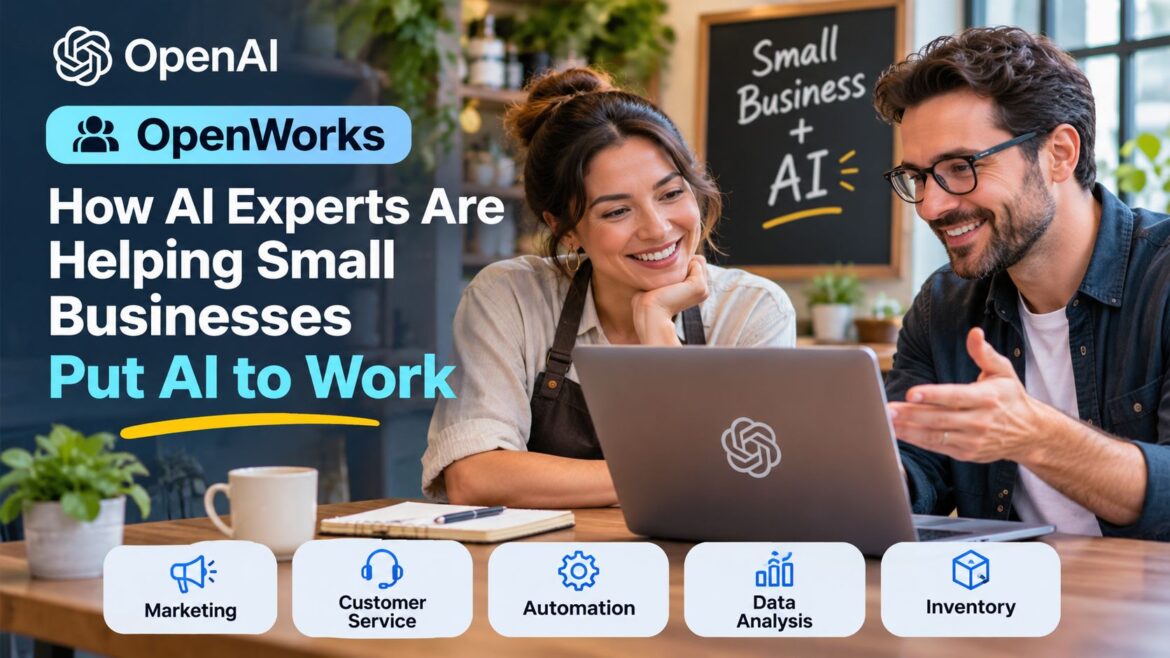
Artificial intelligence tools such as ChatGPT are becoming increasingly accessible, but many small business owners still struggle to understand how to use them in their day-to-day operations. While AI can help with marketing, customer service, research, data analysis, and automation, knowing which tools to use and how to implement them can be a challenge.
OpenAI is attempting to address this gap with OpenWorks, a new initiative that connects small businesses with local AI experts who can help them put AI to practical use. Instead of relying on online tutorials or experimenting with AI tools on their own, participating businesses can work directly with experts to identify problems, build solutions, and learn how to use AI independently.
The initiative also creates an opportunity for AI-skilled individuals and small consultancies to work with local businesses, helping them adopt AI while receiving support and a monthly stipend from OpenAI.
What Is OpenAI OpenWorks?
OpenWorks is a pilot program launched by OpenAI to help small businesses adopt artificial intelligence through hands-on support from local AI experts.
Under the program, OpenAI recruits and supports individuals and small teams with AI skills who work directly with local business owners. These partners help businesses identify opportunities to use AI, implement practical solutions, and learn how to use the technology independently.
Rather than offering only AI training or online courses, OpenWorks focuses on solving actual business problems. A business owner might work with a partner to improve customer outreach, create a marketing campaign, streamline an administrative process, analyze business data, or build a tool that helps employees perform their work more efficiently.
OpenAI is currently piloting OpenWorks in 20 communities across the United States. The initiative is designed to connect local businesses with people who understand AI and can demonstrate how it can be applied to everyday business operations.
What does the OpenWorks program offer?
| For small businesses | For OpenWorks Partners |
|---|---|
| Free hands-on AI assistance | Monthly stipend of up to $8,000 |
| One-on-one support from an AI expert | Tools, resources, and workshop support |
| Help implementing practical AI solutions | Community of other OpenWorks Partners |
| Three months of ChatGPT Business at no cost | Opportunity to work with local businesses |
| Training to help employees use AI independently | Opportunity to teach AI skills through community workshops |
OpenWorks is currently a pilot, so its availability and participation are limited to the program’s current scope. The stipend is up to $8,000 per month, not a guaranteed payment for every partner.
Why Small Businesses Need Help Implementing AI
Many small businesses are interested in AI but don’t know where to start. While tools like ChatGPT can answer questions, generate content, and analyze information, businesses often need help identifying the right use cases and integrating AI into their existing workflows.
Common challenges include:
- Lack of AI knowledge: Business owners may not know which AI tools are useful for their specific needs.
- Limited time: Small business owners already manage multiple responsibilities and may not have time to experiment with new technologies.
- Choosing the right tools: There are many AI tools available, making it difficult to determine which ones are worth using.
- Implementation challenges: Knowing how to use AI is different from integrating it into daily business operations.
- Employee training: Teams may need guidance on using AI effectively and responsibly.
- Unclear return on investment: Businesses want to know whether AI will actually save time, reduce costs, or increase revenue.
This is where AI experts and consultants can make a difference. Instead of simply recommending AI tools, they can help business owners identify specific problems, implement solutions, train employees, and measure the results.
That practical, hands-on approach is the core idea behind OpenWorks.
How OpenWorks Works
OpenWorks is designed around a simple approach: connect small businesses with AI experts who can work directly with them to solve real business problems.
The process involves several key steps:
1. Identify a business problem
The business owner chooses a task, challenge, or opportunity they want to improve. This could be anything from finding new customers and improving marketing to managing inventory or reducing repetitive administrative work.
2. Explore how AI can solve it
The OpenWorks Partner works with the business owner to explore possible AI solutions, identify suitable tools, and determine how AI can be incorporated into the existing workflow.
3. Build or implement a practical solution
Rather than stopping at recommendations, the partner helps put the solution into practice. This could involve creating an AI-powered workflow, developing a simple internal tool, improving an existing process, or using AI to automate repetitive tasks.
4. Train the business owner and employees
The goal is not to make the business permanently dependent on an AI consultant. Owners and employees get hands-on experience and learn how to use the solution themselves, so they can continue using and improving it after the engagement.
OpenWorks Partners are also expected to host a monthly community workshop to help more local business owners understand AI and its practical applications.
The process is designed to focus on practical implementation, not just AI education—helping small businesses identify a problem, build a solution, and learn to use it independently.
What AI Experts Can Help Small Businesses With
AI experts can help small businesses move beyond experimenting with AI chatbots and start using AI to solve everyday operational challenges. The opportunities extend across marketing, customer service, sales, administration, research, and data analysis.
Here are some practical ways AI experts can help.
1. Marketing and Content Creation
AI can help small businesses create marketing content without spending hours writing everything manually.
An AI expert can help businesses:
- Create social media posts and content calendars
- Write email newsletters and promotional campaigns
- Generate product descriptions and website content
- Create advertising copy for different audiences
- Repurpose existing content into multiple formats
2. Customer Service
Businesses can use AI to respond to common customer questions and improve customer communication.
Examples include:
- Drafting replies to frequently asked questions
- Creating customer support knowledge bases
- Developing AI-powered chatbots
- Responding to customer reviews
- Organizing customer feedback and identifying recurring issues
3. Sales and Customer Outreach
AI can help businesses find potential customers and make their outreach more personalized.
An AI expert could help build workflows to:
- Research potential customers
- Identify relevant businesses or prospects
- Draft personalized emails
- Follow up with leads
- Prepare sales proposals and presentations
4. Administrative Tasks and Automation
Small businesses often spend considerable time on repetitive administrative work. AI can help simplify these tasks.
Examples include:
- Drafting emails and business documents
- Summarizing meetings
- Creating reports
- Organizing information
- Automating repetitive workflows between different tools
5. Data Analysis and Reporting
Businesses may have valuable data but lack the time or expertise to analyze it.
AI experts can help them:
- Analyze sales and customer data
- Identify trends and patterns
- Create dashboards and reports
- Understand business performance
- Turn spreadsheets into useful insights
6. Inventory and Operations Management
AI can help businesses improve how they manage inventory, suppliers, and daily operations.
Potential solutions include:
- Tracking inventory levels
- Monitoring product prices
- Identifying slow-moving products
- Organizing supplier information
- Improving inventory forecasting and planning
7. Research and Business Intelligence
AI can make business research faster and easier, especially for businesses that don’t have dedicated research teams.
AI experts can help businesses:
- Research competitors and market trends
- Identify new business opportunities
- Monitor industry developments
- Research potential suppliers
- Summarize information and turn it into actionable insights
8. Building Custom AI Tools
Some businesses may need solutions that go beyond standard AI chatbots. AI experts can build simple customized tools tailored to their needs.
For example:
- An internal tool to search company documents
- A product information assistant
- A custom reporting dashboard
- A tool to compare supplier prices
- A workflow that automatically processes and organizes business information
9. Employee Training and AI Adoption
Introducing AI tools is only part of the challenge. Employees also need to understand how to use them effectively.
AI experts can help businesses:
- Train employees to use AI tools
- Create AI guidelines and workflows
- Develop reusable prompts for common tasks
- Identify suitable AI tools for different roles
- Encourage responsible AI adoption
The key is that AI experts don’t necessarily need to build complex AI systems. In many cases, their value comes from understanding a business problem, selecting the right tools, connecting existing systems, creating practical workflows, and helping employees use them effectively.
These are also potential services that freelancers, consultants, and small AI agencies could offer to businesses in their local communities.
Who Can Apply as an OpenWorks Partner?
OpenAI is looking for technically skilled and curious individuals and small teams who can help local businesses understand and implement AI. Software and AI consultancies are also encouraged to apply.
You may be a good fit if you:
- Have practical AI or technical skills
- Enjoy solving real-world business problems
- Can work directly with business owners
- Are comfortable teaching AI to non-technical people
- Have experience building or implementing AI solutions
You don’t necessarily need to be a large AI company. Individuals, small teams, freelancers, and software or AI consultancies can apply.
What do you need for the application?
Applicants are asked to describe an AI problem they have solved, explain what they did and what changed as a result, and provide a link to a social profile or portfolio.
The example can come from your own work, a client project, or a community project. The current application form does not list a degree requirement or application deadline. OpenAI Help Center+1
Is OpenWorks Available Outside the United States?
This is an important question for people interested in the program from countries such as India.
Currently, OpenWorks is a U.S.-focused pilot program that expects partners to work in person with small businesses in the United States. OpenAI’s current FAQ states that remote participation and working from outside the U.S. are not supported for this pilot.
Although people outside the listed communities may be able to submit an application to express interest, OpenAI does not currently promise program availability in other countries or provide a confirmed international expansion timeline. OpenAI Help Center+1
OpenWorks availability: What we know
| Question | Current answer |
|---|---|
| Can someone in India participate remotely? | Not currently supported |
| Can an AI consultant based in India work with U.S. businesses through the pilot remotely? | Not under the current arrangement |
| Is OpenWorks available in Bengaluru? | No, not currently |
| Is the $8,000 monthly stipend guaranteed? | No. It is the maximum amount offered |
| Is international expansion officially announced? | No confirmed international rollout |
| Could India become a future market? | Potentially, but no announcement has been made |
What this means for aspiring AI consultants in India
Even though OpenWorks is not currently available to AI professionals in India, the initiative highlights a potentially significant opportunity: small businesses around the world may increasingly need people who can help them implement AI practically.
You don’t need to wait for a program like OpenWorks to start building these skills. AI professionals in India can begin by helping local businesses with AI-powered marketing, customer support, automation, reporting, research, and custom workflows.
This is also an opportunity worth watching if OpenAI expands similar programs to other countries in the future.
Real Examples of Small Businesses Using AI
OpenWorks highlights how AI can help small businesses solve problems that would otherwise require significant time, money, or technical expertise. Some of the businesses participating in the program have already used AI to improve inventory management, customer outreach, pricing research, and other operations.
1. A Gift Shop Built an Inventory Dashboard
A small gift shop called Tiny Things in Fargo used AI to build a custom dashboard connected to its existing inventory systems. The dashboard helped the owners manage and view information about more than 1,000 products.
According to the owners, building a similar custom tool through traditional development could have cost approximately $50,000. The AI-assisted solution helped them gain better inventory visibility without that level of investment.
2. A Microgreens Business Improved Customer Outreach
Ghost Grow 843, a microgreens and hydroponic lettuce business in Charleston, used AI to research nearby restaurants and chefs and create personalized outreach emails.
The business reported that its email response rate increased from 20% to 75% and that it gained 10 new restaurant customers within four months.
3. A Sign Business Simplified Price Tracking
Sign Badgers in Fargo used AI tools to help manage inventory information and track vendor pricing.
Previously, checking prices could take hours. The business reported that the process was reduced to approximately 15–20 minutes, saving an estimated two to five hours per week.
4. A Business Identified Billing Errors
Black Paper Party used AI to compare purchase orders with shipping records and identify discrepancies that could lead to billing errors or chargebacks.
The company reported that the process helped identify issues and save thousands of dollars.
These examples demonstrate that small businesses don’t necessarily need complicated AI systems or large technology budgets to benefit from AI. Even relatively simple AI-assisted tools and workflows can help save time, reduce costs, improve customer outreach, and make everyday business operations more efficient.
These examples and results are based on businesses featured by OpenAI as part of the OpenWorks initiative and are reported outcomes, not independently verified results. OpenAI+1
Enjoy Worthview?
Add Worthview as a Preferred Source on Google to see more of our stories in Search.

Worthview Editorial Team is the shared byline for content created collaboratively by Worthview’s editors and contributors. Since 2008, we’ve published thousands of articles across technology, AI, finance, health, home, travel, and lifestyle. Our editorial process emphasizes original research, reputable sources, regular content updates, and clear attribution. Articles covering higher-trust topics, including health and finance, may also undergo review by qualified subject-matter experts.