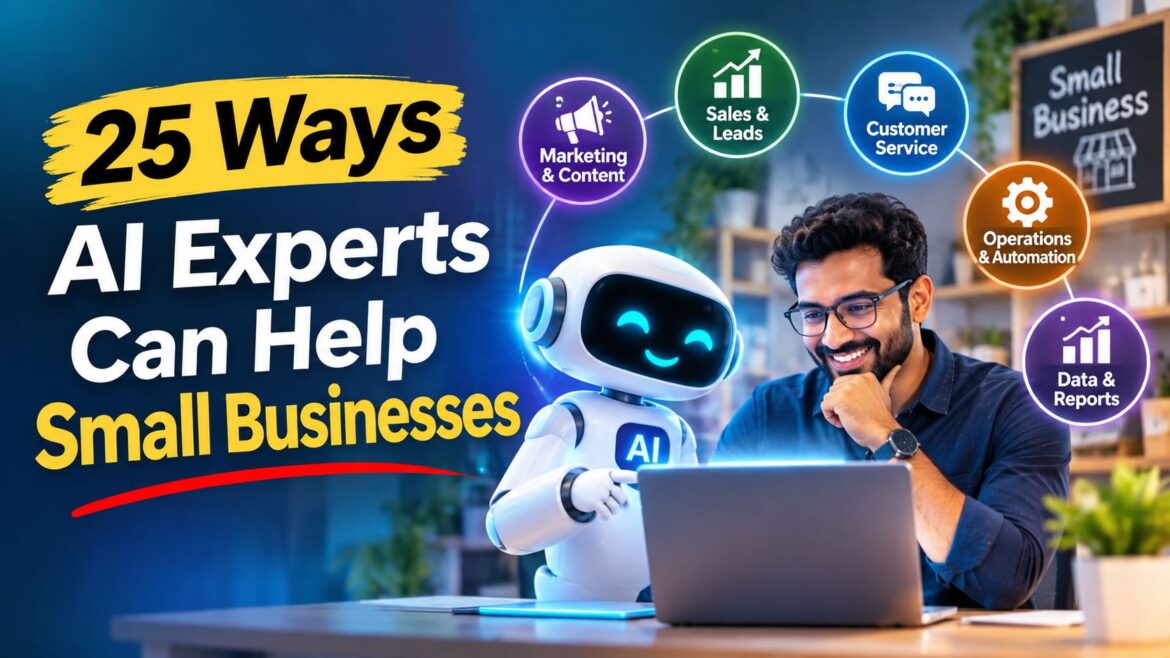
Artificial intelligence is creating new opportunities for small businesses to improve their marketing, customer service, sales, and daily operations. However, many business owners still struggle to understand which AI tools to use and how to apply them to their specific business needs.
This is where AI experts and consultants can help. Rather than simply recommending AI tools, they can identify business challenges, implement practical AI solutions, automate repetitive tasks, and train employees to use AI effectively.
From creating marketing campaigns and finding potential customers to analyzing business data and building custom AI-powered tools, AI experts can help small businesses save time, reduce costs, and improve productivity.
Initiatives such as OpenAI OpenWorks are also highlighting the growing role of AI experts in helping small businesses implement AI solutions.
In this article, we’ll explore 25 practical ways AI experts can help small businesses, including real-world applications and examples of how these solutions can be implemented.
Why Small Businesses Need AI Experts
AI tools are becoming easier to access, but using them effectively in a business requires more than simply signing up for ChatGPT or another AI platform. Small businesses need to understand where AI can make a meaningful difference, which tools are suitable, and how to integrate them into their existing workflows.
AI experts can bridge this gap by helping businesses move from experimentation to practical implementation.
1. Identifying the Right AI Opportunities
Small businesses may know that AI can help but struggle to identify which tasks should be automated or improved first. AI experts can analyze business processes, identify repetitive tasks, and recommend solutions based on the business’s needs.
2. Choosing the Right Tools
With hundreds of AI tools available, choosing the right platform can be confusing. AI experts can evaluate tools based on functionality, cost, ease of use, integrations, and the specific requirements of the business.
3. Implementing AI Solutions
Having access to an AI tool doesn’t guarantee that it will improve business operations. Experts can configure tools, create workflows, connect different applications, and develop customized solutions that fit existing processes.
4. Saving Time and Reducing Manual Work
Many small businesses spend hours on repetitive tasks such as writing emails, preparing reports, updating spreadsheets, researching prospects, and managing documents. AI experts can help automate or simplify these activities, allowing employees to focus on more valuable work.
5. Training Employees
Employees may be unfamiliar with AI tools or unsure how to use them effectively. AI experts can provide training, create reusable prompts, establish workflows, and help teams incorporate AI into their daily responsibilities.
6. Measuring Results and Improving Solutions
AI implementation should deliver measurable business value. Experts can help businesses evaluate whether AI solutions are saving time, reducing costs, improving customer experience, increasing productivity, or generating more leads and sales.
Ultimately, AI experts help small businesses turn AI from a technology they are curious about into a practical tool that supports their business goals.
Next, we’ll move to the main section: 25 Ways AI Experts Can Help Small Businesses. We’ll organize the use cases into categories so the article is easy to scan and each example provides genuine value.
25 Ways AI Experts Can Help Small Businesses
AI experts can help small businesses implement AI across different areas of their operations. The best solutions aren’t necessarily complicated—they often involve improving existing processes, automating repetitive work, and helping employees use AI tools more effectively.
Here are 25 practical ways AI experts can help small businesses.
Marketing and Content Creation
1. Creating Marketing Content
Small businesses often struggle to consistently produce marketing content for their websites, social media, emails, and advertisements.
AI experts can implement AI-powered content workflows that help businesses create blog posts, promotional copy, product descriptions, newsletters, and marketing materials more efficiently.
Businesses can also explore dedicated AI marketing tools such as Google Pomelli, which is designed to help small businesses create on-brand marketing content and campaigns.
Example: A local bakery could use AI to generate weekly promotional content featuring new products, seasonal offers, and special events.
2. Managing Social Media Content
AI can help businesses plan, create, and repurpose social media content across platforms.
AI experts can create workflows for generating post ideas, captions, content calendars, hashtags, and platform-specific content.
Example: A fitness studio could turn one blog post or workout video into multiple Instagram posts, short videos, captions, and promotional content.
3. Improving SEO and Website Content
AI can assist businesses with keyword research, content planning, website content optimization, FAQs, and identifying content gaps.
AI experts can integrate AI into SEO workflows while ensuring that content remains accurate, useful, relevant, and aligned with search engine best practices.
Example: A local plumbing company could identify common customer questions and create useful service pages and blog articles targeting relevant local searches.
4. Creating Email Marketing Campaigns
AI can help businesses write email newsletters, promotional campaigns, welcome emails, follow-ups, and customer re-engagement messages.
An AI expert can create reusable email templates and workflows that help businesses communicate with customers more consistently.
Example: An online store could automatically generate email campaigns for new product launches, seasonal sales, and abandoned shopping carts.
5. Improving Advertising Campaigns
AI can help businesses create and test different advertising messages, headlines, creative concepts, and audience-specific copy.
AI experts can build workflows that help businesses generate campaign variations and analyze performance data to identify opportunities for improvement.
Example: A real estate agent could create different ad messages for first-time homebuyers, investors, and people looking for luxury properties.
Sales and Lead Generation
6. Finding Potential Customers
AI can help businesses research potential customers, identify relevant prospects, and organize lead information.
AI experts can build prospect research workflows using publicly available information and appropriate business data sources.
Example: A web design agency could identify local businesses with outdated websites and build a list of potential prospects for outreach.
7. Personalizing Customer Outreach
Generic sales messages often receive little attention. AI can help businesses create personalized emails and messages based on a prospect’s business, industry, needs, or interests.
Example: A B2B service provider could use AI to research prospects and draft personalized introductory emails instead of sending the same message to hundreds of businesses.
8. Preparing Sales Proposals and Presentations
Creating proposals, quotations, presentations, and sales documents can take considerable time.
AI experts can create templates and workflows that help businesses generate customized proposals using client requirements, service details, pricing, and other information.
Example: A marketing agency could generate a first draft of a client proposal based on meeting notes and a questionnaire completed by the prospective customer.
9. Managing Sales Follow-Ups
AI can help businesses organize sales conversations, summarize meetings, draft follow-up messages, and remind teams about pending opportunities.
Example: A consulting firm could use AI to summarize client meetings and draft follow-up emails outlining discussed services, next steps, and action items.
10. Improving Customer Relationship Management (CRM)
AI can help businesses organize customer information, summarize interactions, identify sales opportunities, and make CRM data easier to use.
AI experts can configure AI features within CRM platforms or develop workflows that connect customer information with other business tools.
Example: A small insurance agency could use AI to summarize customer interactions and help its team identify clients who may need follow-up.
Customer Service and Customer Experience
11. Building AI Chatbots for Customer Support
AI experts can help businesses implement chatbots that answer common customer questions, provide information about products and services, and guide customers through basic support requests.
These chatbots can be deployed on websites or messaging platforms, reducing the need for employees to respond manually to every routine inquiry.
Example: A dental clinic could use a chatbot to answer questions about services, clinic hours, location, and appointment booking procedures.
12. Automating Frequently Asked Questions (FAQs)
Businesses receive many repetitive questions about pricing, delivery, returns, services, availability, and policies.
AI experts can create AI-powered FAQ systems using the business’s own information, helping customers find answers quickly without repeatedly contacting employees.
Example: An online clothing store could use an AI assistant trained on its shipping, return, sizing, and product policies to answer customer questions.
13. Responding to Customer Reviews
Customer reviews across Google, social media, and other platforms can be time-consuming to manage.
AI can help businesses analyze reviews, identify common feedback, and draft appropriate responses to both positive and negative reviews.
Example: A restaurant could use AI to draft personalized responses to customer reviews and identify recurring complaints about service, food quality, or waiting times.
14. Analyzing Customer Feedback
AI experts can help businesses collect and analyze feedback from reviews, surveys, emails, support conversations, and social media comments.
AI can identify recurring problems, customer preferences, complaints, and areas where the business could improve.
Example: A hotel could analyze guest feedback to identify common complaints about check-in delays, room cleanliness, breakfast, or amenities.
15. Improving Customer Communication
AI can help businesses communicate more effectively with customers through personalized messages, reminders, notifications, and follow-ups.
AI experts can create workflows that help businesses send timely and relevant communications without manually drafting every message.
Example: A salon could automate appointment reminders, follow-up messages after visits, service recommendations, and notifications about upcoming offers.
Next, we’ll move to Operations and Administration, where AI can help reduce repetitive work and improve everyday business processes.
Operations and Administration
16. Automating Repetitive Business Tasks
Small businesses often spend considerable time on repetitive tasks such as copying information between applications, updating records, sending notifications, and organizing data.
AI experts can identify these repetitive processes and create automated workflows using AI tools and automation platforms.
AI platforms are increasingly offering business-focused solutions, such as Claude for Small Business, which can help businesses automate tasks and work with their existing tools.
Example: A consulting business could automate its inquiry process so that new website leads are recorded in a spreadsheet or CRM, categorized, and assigned for follow-up automatically.
17. Processing Documents and Extracting Information
Businesses handle invoices, receipts, forms, contracts, purchase orders, and other documents that often contain information that needs to be manually extracted and entered.
AI experts can implement document-processing workflows that extract relevant information, categorize documents, summarize content, and transfer data into business systems.
Example: A small logistics company could use AI to extract shipment details, tracking numbers, dates, and customer information from uploaded documents.
18. Managing Meetings and Tasks
AI can help businesses record or transcribe meetings, summarize discussions, identify decisions, and extract action items.
AI experts can create workflows that turn meeting notes into task lists and follow-up reminders, helping teams avoid missing important actions.
Example: A small marketing agency could automatically convert client meeting notes into tasks assigned to different team members, along with deadlines and follow-up requirements.
19. Creating Business Documents and SOPs
Small businesses may not have formal documentation for their processes, policies, and daily operations.
AI experts can help create standard operating procedures (SOPs), checklists, training documents, employee guidelines, templates, and internal knowledge resources using existing business information.
Example: A restaurant owner could document opening procedures, food preparation workflows, cleaning checklists, and employee responsibilities with the help of AI.
20. Improving Workflow and Business Process Efficiency
AI experts can review how a business currently operates and identify opportunities to reduce unnecessary steps, improve coordination, and simplify processes.
Rather than introducing AI everywhere, they can determine which workflows would benefit most from AI, automation, or a combination of existing tools.
Example: An online retailer could improve its order-management workflow by connecting customer inquiries, order information, delivery updates, and support requests into a more organized process.
Data, Finance, Research, and Technology
21. Analyzing Business Data and Creating Reports
Small businesses often have valuable data in spreadsheets, sales systems, website analytics, and other tools but may not have the time or expertise to analyze it.
AI experts can help businesses organize their data, create dashboards, generate reports, identify trends, and make information easier to understand.
Example: A retail store could analyze monthly sales data to identify its best-selling products, peak sales periods, and products that are losing demand.
22. Supporting Financial and Accounting Tasks
AI can help simplify certain financial and accounting workflows, including organizing expenses, extracting invoice information, categorizing transactions, and summarizing financial records.
AI experts can implement workflows that reduce manual data entry and help business owners organize financial information. These solutions should complement—not replace—qualified accounting professionals.
Example: A small business could use AI to extract information from invoices and receipts, organize expenses into categories, and prepare records for review by its accountant.
23. Improving Recruitment and Employee Onboarding
AI can help small businesses streamline recruitment and onboarding by preparing job descriptions, organizing applications, creating interview questions, developing training materials, and answering common employee questions.
AI experts can build workflows that reduce administrative work while keeping important hiring and employment decisions under human review.
Example: A growing business could use AI to create job descriptions, prepare interview questions, and develop onboarding checklists for new employees.
24. Conducting Market and Competitor Research
AI can help businesses research competitors, analyze market trends, monitor industry developments, and organize information about potential opportunities.
AI experts can create research workflows that collect information from appropriate sources and summarize it into useful reports for business owners.
Example: A local restaurant could analyze competitors’ menus, pricing, customer reviews, promotions, and online presence to identify opportunities to differentiate itself.
25. Building Custom AI Assistants and Business Tools
Some businesses need AI solutions tailored to their own products, services, documents, or internal processes. AI experts can build customized AI assistants, knowledge bases, internal tools, and workflows that help employees access information or perform tasks more efficiently.
Depending on the requirement, these solutions could use existing AI platforms, custom integrations, automation tools, or software developed specifically for the business.
Example: A small manufacturing company could build an internal AI assistant that helps employees find information about product specifications, operating procedures, troubleshooting guides, and company documentation.
What these 25 use cases demonstrate
AI experts don’t need to focus on building advanced AI models to create value for small businesses. Many opportunities involve understanding business problems, choosing the right tools, connecting existing systems, creating useful workflows, and helping employees adopt AI.
The most valuable solutions are those that address a real business need and deliver measurable improvements in time, cost, productivity, customer experience, or revenue.
Examples of AI Solutions for Different Small Businesses
AI solutions can be customized based on the industry, business size, and specific challenges. Here are a few examples of how AI experts could help different small businesses.
| Small Business | AI Solution | Potential Benefit |
|---|---|---|
| Restaurant | AI-powered customer FAQs, menu content, review analysis, and promotional campaigns | Better customer communication and marketing efficiency |
| Retail Store | Inventory analysis, product descriptions, customer support, and sales insights | Improved inventory visibility and customer experience |
| Real Estate Agency | Property descriptions, lead qualification, customer follow-ups, and listing content | More efficient marketing and lead management |
| Marketing Agency | Content workflows, reporting automation, campaign analysis, and proposal generation | Reduced manual work and improved productivity |
| Accounting Firm | Document processing, client communication, data organization, and report preparation | Less repetitive administrative work |
| Healthcare Clinic | Appointment FAQs, patient communication, administrative workflows, and document organization | More efficient administrative processes |
The important point is that AI solutions should be tailored to the business rather than implemented simply because a tool is available. An AI expert can help identify the most useful opportunities, select appropriate tools, and create solutions that fit the business’s existing processes.
For healthcare and other regulated industries, AI workflows should also account for privacy, security, and professional oversight requirements.
an You Become an AI Expert and Offer These Services?
Yes. You don’t necessarily need to develop AI models or have a background in advanced machine learning to start helping small businesses use AI.
Many opportunities involve learning how to use AI tools effectively, understanding business challenges, building practical workflows, automating repetitive tasks, and helping businesses adopt these solutions.
For example, you could start by learning AI tools such as ChatGPT, Claude, and Gemini, along with automation platforms and basic data analysis. You can then apply these skills to real business problems, build sample projects, and gradually offer AI-related services to small businesses.
Skills You Can Develop
- AI tools and prompting: Learn to use AI tools effectively for business tasks.
- Workflow automation: Connect applications and automate repetitive processes.
- Business problem-solving: Understand business challenges and identify where AI can help.
- Data analysis: Use AI to analyze spreadsheets, reports, and business information.
- AI implementation: Create practical workflows, assistants, and customized solutions.
- Communication and training: Help business owners and employees understand and use AI solutions.
You can start with small projects, build a portfolio demonstrating the solutions you’ve created, and gradually expand into paid AI consulting or implementation services.
We’ll explore this topic in greater detail in a separate article: How to Become an AI Expert and Help Small Businesses.
Frequently Asked Questions
1. What can AI experts do for small businesses?
AI experts can help small businesses improve marketing, sales, customer service, operations, data analysis, and automation. They can implement AI tools, build customized workflows, automate repetitive tasks, and train employees to use AI effectively.
2. Do small businesses need to hire a full-time AI expert?
No. Many small businesses can work with freelance AI consultants, agencies, or specialists on a project basis. They may only need help implementing specific solutions, automating workflows, or training employees.
3. How much does it cost to hire an AI consultant for a small business?
The cost depends on the consultant’s experience, the complexity of the project, the tools involved, and the scope of implementation. Simple AI setup or training projects may cost considerably less than custom integrations or software development. Businesses should clearly define their requirements and obtain quotes before proceeding.
4. Can AI experts help businesses without technical teams?
Yes. AI experts can recommend easy-to-use tools, configure solutions, create workflows, and train business owners and employees. Many AI solutions can be implemented without requiring a dedicated IT department.
5. What are the best AI services to offer small businesses?
Some practical services include AI-powered content creation, marketing automation, customer support chatbots, lead generation, workflow automation, data analysis, document processing, custom AI assistants, and employee training.
Enjoy Worthview?
Add Worthview as a Preferred Source on Google to see more of our stories in Search.

Sethuram Kishore is the founder and editor of Worthview, an online publication established in 2008. With over 18 years of experience in SEO, digital marketing, and online publishing, he writes about AI, technology, business, and digital trends. He also runs AISearchBrief.com, an AI-curated daily news brief for SEO and AI-search professionals.