In the fast-moving world of artificial intelligence, even the biggest players can make surprisingly simple mistakes. That’s exactly what happened with Anthropic — a leading AI company known for building advanced systems like Claude.
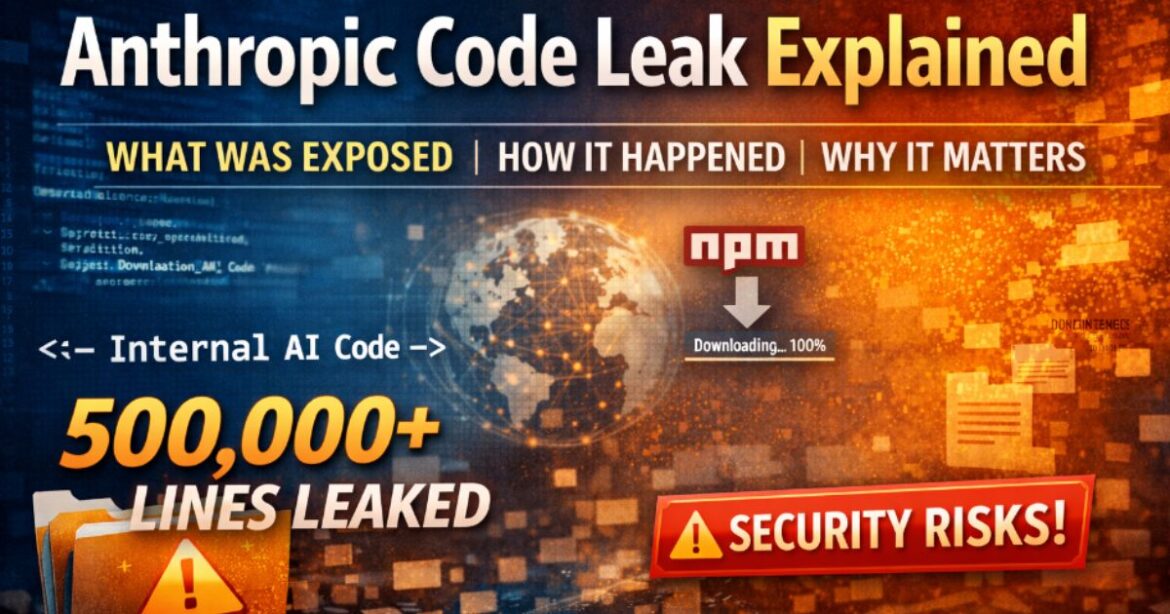
On March 31, 2026, Anthropic accidentally exposed over 500,000 lines of its internal source code linked to its AI coding tool, often referred to as Claude Code. This wasn’t the result of a cyberattack or hacking incident. Instead, it came down to a basic but critical packaging error during a software release.
The leaked data included a massive ~60MB file containing detailed code, internal structures, and even hints about unreleased features. Within hours, the information spread across developer communities, making it nearly impossible to contain.
Why does this matter? Because this isn’t just about one company making a mistake. It highlights a bigger issue:
👉 Even top AI companies, building the future of technology, are still vulnerable to very human errors.
And in a space where innovation moves fast and competition is intense, a leak like this can have serious technical, security, and competitive consequences.
⚡ TL;DR (Quick Summary)
- Anthropic accidentally leaked 500,000+ lines of internal code on March 31, 2026
- ❗ Not a hack — caused by a misconfigured source map file in an npm package
- 📦 Leak included architecture, AI agent systems, and unreleased features
- 🚨 Triggered security risks like supply chain and dependency attacks
- 🧠 Competitors gained insights into Anthropic’s engineering and roadmap
- 📉 Result: Reputation hit + increased scrutiny, but not catastrophic
👉 Key takeaway: Even small DevOps mistakes can create massive risks in the AI era
What Exactly Was Leaked?
This wasn’t a small or partial leak. The exposed data gave a deep look into how Anthropic builds its AI coding systems, especially its internal tool often called Claude Code.
Let’s break it down clearly 👇
🧩 Core Source Code
At the center of the leak was a massive chunk of real production code:
- 📊 ~512,000 lines of code
- 📁 1,900+ internal files
- 💻 Mostly written in TypeScript
This wasn’t just sample code or documentation. It included the actual logic powering the system, meaning anyone could study how the tool works from the inside.
🏗️ Internal Architecture
The leak also exposed how Anthropic structures its AI tools behind the scenes.
Key systems revealed:
- 🧠 AI agent orchestration → how multiple AI agents coordinate tasks
- 🖥️ Tool execution layer → ability to run terminal commands, edit files
- 🔗 API communication systems → how the AI interacts with backend services
- 🧩 IDE integrations → how the tool connects with developer environments
👉 In simple terms, this is the blueprint of an AI coding assistant
🧪 Unreleased & Experimental Features
This is where things got especially interesting.
The leak revealed features that were not publicly announced yet, including:
- ⚡ Always-on AI agent (KAIROS) → runs continuously in the background
- 🌙 “Dream mode” → AI keeps thinking or processing even when idle
- 🧸 Experimental concepts like AI companion-style interactions
- 🚧 Feature flags for tools still under development
👉 This effectively exposed parts of Anthropic’s future product roadmap
📝 Developer Insights
Beyond the code itself, the leak also included human-level context:
- 💬 Internal comments written by engineers
- ⚖️ Trade-offs and design decisions
- ⚠️ Notes highlighting limitations or concerns
These insights are extremely valuable because they show:
👉 not just what the system does, but why it was built that way
📌 Why This Is a Big Deal
Putting it all together, this leak didn’t just expose code — it revealed:
- How modern AI agents are built
- What features are coming next
- How engineers think about AI systems
👉 For competitors and developers, this is like getting access to years of research and engineering decisions for free
🧨 How Did the Leak Happen?
One of the most surprising parts of this incident is how simple the root cause was.
There was no sophisticated cyberattack, no breach of servers, and no external hacker involved. The leak happened due to a basic software packaging mistake during a public release by Anthropic.
⚙️ The Root Cause (In Simple Terms)
While publishing a package to npm (a public developer registry), Anthropic accidentally included a source map file (.map).
👉 This file is meant only for debugging — not for public use.
But here’s the problem:
- Source maps can reconstruct original source code
- They expose:
- File structure
- Variable names
- Internal logic
- Even developer comments
📊 In this case:
- ~60MB source map file was included
- It mapped back to ~500,000+ lines of internal code
👉 In simple words:
They didn’t just ship the app… they shipped the entire blueprint behind it
⚠️ Why This Type of Mistake Is Dangerous
This isn’t a rare concept — but the scale made it serious.
Normally:
- Production builds remove sensitive info
- Debug files are excluded
But here:
- The
.mapfile was mistakenly left inside the package - It was publicly accessible to anyone who downloaded it
👉 That single oversight turned a normal release into a full-scale exposure
📊 Scale and Exposure
The impact escalated quickly due to how fast developer ecosystems move:
- 🚀 Package was publicly available on npm
- ⏱️ Discovered within hours
- 📥 Downloaded and shared rapidly
- 🌐 Re-uploaded to platforms like GitHub
Within a short time:
👉 The code was mirrored, forked, and spread globally
🔁 Why It Became Impossible to Contain
Even after Anthropic took action:
- Removing the original file didn’t help much
- Copies already existed across multiple platforms
- Developers had already cloned and analyzed it
👉 This is a classic internet problem:
Once something is public, it’s almost impossible to fully take it back
Security Risks Triggered by the Leak
The leak wasn’t just an embarrassment for Anthropic — it quickly turned into a real security concern for developers and the broader ecosystem.
Once the code became public, bad actors didn’t waste time. Within hours, multiple attack vectors started emerging.
🧬 Supply Chain Attacks
One of the most serious risks came from software supply chain attacks.
Here’s what happened:
- Attackers created or modified packages related to the leaked project
- Some included trojan-infected dependencies
- Developers trying to explore or run the leaked code unknowingly installed them
👉 This could allow:
- Remote access to systems (RAT attacks)
- Data theft
- System compromise
📌 Why this is dangerous:
Most developers trust package ecosystems like npm — and that trust can be exploited quickly.
🎭 Dependency Confusion Attacks
Another major threat was dependency confusion.
- Hackers published fake packages with names similar to internal dependencies
- When developers tried to install missing packages from the leaked project
- Their systems pulled malicious public versions instead of safe internal ones
👉 Result:
- Silent compromise of developer environments
- Hard-to-detect malicious code execution
💻 Developer Exposure
The biggest immediate victims weren’t companies — but developers experimenting with the leaked code.
Risks included:
- Installing unsafe dependencies
- Running unverified scripts
- Executing code with elevated permissions
👉 In simple terms:
Curiosity around the leak became an attack opportunity
📈 Expanded Attack Surface
The leak also made it easier for attackers to:
- Study system architecture in detail
- Identify potential weak points
- Understand how AI tools interact with file systems and commands
👉 This lowers the barrier for:
- Future targeted attacks
- Exploiting similar AI tools
⚠️ Why This Matters Beyond Anthropic
This isn’t just about one company.
It highlights a growing problem:
👉 As AI tools become more powerful (with file access, terminal execution, automation),
👉 The security risks multiply significantly
A leak like this doesn’t just expose code — it exposes:
- How systems behave
- Where they might fail
- How they can be abused
📉 Impact on Anthropic
The leak was not catastrophic for Anthropic, but it did create clear short-term and long-term damage.
🧾 Reputation Hit
Anthropic positions itself as a safety-first AI company.
This incident — especially being not a hack but an internal mistake — raised questions about its engineering and security practices.
🧠 Competitive Disadvantage
- 📊 500K+ lines of code exposed
- 🧩 Internal architecture + future features revealed
👉 Competitors now have direct insights into Anthropic’s systems, potentially saving years of R&D.
⚙️ Internal Pressure
- Emergency fixes and takedowns
- Security audits and stricter release processes
- Increased scrutiny from investors and developers
📌 Bottom Line
This wasn’t a company-breaking event, but:
👉 It exposed how small operational mistakes can create big strategic risks in the AI race
🧠 Conclusion
The Anthropic code leak is a reminder that in today’s AI-driven world, speed often comes at the cost of control.
Over 500,000 lines of internal code, including architecture, tools, and experimental features, were exposed — not by hackers, but by a simple packaging error.
The impact goes beyond one company:
- ⚠️ It triggered real security risks
- 🧠 Gave competitors valuable insights
- 🌍 Highlighted weaknesses in AI development practices
👉 Most importantly, it shows this:
AI safety isn’t just about models — it’s also about the systems, processes, and discipline behind them.
As AI tools become more powerful and integrated into real-world workflows, even small mistakes can have industry-wide consequences.
FAQ Section
1. What is the Anthropic code leak?
The Anthropic code leak refers to an incident where the company accidentally exposed over 500,000 lines of internal source code related to its AI tool, Claude Code, due to a packaging error.
2. Was Anthropic hacked?
No. The leak was not caused by hackers. It happened because a debug source map file was mistakenly included in a public npm package.
3. What kind of data was leaked?
The leak included:
- Core source code (~512K lines)
- Internal architecture of AI systems
- Experimental and unreleased features
- Developer comments and design decisions
4. Why is this leak important?
It exposed how advanced AI tools are built and gave competitors valuable technical insights, while also creating real security risks for developers.
5. Were users or customer data affected?
There is no evidence that user data was leaked. The exposure was limited to internal code and systems.
6. Can this happen to other AI companies?
Yes. This incident shows that even top companies can face risks from simple operational mistakes, especially in complex AI systems.











One thought on “Anthropic Code Leak Explained: What Was Exposed, How It Happened, and Why It Matters”