Just two weeks after the debut of Claude Opus 4.6, Anthropic has released Claude Sonnet 4.6, an upgrade that fundamentally shifts the “intelligence-per-dollar” equation. While the Sonnet line has traditionally been the mid-tier “balanced” model, version 4.6 is consistently outperforming previous “Opus-class” models, making it the new default powerhouse for both free and paid users.
Here is everything you need to know about the latest release.
1. Frontier Reasoning at a “Workhorse” Price
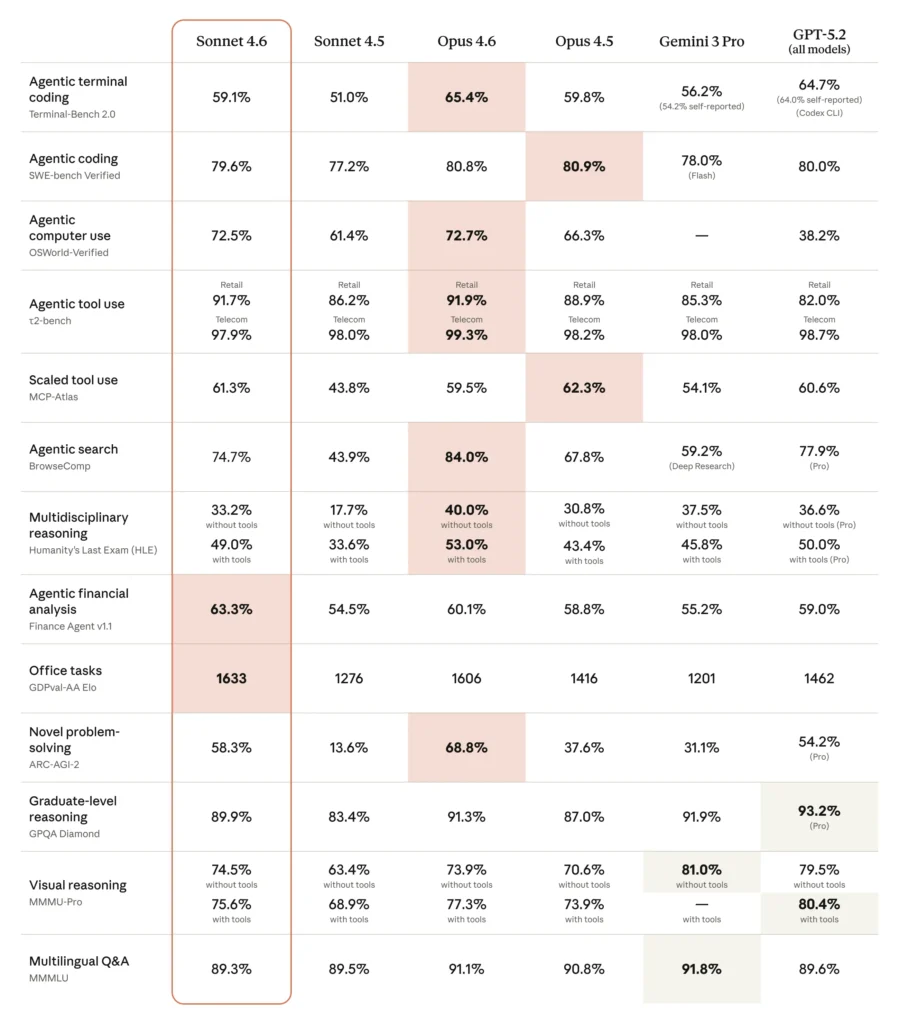
The most striking takeaway from the launch is that Sonnet 4.6 is now rivaling the smartest models on the market. In many internal benchmarks and early developer tests, Sonnet 4.6 outperformed Claude Opus 4.5 (released in late 2025).
Anthropic is positioning this as a “full upgrade” across:
-
Coding: Developers with early access report a marked preference for 4.6, noting its ability to reason through complex, multi-file codebases and follow instructions with much higher consistency.
-
Computer Use: This release marks a significant jump in “Computer Use” capabilities. It can now navigate complex spreadsheets and multi-step web forms with near-human reliability.
-
Agent Planning: The model shows a “pivoting” strategy in long-horizon tasks—investing in capacity early and focusing on profitability toward the end of a simulation—beating competitors in agentic benchmarks like Vending-Bench.
2. The 1 Million Token Context Window
In a major technical leap, Sonnet 4.6 now features a 1 million token context window (currently in beta for API users).
-
What this means: You can now drop entire codebases, dozens of research papers, or massive legal contracts into a single prompt.
-
Why it matters: Unlike previous large-context models that “lost the thread” in the middle, Sonnet 4.6 is designed to reason effectively across the entire million tokens, enabling better long-term planning and synthesis.
3. New Features: “Context Compaction” and Tools
Alongside the model, Anthropic introduced several quality-of-life updates for the Claude ecosystem:
-
Context Compaction: A new beta feature that automatically summarizes older parts of a conversation as it nears the context limit. This allows for much longer-running tasks without hitting “memory” walls.
-
Web Search & Fetch Improvements: Claude’s search tools now automatically write and execute code to filter results, meaning you get the most relevant information without wasting tokens on “fluff.”
-
Enhanced Free Tier: Free users now get Sonnet 4.6 as their default model, along with access to features previously reserved for Pro users, like file creation and skills.
4. Benchmarks at a Glance
Sonnet 4.6 is setting high bars across standard AI evaluations:
-
SWE-bench Verified: 79.6% (Approaching Opus 4.6 levels)
-
GPQA Diamond: 89.9%
-
MMMLU: 89.3%
-
OSWorld (Computer Use): 94% on insurance-specific benchmarks, the highest score recorded for a Claude model.
5. Availability and Pricing
Anthropic is sticking to its accessible pricing model, keeping the cost the same as Sonnet 4.5:
-
API Pricing: $3 per million input tokens / $15 per million output tokens.
-
Claude.ai: Now the default model for Free, Pro, and Team plans.
-
Cloud Platforms: Available immediately on Amazon Bedrock, Google Cloud’s Vertex AI, and Microsoft Foundry.
The Verdict
With the release of Sonnet 4.6, the gap between “fast” models and “smart” models has virtually disappeared. For developers and enterprises, this means the ability to run “Opus-level” workflows at a fraction of the cost and latency. If you haven’t switched your API keys or checked your Claude.ai chat lately, now is the time to start testing the new frontier.
Related Posts