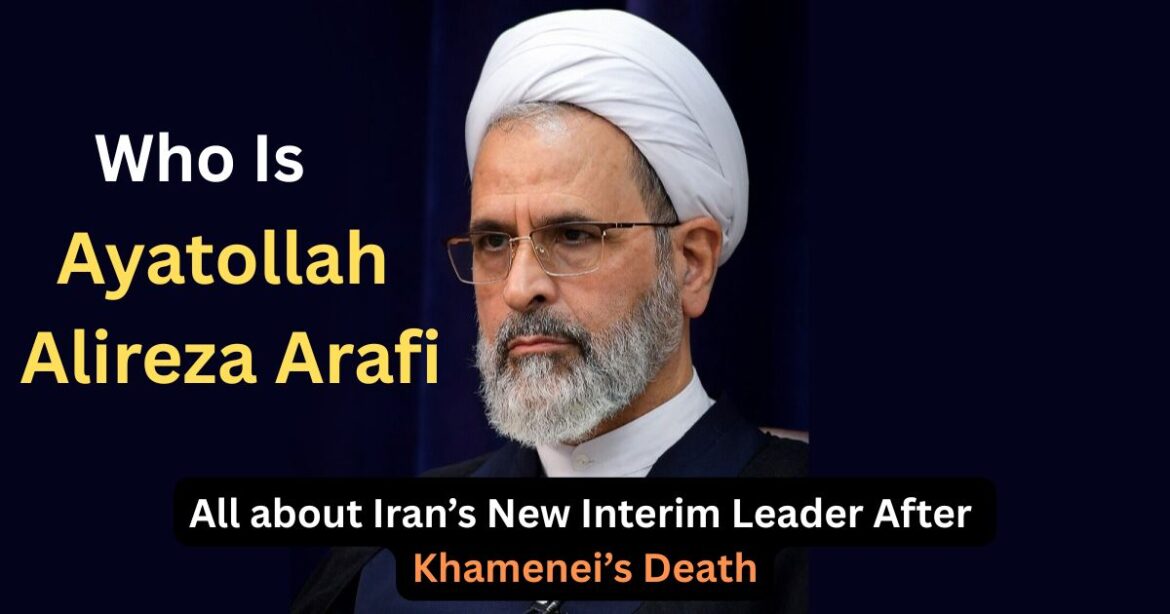
After the reported killing of Ayatollah Ali Khamenei in a joint U.S.–Israeli airstrike on Tehran, Iran has moved quickly to ensure continuity in its political and religious leadership. Iranian state media and official agencies say that Ayatollah Alireza Arafi has been appointed as part of the country’s interim leadership arrangement under the nation’s constitution.
Under Article 111 of Iran’s Constitution, when the supreme leader dies, a temporary governing body called the Interim Leadership Council takes over supreme leader duties until a permanent successor is chosen by the Assembly of Experts. This council currently includes:
- Ayatollah Alireza Arafi as the jurist representative,
- President Masoud Pezeshkian, and
- Chief Justice Gholamhossein Mohseni Ejei.
Who Is Ayatollah Alireza Arafi?
Ayatollah Alireza Arafi, born in 1959 in Meybod, Yazd Province, is a senior Iranian cleric with deep roots in the country’s religious and political hierarchy. He has been:
- A member of the Guardian Council since 2019, the constitutional body that vets election candidates and reviews legislation.
- A member of the Assembly of Experts since 2022, the clerical body responsible for choosing the Supreme Leader.
- Head of Iran’s Islamic seminary network since 2016.
- Former president of the Al-Mustafa International University, a leading institution for Shiite religious education.
- Imam for the Friday Prayer in Qom, Iran’s religious capital.
Arafi has also been described by analysts as fluent in Arabic and English and known for blending religious authority with administrative experience. This combination made him a fitting choice as the cleric representative on the interim council, especially at a time when maintaining institutional stability is crucial.
Relationship With Khamenei
Arafi has long been part of the elite clerical circle associated with Khamenei’s leadership. He was appointed to major positions, including the Guardian Council and seminary leadership, under Khamenei’s supervision — indicating trust and integration within the system. While not believed to be a direct personal protege, his rise shows continuity between the old leadership and the new interim authority.
Who Could Become the Next Permanent Supreme Leader?
Under Iran’s constitution, a permanent successor must be chosen by the Assembly of Experts, an assembly of 88 senior Shiite clerics. This process typically takes up to three months, although state media has hinted it could happen much sooner.
🔎 Possible Candidates
Experts and regional analysts have discussed several possibilities:
-
Ayatollah Alireza Arafi — now a key figure in the interim council and a senior cleric with broad support among traditionalist clergy.
-
Mojtaba Khamenei — son of the late leader, who has been seen as a potential successor for years. However, concerns about hereditary succession could make this controversial.
-
Other senior clerics — various grand ayatollahs and Guardian Council members could emerge as compromise candidates if factions seek a religious authority figure with widespread legitimacy.
🛠 How It Works
The Assembly of Experts vets and selects the next Supreme Leader behind closed doors. While foreign analysts often speculate publicly, the actual process stays internal and heavily influenced by Iran’s religious establishment — including factions aligned with the Islamic Revolutionary Guard Corps.
In the meantime, the interim Leadership Council continues to exercise supreme authority, serving as a temporary measure while Iran navigates both external conflict and internal transition.
Related Posts
 Israel’s Airstrike on Iran’s Evin Prison: A Symbolic Blow in an Escalating Conflict
 The U.S. Bombing of Iran in 2025: What’s Going On and Why It Matters
 Strait of Hormuz Explained: What It Is, Why It’s Important & the Current Crisis
 Iran’s Supreme Leader Ayatollah Ali Khamenei Killed in Major U.S.-Israeli Airstrikes