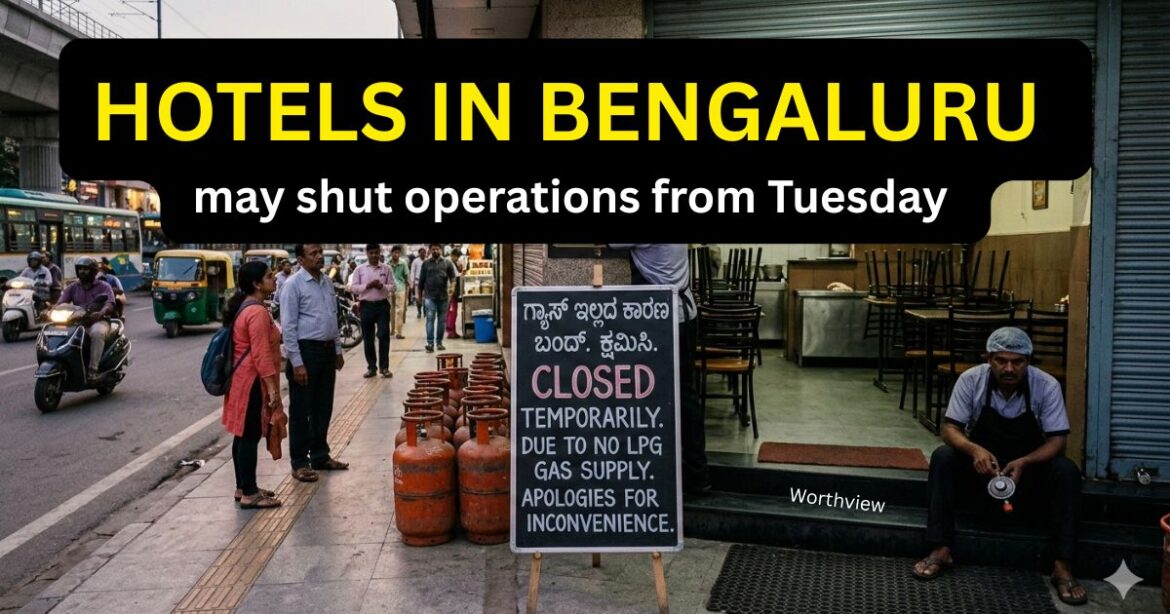
Over 3,000 restaurants face closure from March 10 — office workers, students, senior citizens, and hospital patients likely to be left without affordable meals
Thousands of hotels and restaurants across Bengaluru could go dark as early as tomorrow morning after oil companies abruptly stopped delivering commercial LPG cylinders — with zero prior notice.
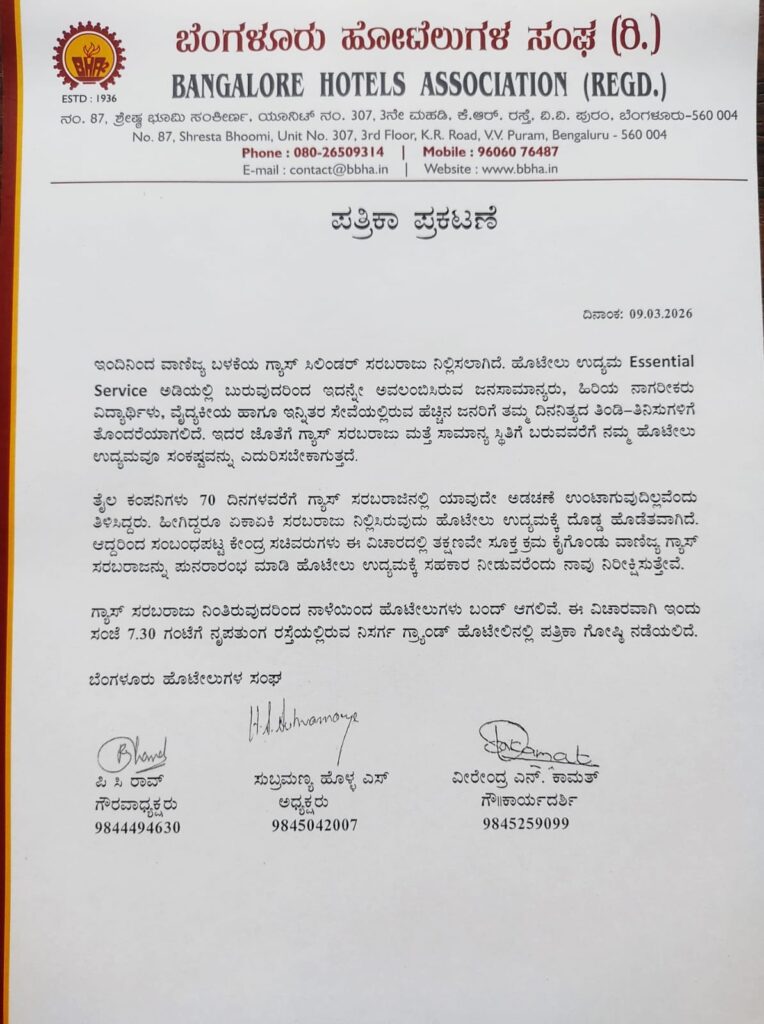
The Bangalore Hotels Association, which represents over 3,000 eateries and restaurants in the city, issued a press statement on Monday warning that kitchens across Bengaluru could shut down from Tuesday, March 10, unless the government steps in immediately.
The crisis has a direct link to the US-Iran war. About 60% of India’s LPG is imported from Persian Gulf nations, mostly Saudi Arabia and Qatar. Since the US and Israel launched strikes on Iran on February 28, Iran has effectively closed the Strait of Hormuz — the world’s most important energy shipping lane. With Indian LPG imports severely disrupted, oil companies have run out of commercial stock to supply.
Quick Facts
- 3,000+ restaurants and eateries represented by the Bangalore Hotels Association.
- 60% of India’s LPG is imported — mostly through the now-disrupted Strait of Hormuz.
- 70 days of uninterrupted supply were promised by oil companies. The supply stopped within days.
- March 10 is the date from which kitchens are expected to begin shutting down.
- 19-kg cylinders are the commercial standard used by restaurant kitchens across India.
What Happened — And Why It Happened Suddenly
Hotel owners across the city woke up Monday to a shock: their regular 19-kg commercial LPG cylinder deliveries simply did not arrive. No explanation. No prior notice. Just silence from oil companies.
What makes this worse is that oil companies had explicitly promised there would be no supply disruption for at least 70 days. Hotels and restaurants had planned their businesses on that assurance. The sudden reversal has left owners with no time to prepare.
“Oil companies had assured us that there would be no disruption in gas supply for at least 70 days. The sudden stoppage is a devastating blow to the hotel industry. Since the hotel industry is classified as an Essential Service, the common people, senior citizens, students, and those dependent on affordable daily meals will be the first to suffer.”
— Bangalore Hotels Association, press statement, March 9, 2026
How Long Before Kitchens Go Cold?
Most restaurants in the city still have some LPG left in their current cylinders. But according to the association’s president, that remaining stock is expected to last only until Tuesday evening, March 10.
“Hotels are not planning to shut immediately, but the situation could change quickly if fresh cylinders are not delivered.”
— Association President, speaking to India TV
Not every restaurant will close at the same time. As individual cylinders run out one by one, kitchens will go cold one after another across the city — unless the government acts fast.
Who Will Be Hit the Hardest?
Bengaluru is a city where eating out is not a luxury — it is a daily necessity for millions. A shutdown of commercial kitchens will directly hurt:
- Office workers and IT employees who depend on small hotels and darshinis for affordable breakfast and lunch every working day.
- Students and college hostels that rely on nearby eateries for their daily meals.
- Senior citizens who are unable to cook for themselves and depend on nearby restaurants.
- Hospital patients and their families staying near medical facilities who need cooked food nearby.
- Daily wage workers for whom hotel meals are the cheapest and most practical food option.
- Banquet and event bookings that have already been confirmed and paid for by customers.
Is This Only a Bengaluru Problem?
No. The LPG crisis is spreading fast across South India and beyond.
The Chennai Hotels Association has written directly to Prime Minister Narendra Modi requesting urgent intervention, warning that the food industry operates round-the-clock and supplies hospitals, IT parks, college hostels, train passengers, and business travellers.
In Kerala, the Hotels and Restaurants Association reported that a large number of establishments have already exhausted their LPG stocks and are rationing what little they have left. At the Indian Oil Corporation’s bottling plant at Chelari in Malappuram, commercial LPG cylinder refilling was halted entirely — meaning even gas agencies with orders cannot get refills.
In Pune, gas crematoriums have also been temporarily shut due to the same LPG shortage — a sign of how wide the crisis is spreading.
What the Government Has Said
As per news articles, the Government has clarified that there is no ban on supply of commercial LPG cylinders for the restaurant industry. However, the ground situation is different, with suppliers expressing inability to supply the same.
This is severely impacting the…
— NRAI (@NRAI_India) March 9, 2026
The National Restaurant Association of India (NRAI) posted on X (formerly Twitter):
“As per news articles, the Government has clarified that there is no ban on supply of commercial LPG cylinders for the restaurant industry. However, the ground situation is different, with suppliers expressing inability to supply the same. This is severely impacting the restaurant industry and in turn supply of food as an essential service for citizens. We request urgent clarification / intervention.”
— NRAI (@NRAI_India), March 9, 2026
The government has directed domestic refineries to boost LPG production and prioritize household cooking gas consumers to prevent domestic supply from running out. To curb hoarding, the booking gap for domestic LPG cylinders has been increased from 21 days to 25 days.
Indian Oil Corporation (IOC) stated that supply is normal — but distributors on the ground are telling a different story, saying they simply have no commercial stock left to deliver.
Why India Is Especially Vulnerable
India imports roughly 60% of its LPG — mostly propane and butane — from Saudi Arabia and Qatar. Both countries export their gas through tankers that travel through the Strait of Hormuz.
Since Iran effectively closed the strait on March 1, those tankers have stopped moving. India’s oil marketing companies — Indian Oil Corporation (IOC) and Bharat Petroleum (BPCL) — together handle about 40% of India’s LPG demand through domestic production. But that is not enough to replace what is no longer arriving by sea.
The government is now trying to reroute LPG imports from the United States, where it is produced as natural gas liquids from shale gas. But US supplies take longer to arrive, and the volumes are not yet enough to fill the gap.
What the Association Is Demanding
The Bangalore Hotels Association has made two clear demands:
- Immediate resumption of commercial LPG cylinder supply by oil companies, with intervention from Union ministers.
- Financial support for hotel businesses if the disruption continues for an extended period — to help owners survive the loss of revenue from forced closures.
A press conference has been called for Monday evening at 7:30 PM at Nagar Grand Hotel, where association leaders will address the media and outline next steps.
Related Posts