Today is our hero Bhagat Singh (28 September 1907 – 23 March 1931) birthday. He is considered to be one of the most influential revolutionaries of the Indian independence movement.
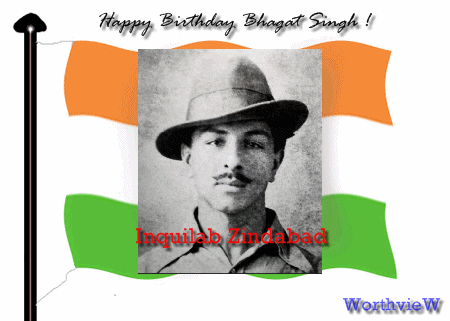
Here are some of the famous quotes by Bhagat Singh:
- The aim of life is no more to control the mind, but to develop it harmoniously; not to achieve salvation here after, but to make the best use of it here below; and not to realise truth, beauty and good only in contemplation, but also in the actual experience of daily life; social progress depends not upon the ennoblement of the few but on the enrichment of democracy; universal brotherhood can be achieved only when there is an equality of opportunity – of opportunity in the social, political and individual life.— from Bhagat Singh’s prison diary, p. 124”
— Bhagat Singh, The Jail Notebook And Other Writings
- Lovers, Lunatics and poets are made of same stuff.”
— Bhagat Singh
- Life is lived its own..others help is needed in funerals only
— Bhagat Singh, Why I Am An Atheist: An Autobiographical Discourse
- Every tiny molecule of Ash is in motion with my heat
I am such a Lunatic that I am free even in Jail – Jail Note Book of Shahid Bhagat Singh (1929)
- One should not interpret the word “Revolution” in its literal sense. Various meanings and significances are attributed to this word, according to the interests of those who use or misuse it. For the established agencies of exploitation it conjures up a feeling of blood stained horror. To the revolutionaries it is a sacred phrase.
- Letter published in The Tribune (25 December 1929)
- Revolution did not necessarily involve sanguinary strife. It was not a cult of bomb and pistol. They may sometimes be mere means for its achievement. No doubt they play a prominent part in some movements, but they do not — for that very reason — become one and the same thing. A rebellion is not a revolution. It may ultimately lead to that end.
The sense in which the word Revolution is used in that phrase, is the spirit, the longing for a change for the better. The people generally get accustomed to the established order of things and begin to tremble at the very idea of a change. It is this lethargical spirit that needs be replaced by the revolutionary spirit. Otherwise degeneration gains the upper hand and the whole humanity is led stray by the reactionary forces. Such a state of affairs leads to stagnation and paralysis in human progress. The spirit of Revolution should always permeate the soul of humanity, so that the reactionary forces may not accumulate to check its eternal onward march. Old order should change, always and ever, yielding place to new, so that one “good” order may not corrupt the world. It is in this sense that we raise the shout “Long Live Revolution.”- Letter published in The Tribune (25 December 1929), with some reference to lines from Idylls of the King by Alfred Tennyson
- Any man who stands for progress has to criticize, disbelieve and challenge every item of the old faith. Item by item he has to reason out every nook and corner of the prevailing faith. If after considerable reasoning one is led to believe in any theory or philosophy, his faith is welcomed. His reasoning can be mistaken, wrong, misled and sometimes fallacious. But he is liable to correction because reason is the guiding star of his life. But mere faith and blind faith is dangerous: it dulls the brain, and makes a man reactionary.
- Why I am an atheist? (1930)
- By “Revolution”, we mean the ultimate establishment of an order of society which may not be threatened by such breakdown, and in which the sovereignty of the proletariat should be recognized and a world federation should redeem humanity from the bondage of capitalism and misery of imperial wars.
- As quoted in Bhagat Singh and His Ideology (1981) by Shiri Ram Bakshi
- I emphasize that I am full of ambition and hope and of full charm of life. But I can renounce all at the time of need, and that is the real sacrifice.These things can never be hinderance in the way of man, provided he be a man. You will have the practical proof in the near future.
- Selected writings of Shaheed Bhagat Singh (1986), p. 65
- If the deaf are to hear, the sound has to be very loud.When we dropped the bomb, it was not our intention to kill anybody. We have bombed the British Government. The British must quit India and make her free.
- As quoted in Awakening Indians to India (2008), p. 82
- Non-violence is backed by the theory of soul-force in which suffering is courted in the hope of ultimately winning over the opponent. But what happens when such an attempt fail to achieve the object? It is here that soul-force has to be combined with physical force so as not to remain at the mercy of tyrannical and ruthless enemy.
- As quoted in The Sikh Review, Vol. 55 (2007), p. 173
FAQs about Bhagat Singh
1. Who was Bhagat Singh?
Bhagat Singh was a revolutionary freedom fighter who played a crucial role in India’s struggle for independence against British rule. He is known for his fearless patriotism, intellect, and sacrifice for the nation.
2. When and where was Bhagat Singh born?
Bhagat Singh was born on September 28, 1907, in Banga, Punjab (now in Pakistan).
3. What were Bhagat Singh’s major contributions to India’s freedom struggle?
Bhagat Singh was involved in several revolutionary activities, including the protest against the Simon Commission, the killing of British officer J.P. Saunders in retaliation for Lala Lajpat Rai’s death, and throwing harmless bombs in the Central Legislative Assembly to make the British hear India’s voice.
4. What were Bhagat Singh’s famous quotes?
Some of his most famous quotes include:
-
“Inquilab Zindabad!” (Long live the revolution!)
-
“Bombs and pistols do not make a revolution. The sword of revolution is sharpened on the whetting stone of ideas.”
-
“It is easy to kill individuals, but you cannot kill ideas.”
5. Why did Bhagat Singh kill J.P. Saunders?
Bhagat Singh, along with Rajguru and Sukhdev, killed J.P. Saunders to avenge the death of Lala Lajpat Rai, who was brutally lathi-charged by the police under the orders of James A. Scott.
6. How old was Bhagat Singh when he was hanged?
Bhagat Singh was only 23 years old when he was executed by the British on March 23, 1931.
7. Who were Bhagat Singh’s close associates in the freedom struggle?
Bhagat Singh worked closely with other revolutionaries like Chandrasekhar Azad, Rajguru, Sukhdev, Batukeshwar Dutt, and Shivaram Hari Rajguru.
8. Why did Bhagat Singh refuse to plead for mercy?
Bhagat Singh believed in the power of sacrifice and wanted to set an example for future generations. He refused to beg for mercy from the British, choosing instead to embrace martyrdom for the country’s freedom.
9. What was Bhagat Singh’s ideology?
Bhagat Singh was deeply influenced by socialism and believed in an independent India where all people had equal rights and opportunities, free from both British rule and internal oppression.
10. How is Bhagat Singh remembered today?
Bhagat Singh is remembered as a martyr and national hero. His legacy lives on in books, movies, and political discussions. March 23, the day of his execution, is observed as Shaheed Diwas (Martyrs’ Day) in India.




Hi there! I’m Sethu, your go-to guy for all things tech, travel, internet, movies, and business tips. I love sharing insights and stories that make life more interesting. Let’s explore the world together, one article at a time!






Ok
Salute to the great revolutionary leader bhagat singh
Not good
Nice collection….!!