After months of speculation, OpenAI has officially released GPT-5, a major milestone in the evolution of large language models. This comes shortly after the company made headlines by releasing a suite of open-weight models, signaling a new era of transparency and accessibility in AI development.
Building upon GPT-4, GPT-4.5, and the o-series (like o1 and o3), GPT-5 is not just a scaled-up version—it’s a significant architectural and functional leap.
Unlike its predecessors, GPT-5 fuses multi-modal intelligence, persistent memory, agentic behavior, and advanced reasoning—marking a major step toward Artificial General Intelligence (AGI), even if we’re not quite there yet.
Starting Thursday, GPT-5 will be available to all free users of ChatGPT as their default model.
What Is GPT‑5?
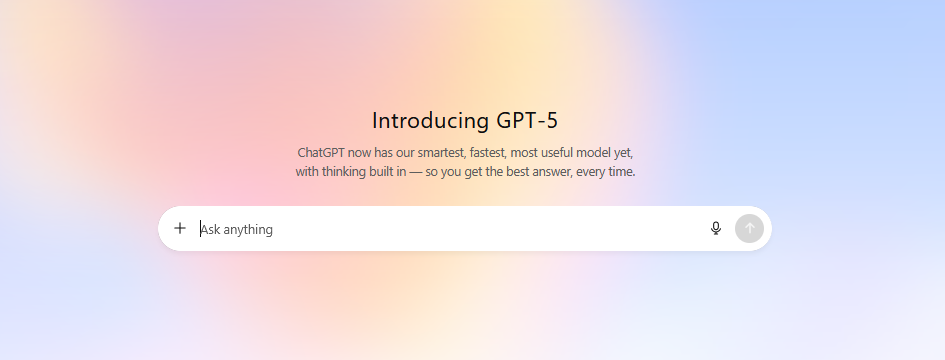
GPT‑5 is OpenAI’s most advanced language model yet, combining strengths from both the GPT-series (like GPT‑4.5) and the reasoning-focused o-series (e.g., o1, o3) into a single, unified system
“Generally intelligent,” but not AGI: Sam Altman described it as a significant step toward artificial general intelligence (AGI), though it still lacks some AGI traits—most notably, continuous learning.
🧠 Architecture: What Makes GPT-5 Different?
🔸 Hybrid Model Design
GPT-5 integrates the “GPT-n” line’s fluency with the “o-series” logic and planning capabilities, forming a hybrid architecture designed to:
- Process longer and more diverse contexts
- Support tool use (code execution, API calls, agents)
- Enable persistent and dynamic memory
🔸 Context Window: Up to 1 Million Tokens
While GPT-4-turbo had a 128K context limit, GPT-5 pushes the boundary further:
- Base model: 256K tokens
- Extended version (enterprise and research): Up to 1 million tokens
This allows for entire books, codebases, and long-term chats to be processed in a single prompt without truncation.
🛠️ Key Features of GPT-5
1. Chain-of-Thought Reasoning (Default Mode)
- GPT-5 natively engages in step-by-step thinking, making it more accurate in multi-hop logic, math problems, and structured decision-making.
- In internal benchmarks, it outperformed GPT-4 and Claude 3 Opus on nearly all reasoning tasks.
2. Persistent Memory
- GPT-5 remembers users’ preferences, past interactions, and context across sessions (with user permission).
- This allows for more personalized and contextually aware conversations.
3. Multimodal Input Support
- GPT-5 processes and understands:
- Text
- Images
- Audio
- Video
- Use cases now span from code generation to video summarization, voice-based command interfaces, and real-time image analysis.
4. Agentic Capabilities
- GPT-5 can perform autonomous, multi-step tasks, such as:
- Scheduling a meeting by connecting with your calendar
- Running scripts via tools like Python, Bash, or SQL
- Writing, debugging, and deploying microservices
It performs “tool chaining” natively—calling APIs, fetching URLs, or even querying databases when needed.
5. Reduced Hallucination
- OpenAI claims hallucination rates dropped by over 35% compared to GPT-4-turbo.
- It now verifies facts, cites sources, and flags uncertainty in real time.
📦 Variants: One Model, Many Flavors
OpenAI introduced four GPT-5 variants to meet different needs:
| Variant | Designed For |
|---|---|
| GPT-5 | General-purpose, enterprise-level workloads |
| GPT-5-Mini | Lightweight deployments, mobile apps |
| GPT-5-Nano | Edge devices, embedded systems |
| GPT-5-Chat | Chat-first interface, optimized for conversation |
These are accessible via ChatGPT, OpenAI API, and Azure AI Foundry, with GitHub Copilot and Microsoft 365 integrations already live.
💲 Pricing & Access
💼 ChatGPT Platform
- Free users now use a compressed GPT-5-Mini
- Plus users ($20/month) get access to standard GPT-5
- Pro users ($200/month) unlock:
- GPT-5-Pro
- “Thinking Mode” for agentic tasks
- Custom personalities and toolsets
💰 API Pricing (per 1M tokens):
| Model | Input Cost | Output Cost |
|---|---|---|
| GPT-5 | $1.25 | $10.00 |
| GPT-5-Mini | $0.25 | $2.00 |
| GPT-5-Nano | $0.05 | $0.40 |
⚙️ Developer & Enterprise Features
✅ Integration with:
- Microsoft 365 Copilot
- GitHub Copilot (VS Code, Chat, Mobile)
- Google Calendar & Gmail
- Custom Tools in ChatGPT (Python, Browser, DALL·E, Code Interpreter)
👷 AI Agents for Automation
GPT-5’s new “agent runtime layer” enables persistent background agents that:
- Monitor files
- Execute scheduled tasks
- Interact with APIs or databases
- Automate DevOps pipelines
This makes it ideal for building AI coworkers or RPA (Robotic Process Automation) flows.
📉 Performance Benchmarks
| Task Type | GPT-4-Turbo | GPT-5 | Δ Accuracy |
|---|---|---|---|
| Math (GSM8K) | 92% | 97.4% | +5.4% |
| Code Generation | 88% | 94.2% | +6.2% |
| Multi-hop QA (HotpotQA) | 83% | 91.1% | +8.1% |
| Medical QA (MedQA) | 84.5% | 90.9% | +6.4% |
| Factual Recall | 87.2% | 94.3% | +7.1% |
Benchmarks from OpenAI’s internal evaluations and external audits (2025)
🌍 Implications: What GPT‑5 Means for the Future
- Coding: Developers can now write, debug, and deploy apps with minimal input. Entire workflows can be agent-managed.
- Enterprise: CRM, support, reporting, and data handling are now automatable at scale.
- Research & Education: Long-context reading comprehension, summarization, and tutoring at PhD levels are viable.
- Healthcare: More accurate, explainable responses in diagnostics and medical Q&A.
- AGI? While GPT-5 isn’t AGI, it’s arguably AGI-ready in sandboxed environments, depending on how it’s used.
🧩 Final Thoughts
GPT‑5 marks the beginning of a new era of interaction between humans and machines—an era where memory, reasoning, multi-modality, and autonomy converge. For developers, researchers, and technologists, GPT-5 isn’t just a better chatbot—it’s a platform for building intelligent systems.
It’s not perfect. It still hallucinates, and it’s not sentient. But it’s undeniably closer to being an AI you can rely on.
📢 Want to build with GPT-5?