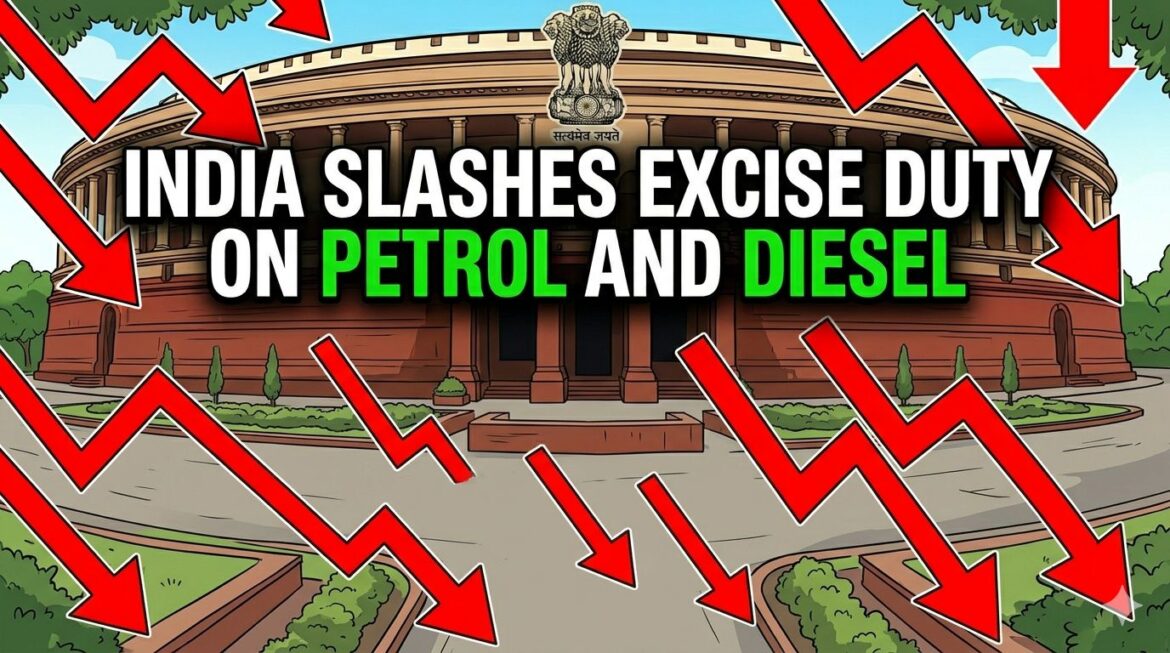
On the night of March 26, 2026, the Finance Ministry issued a Gazette notification that changed India’s fuel tax structure with immediate effect. The move was quiet — no press conference, no prime time announcement. But the implications are massive.
Here is everything you need to know, in plain language.
What Exactly Changed?
The government cut the Special Additional Excise Duty (SAED) on petrol and diesel — the central government’s tax component on fuel sold within India.
| Fuel | Old Duty | New Duty | Reduction |
| Petrol | ₹13 per litre | ₹3 per litre | ₹10 per litre |
| Diesel | ₹10 per litre | Zero | ₹10 per litre |
Both cuts are effective immediately. No phase-in. No conditions. The Finance Ministry Gazette notification is live.
Alongside the duty cuts, the government also imposed steep export taxes to prevent domestic fuel from being shipped abroad while India needs it:
- Diesel exports: New tax of Rs 21.5 per litre
- Aviation Turbine Fuel (ATF) exports: New tax of Rs 29.5 per litre
- PSU exports to Nepal, Bhutan, Bangladesh, and Sri Lanka remain exempt
Why Did the Government Do This Now?
The trigger is the West Asia conflict. Since the US and Israel launched strikes on Iran on February 28, 2026, crude oil prices have surged by nearly 50 per cent — from around $70 a barrel to a peak of $119, before settling near $100-106 as of today.
India’s oil marketing companies (OMCs) — IOCL, BPCL, and HPCL — have been selling petrol and diesel at frozen retail prices while their raw material costs (crude oil) have exploded. The math was brutal: according to ICRA, OMCs were losing Rs 11 per litre on petrol and Rs 14 per litre on diesel at $100-105 crude. Combined, OMCs were absorbing roughly Rs 48.8 per litre on every litre sold. Their daily under-recovery was running at approximately Rs 2,400 crore.
The excise duty cut shifts a portion of that burden back onto the government — giving OMCs breathing room to keep supply running without raising pump prices.
Will Petrol and Diesel Get Cheaper for You?
Short answer: Probably not immediately.
In Delhi, petrol is still retailing at Rs 94.77 per litre and diesel at Rs 87.67 — unchanged from before the announcement. The duty cut is not being passed on as a price reduction at the pump. Instead, it is being used to offset OMC losses so they can keep supply stable.
Think of it this way: the government is not giving you a discount. It is covering part of the losses that would otherwise force pump prices to rise sharply. Without this cut, petrol prices might have needed to go up by Rs 24 per litre and diesel by Rs 30 per litre to reflect real costs. The duty cut prevents that spike from hitting you.
There is an important nuance on total excise paid. Even after the SAED cut, consumers still pay other central duties and cess:
- On petrol: Basic excise (Rs 1.40) + SAED (Rs 3) + Agriculture cess (Rs 2.50) + Road cess (Rs 5) = roughly Rs 11.90 per litre total central levy
- On diesel: Basic excise (Rs 1.80) + Agriculture cess (Rs 4) + Road cess (Rs 2) = roughly Rs 7.80 per litre total central levy
State VAT — which varies from 20-30% across states — is additional and has not changed.
What About Private Petrol Pumps?
Not everyone is playing by the same rules. Nayara Energy — which operates 6,967 petrol pumps out of India’s total 1 lakh-plus outlets — has already raised petrol by Rs 5 per litre and diesel by Rs 3 per litre, citing higher input costs.
Jio-bp, a joint venture between Reliance Industries and BP, has so far held its prices despite reported losses. State-run OMCs (IOCL, BPCL, HPCL), which control about 90% of the domestic market, are keeping prices frozen as per government instructions.
Bottom line: if you are filling up at a Nayara pump, you are already paying more. At an Indian Oil, BPCL, or HPCL pump, prices are unchanged for now.
What Is This Costing the Government?
A lot. Analysts estimate the annualised fiscal impact at Rs 1.55 to 1.75 lakh crore — that is the revenue the government is foregoing by collecting less excise. The excise cut is expected to offset about 30 to 40 per cent of OMC losses at current crude prices.
The government has said the fiscal hit will be reviewed fortnightly, meaning they will adjust the duty structure based on how crude prices move. If oil eases, the equation improves. If prices surge again, more action may be needed.
Bond markets have already reacted: the 10-year government bond yield rose 7 basis points to 6.95%, its highest in 20 months, as investors priced in higher borrowing to fund the revenue shortfall.
Quick Snapshot
| What | Detail |
| Petrol SAED | Cut from Rs 13 to Rs 3 per litre |
| Diesel SAED | Cut from Rs 10 to zero |
| Effective from | March 27, 2026 — immediate |
| Retail pump prices | Unchanged in Delhi (Petrol Rs 94.77, Diesel Rs 87.67) |
| Who benefits immediately | OMCs (IOCL, BPCL, HPCL) — not consumers directly |
| Diesel export tax | Rs 21.5 per litre (new) |
| ATF export tax | Rs 29.5 per litre (new) |
| Estimated fiscal cost | Rs 1.55 to 1.75 lakh crore annually |
| Nayara Energy | Already raised petrol +Rs 5, diesel +Rs 3 |
| OMC instructions | Do not increase prices — per government |
The Bottom Line
This is not a tax cut that puts money in your pocket today. It is the government absorbing a global oil shock on your behalf — preventing a Rs 24-30 per litre pump price explosion that would have hit every household, every trucker, every auto-rickshaw driver in India.
It is a fiscally expensive decision. It will widen the deficit. But the alternative — letting OMCs collapse under losses or letting fuel prices spike — would have been far more damaging for inflation, for the economy, and for ordinary Indians.
Watch this space: if crude prices stay elevated or rise further, either pump prices will have to move up eventually, or the government will need to find more fiscal room to keep absorbing the shock.
Related Posts
 Iran Missiles Strike World’s Largest LNG Plant in Qatar — What It Means for India
 🇮🇳 What India Must Learn from the Middle East Crisis: Energy Security Lessons
 What If Oil Really Hits $200 a Barrel? Here’s What It Means for India and the World
 Energy Lockdown ⚡Explained: Why the World Is Talking About It Right Now