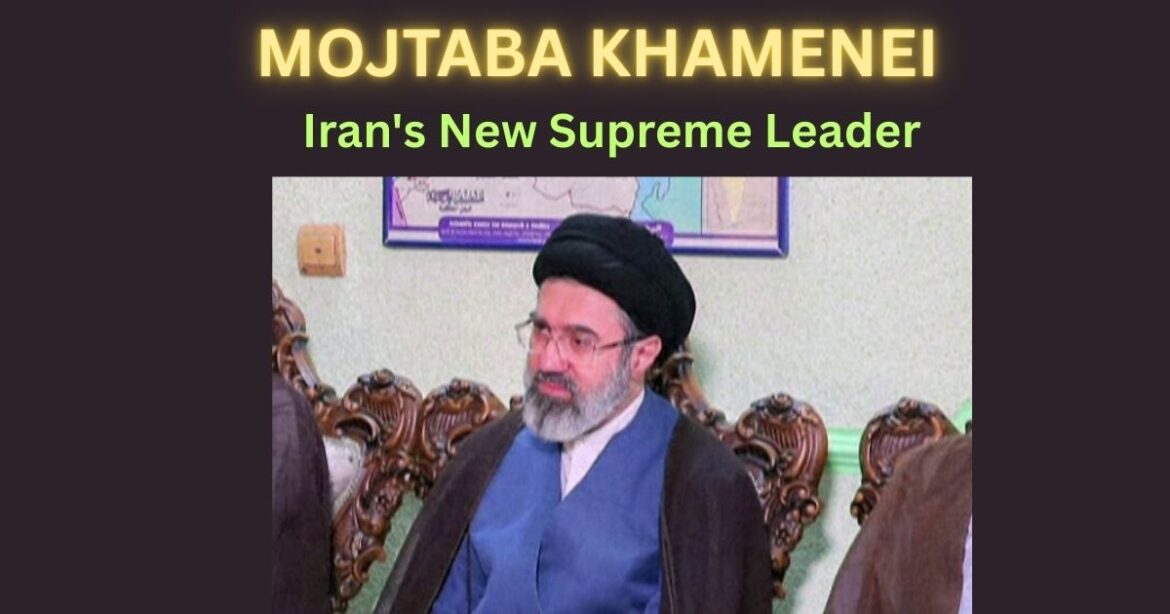
The 56-year-old hardline cleric and son of the assassinated Ayatollah Ali Khamenei has been declared Iran’s third Supreme Leader amid an active war with the United States and Israel — a move that signals defiance, dynastic continuity, and deeper conflict ahead.
On Sunday, March 8, 2026 — just over a week after his father was killed in joint U.S.-Israeli strikes — Iran’s Assembly of Experts formally declared Mojtaba Khamenei as the Islamic Republic’s third Supreme Leader. The announcement came just past midnight Tehran time, with the 88-member clerical body issuing a statement that read:
‘By a decisive vote, the Assembly of Experts appointed Ayatollah Seyyed Mojtaba Hosseini Khamenei as the third Leader of the sacred system of the Islamic Republic of Iran.’
Iran’s powerful Islamic Revolutionary Guard Corps (IRGC) was among the first to pledge allegiance, declaring full obedience and readiness to carry out his commands. Iran’s President Masoud Pezeshkian also hailed the selection as a reflection of national unity and resilience.
The selection was anything but smooth. The process was turbulent, marked by significant internal disagreements, reported IRGC pressure on Assembly members, and an extraordinary online vote held in war conditions. The Assembly of Experts office in Qom was reportedly bombed by U.S. and Israeli forces even as votes were being cast, though the count was reportedly completed before the strike.
Key Facts at a Glance
Full Name: Mojtaba Hosseini Khamenei
Age: 56 (born 1969)
Title: Third Supreme Leader of the Islamic Republic of Iran
Father: Ayatollah Ali Khamenei (assassinated February 28, 2026)
Clerical Rank: Hojatoleslam (mid-level; not ayatollah)
Education: Seminaries of Qom; trained under Ayatollah Mesbah Yazdi
Military Service: IRGC Habib Battalion during the Iran-Iraq War (1980s)
Political Role: Shadow operator; architect of 2005 Ahmadinejad election
US Sanctions: Sanctioned by U.S. Treasury in 2019
Public Profile: Deliberately low — no public sermons, speeches, or interviews
Succession: Formally declared by Assembly of Experts on March 8, 2026
Who Is Mojtaba Khamenei?
Background and Early Life
Mojtaba Khamenei was born in 1969 as the second son of Ayatollah Ali Khamenei. His formative years were shaped by two seismic events: the 1979 Islamic Revolution that toppled the Pahlavi monarchy, and his father’s own ascent to power — first as Iran’s president in 1981, then as Supreme Leader in 1989.
Religious Education and Credentials
Mojtaba studied theology at the seminaries of Qom — the heartland of Shia Islamic scholarship. He was trained under the late Ayatollah Mohammad Taghi Mesbah Yazdi, one of the most hardline clerics in Iran’s post-revolutionary history, known for advocating the violent suppression of those deemed to promote ‘Western immorality.’
His clerical rank is hojatoleslam — a mid-level designation, not the higher rank of ayatollah. This has been a major point of contention. However, precedent exists: his own father was not an ayatollah when he became Supreme Leader in 1989, and Iran’s constitution was amended to accommodate him. A similar adjustment is expected for Mojtaba.
Military Roots: The Iran-Iraq War
Mojtaba Khamenei is not just a cleric — he is a product of Iran’s revolutionary military culture. He served in the Habib Battalion of the IRGC during multiple operations in the Iran-Iraq War of the 1980s. Many of his comrades from that era went on to hold senior positions in Iran’s security and intelligence apparatus, giving him deep institutional networks within the IRGC.
The Shadow Operator: His Role Before the Throne
For decades, Mojtaba Khamenei operated in the shadows of power — never holding public office, never giving Friday sermons, never making political speeches. Al Jazeera’s correspondent described him as ‘his father’s gatekeeper.’ Many Iranians have reportedly never even heard his voice, despite knowing for years that he was the rising star of the theocratic establishment.
His behind-the-scenes influence is believed to be vast. He is widely credited with engineering the controversial 2005 election that brought Mahmoud Ahmadinejad to the presidency. More damning — according to the Council on Foreign Relations — he reportedly personally supervised the IRGC’s brutal crackdown on the 2009 Green Movement protests, in which demonstrators flooded Iran’s streets to challenge a disputed election result.
For nearly two decades, local and diaspora opponents have linked his name to the violent suppression of Iranian protesters. His ties to ideologically extremist clerics at the forefront of the regime’s most repressive crackdowns are well-documented.
The Business Empire Behind the Veil
Mojtaba Khamenei is not simply a cleric or a political operative — he is, according to Bloomberg and other Western outlets, the manager of a vast financial empire. His name reportedly does not appear directly on any of the transactions, but he is alleged to have moved billions of dollars through a network of insiders and associates connected to the Iranian establishment.
Bloomberg specifically linked him to Ali Ansari, whose Bank Ayandeh was forcibly dissolved by the Iranian state after going bankrupt from handing out loans to unnamed insiders. Reports suggest Mojtaba holds luxury property investments across multiple countries, making him one of the wealthiest figures in Iran’s ruling structure.
In 2019, the U.S. Treasury placed him under sanctions, stating that he had worked to ‘advance his father’s destabilizing regional ambitions and oppressive domestic objectives.’ He has been under Western sanctions since.
The Dynastic Problem: A Revolution Against Dynasties, Now Led by One
The Islamic Revolution of 1979 was, at its core, a revolt against hereditary rule — specifically the U.S.-backed monarchy of Shah Mohammad Reza Pahlavi. The irony of Mojtaba’s succession is not lost on Iranians or political observers: the Islamic Republic has now effectively created its own dynasty.
Mojtaba himself reportedly never spoke publicly about succession — a deliberately sensitive subject. His own father, Ayatollah Ali Khamenei, was said to have opposed the idea of his son’s succession and never allowed it to be raised during his lifetime. An Assembly member confirmed that Ali Khamenei ‘was not pleased with the idea of his son’s leadership.’
Professor Valentine Moghadam of Northeastern University captured the public mood: ‘Most Iranians had been hoping for a transition to a system of governance not led by an Islamic cleric, but rather by a president and council of ministers, preceded, of course, by a referendum.’ Instead, they are getting a second Khamenei.
The War Context: Selected in the Middle of a Crisis
Mojtaba’s elevation did not occur in peacetime deliberation. It happened in the middle of an active war. On February 28, 2026, the United States and Israel launched joint strikes on Iran, killing Ayatollah Ali Khamenei along with Mojtaba’s mother, wife, and one of his sisters. Mojtaba himself was reportedly not present and survived the initial strikes.
Since then, U.S.-Israeli attacks have killed at least 1,332 Iranian civilians and wounded thousands, according to Iran’s UN ambassador. Seven American service members have also died from wounds sustained during Iran’s initial counter-attack. Iran’s parliament speaker has said Tehran is not seeking a ceasefire and plans to ‘punish aggressors.’
The selection itself was conducted under extreme pressure. IRGC commanders reportedly made repeated contacts with Assembly members to vote for Mojtaba. The first vote was held in an online session described by participants as having an ‘unnatural’ atmosphere — opponents were given limited time to speak, discussion was cut short, and a vote was rushed through.
Trump Disapproves. Israel Has Vowed to Target Him.
The international reaction has been sharp. U.S. President Donald Trump called Mojtaba a ‘lightweight’ and declared him ‘unacceptable,’ going so far as to claim he should be involved in approving Iran’s leadership selection — ‘I have to be involved in the appointment,’ Trump said. He warned that whoever is picked ‘is not going to last long’ without Washington’s approval.
The Israeli military issued a direct warning: any successor to Ali Khamenei would be considered a target. The IDF has already threatened to kill any declared replacement. On Sunday, as Mojtaba’s name was announced, the threat was reiterated.
Ironically, one Assembly member cited Trump’s hostility as the reason to select Mojtaba — arguing that a good leader should ‘be hated by the enemy’ rather than praised by it. ‘Even the Great Satan has mentioned his name,’ the cleric said.
What Kind of Supreme Leader Will He Be?
All available signals point in one direction: hardline. Analysts and journalists who have tracked Mojtaba for years describe him as more ideologically rigid than his father — deeply embedded with the most extreme elements within the IRGC and the clerical establishment.
Al Jazeera’s Ali Hashem put it bluntly: ‘He adopts the positions of his father with respect to the United States, with respect to Israel. So we are expecting a confrontational leader. We’re not expecting any moderation.’
His selection signals that the hardline factions within Iran’s establishment — particularly the IRGC — retain control even as the country is under sustained military attack. Washington Post analysis described his choice as sending ‘a strong message of defiance against President Donald Trump.’
That said, Hashem offered a cautious nuance: ‘If this war comes to an end and he is still alive, and he is able to continue running the country, there is going to be big potential’ — acknowledging that circumstances could shape the new Supreme Leader’s posture in unexpected ways.
The Bottom Line
Mojtaba Khamenei is now the most powerful figure in the Islamic Republic — a man shaped by war, trained by extremists, empowered by the IRGC, and despised by both Washington and significant segments of his own population. He inherits his father’s throne in the middle of the worst military crisis Iran has faced since the 1980s, with American and Israeli bombs still falling.
Whether he survives, consolidates power, or is targeted and killed as Israel and Trump have threatened, the declaration of Mojtaba Khamenei as Supreme Leader marks a pivotal, irreversible moment in the Islamic Republic’s history — a dynastic succession in a republic born by destroying a dynasty.
Related Posts
 “I Apologise”: Iran’s President Says Sorry to Neighbours — as Israel Sets Tehran’s Airport on Fire
 “We Will Never Surrender”: Iran Defies US Ultimatum as War Enters Eighth Day
 Which Countries Support Iran in the Current Conflict? Full Breakdown
 Ayatollah Alireza Arafi – Iran’s New Interim Leader After Khamenei’s Death