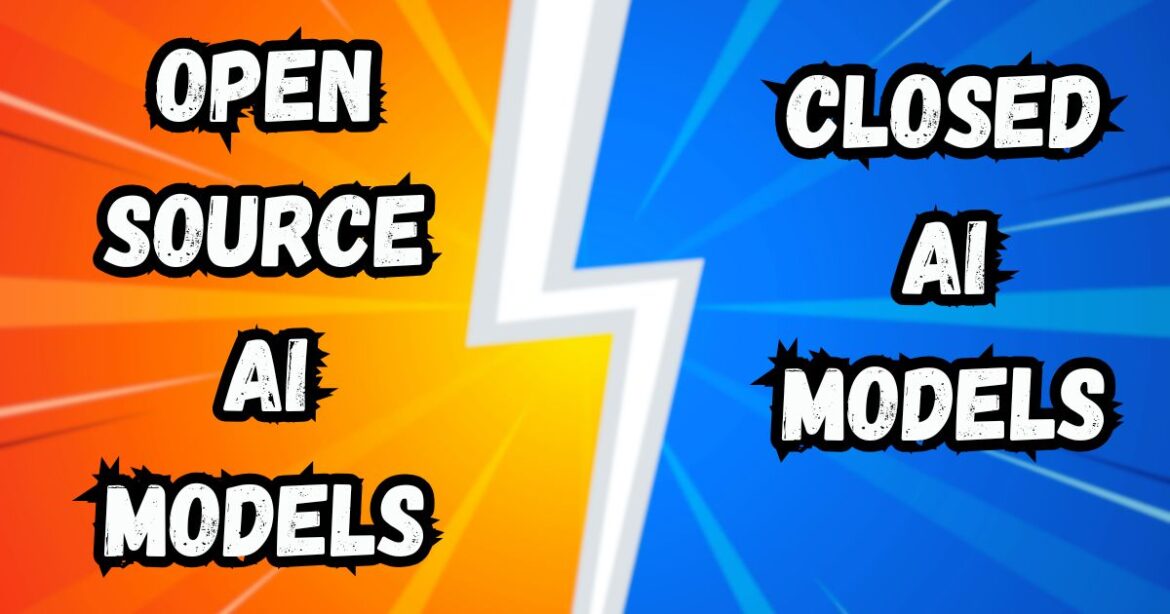
Open source AI models (like Meta’s LLaMA and Mistral) make their code and model weights freely available — anyone can download, run, and modify them. Closed AI models (like ChatGPT, Claude, and Gemini) keep their inner workings secret — you access them through a paid API or website but can never own or customise the model itself. Open source wins on cost, privacy, and flexibility. Closed AI wins on ease of use, raw performance at the frontier, and enterprise reliability.
A few years ago, the answer was simple: if you needed powerful AI, you paid OpenAI or Google. Open source alternatives existed but were clearly inferior — curiosities for researchers, not tools for real work.
That has changed dramatically. In 2026, open source AI models are closing the performance gap faster than almost anyone predicted. The Mistral + NVIDIA partnership announced at GTC 2026 is the latest sign that the open source AI ecosystem is maturing into a genuine force — one that could reshape how individuals, startups, and enterprises build AI-powered products.
This guide explains everything you need to know — in plain language — with a special focus on what this means for Indian readers, businesses, and developers.
Key Takeaways
- Open source AI lets you download and run the model yourself — free of charge, no usage fees.
- Closed AI (ChatGPT, Claude, Gemini) keeps the model secret — you rent access and pay per use.
- Open source models now deliver about 90% of closed model performance at up to 87% lower cost (MIT Sloan, 2026).
- The performance gap between open and closed models has narrowed from 17.5 percentage points in 2023 to near-zero on most knowledge benchmarks by early 2026.
- India’s Sarvam AI is a founding member of NVIDIA’s new open AI coalition — building AI specifically for Indian languages and needs.
- The right choice depends on your use case — this guide helps you decide.
What Is Open Source AI? Simple Explanation
To understand open source AI, start with an analogy.
Imagine a master chef creates a world-famous dish.
A closed-source chef guards the recipe — you can only eat the dish at their restaurant, paying their prices, on their terms.
An open source chef publishes the full recipe online — anyone can cook it at home, modify it, sell their own version, or teach it to others.
In AI, the ‘recipe’ is called model weights — the billions of numerical parameters that define how an AI model thinks and responds. When a company makes these weights publicly available for download, the model is called open source (or more precisely, open-weight).
Key point: Once you download an open source model, you own a copy permanently. No subscription, no API fees, no data sent to anyone else’s server.
Popular Open Source AI Models in 2026
| Model | Made By | Licence | Best Known For |
|---|---|---|---|
| LLaMA 3 / LLaMA 4 | Meta (Facebook) | Custom Open | General purpose, widely used |
| Mistral / Mixtral | Mistral AI (France) | Apache 2.0 | Efficiency, coding, European data |
| Gemma | Open | Lightweight, runs on laptops | |
| Qwen | Alibaba | Open | Multilingual, strong in Asian languages |
| DeepSeek R1 | DeepSeek (China) | MIT | Reasoning, matches GPT-4 class |
| Nemotron (upcoming) | NVIDIA + Mistral | Open | Frontier open model, 2026 |
What Is Closed AI? How ChatGPT, Claude, and Gemini Work
Closed AI models are developed and kept entirely private by the companies that build them. You cannot download the model, see its internal workings, or run it on your own servers.
Instead, you access it through:
- A website or app (e.g. chat.openai.com, claude.ai, gemini.google.com)
- An API — a connection that lets your software send questions and receive answers
- Integrated tools (e.g. Gemini inside Google Docs, Copilot inside Microsoft Office)
Every time you use these models, your query goes to their cloud servers, gets processed, and the answer comes back to you. The model itself never leaves their infrastructure.
Leading Closed AI Models in 2026
| Model | Company | Access | Known For |
|---|---|---|---|
| GPT-4o / GPT-5 | OpenAI | Paid API + ChatGPT | Versatile, strong reasoning |
| Claude Sonnet / Opus | Anthropic | Paid API + claude.ai | Long context, safety, coding |
| Gemini 1.5 / Ultra | Paid API + Workspace | Multimodal, Google integration | |
| Grok | xAI (Elon Musk) | X Premium | Real-time web data |
Common Misconceptions About Open Source AI
Misconception 1: ‘Open source AI is free, so it must be low quality’
This was true in 2022. It is not true in 2026. MIT Sloan research found that open models achieve about 90% of the performance of closed models at the time of release — and quickly close the remaining gap. DeepSeek R1, released under an MIT licence, matched OpenAI’s o1 on most benchmarks when it launched. The cost of training DeepSeek was around $5.6 million — compared to estimated hundreds of millions for GPT-5.
Misconception 2: ‘Open source means anyone can use it for anything’
Not always. Open source AI models come with different licenses. Some are fully permissive (MIT, Apache 2.0 — use for anything, including commercial products). Others have restrictions (Meta’s LLaMA license, for example, restricts use for companies above a certain scale). Always check the license before building a product.
Misconception 3: ‘Open source AI is unsafe or unfiltered’
Open source models go through extensive safety tuning before release — just like closed models. The difference is that a determined developer could, in theory, remove those safeguards on their own copy. Reputable open source models from Meta, Mistral, and Google are considered safe for standard use cases.
Misconception 4: ‘Closed AI is always more private’
This is actually backwards. With closed AI, your prompts are sent to and processed on someone else’s servers. With open source AI running locally, your data never leaves your own machine. For sensitive industries — healthcare, legal, finance — local open source deployment can be significantly more private than any cloud-based closed model.
Why This Debate Matters — Especially for India
The open vs closed AI debate is not just a technical discussion. It has real-world consequences for cost, privacy, language support, and who gets to participate in the AI economy.
Cost — The Dollar Problem
Most closed AI APIs are priced in US dollars. For Indian startups and developers, this creates a compounding cost challenge — especially as the rupee fluctuates. Open source models deployed on affordable cloud infrastructure (like AWS Mumbai, Azure India, or even a single rented GPU) can reduce AI inference costs by 70–90% compared to closed API pricing.
|
Language — AI That Actually Speaks Indian Languages
Major closed models are predominantly trained on English data. While they support Hindi and a few other Indian languages, performance in Tamil, Telugu, Kannada, Marathi, Bengali, and other regional languages remains inconsistent.
Open source models can be fine-tuned — retrained on Indian language datasets to dramatically improve performance. This is exactly what Sarvam AI (Bengaluru) has been doing: taking open base models and adapting them for multilingual, voice-first Indian contexts. Their inclusion as a founding member of NVIDIA’s Nemotron Coalition in 2026 signals that this approach is being taken seriously at the highest level of the global AI industry.
Data Sovereignty
When Indian companies send their customer data, internal documents, or proprietary information to OpenAI or Google’s servers for AI processing, that data leaves Indian jurisdiction. For banks, hospitals, government agencies, and legal firms — this is a compliance and security risk. Open source models deployed on Indian servers keep data within India’s borders, making regulatory compliance significantly easier.
Building Indian AI Products
If you’re an Indian founder, developer, or content creator thinking about building AI-powered tools — open source models are your most cost-effective foundation. Whether you’re building an AI-powered regional news aggregator, a GST invoice assistant, or a vernacular content tool, you can start with a capable open model without paying per-token to a US company on every user interaction.
Real World Examples — Who Is Using What and Why
Scenario 1: A Small Indian Startup Building a Customer Support Bot
Best choice: Open source (self-hosted or via Together.ai / Groq)
A 10-person SaaS startup in Pune cannot afford ₹5–10 per 1,000 tokens at scale. By deploying a fine-tuned Mistral or LLaMA model on a rented GPU, they get 80–90% of the quality at 10% of the cost — and their customer data stays on their server.
Scenario 2: A Healthcare Company Processing Patient Records
Best choice: Open source (on-premises deployment)
Patient data is among the most sensitive information in existence. A hospital cannot send patient queries to OpenAI’s servers. A locally deployed open source model processes everything in-house, meeting healthcare data regulations while still leveraging powerful AI.
Scenario 3: A Marketing Agency Doing Creative Work
Best choice: Closed AI (Claude or ChatGPT)
For a 5-person agency doing copywriting, creative briefs, and client presentations, ease of use and top-quality output matter more than data sovereignty or cost at scale. Claude or ChatGPT accessed through a browser requires zero technical setup and delivers excellent results immediately.
Scenario 4: A Developer Building a Multilingual App for Tier 2/3 India
Best choice: Fine-tuned open source model (Sarvam AI, Qwen, or LLaMA)
For an app serving users in Bhojpuri, Odia, or Assamese — no closed model currently handles these languages well. An open source model fine-tuned on regional language data is the only viable path to genuine language quality.
Head-to-Head Comparison: Open Source vs Closed AI
| Factor | Open Source AI | Closed AI (ChatGPT/Claude/Gemini) |
|---|---|---|
| Cost | Near zero per token (pay only for compute) | Several dollars per million tokens |
| Setup | Requires technical skill and infrastructure | Zero setup — use browser or API key |
| Performance | 90%+ of closed model quality for most tasks | Best frontier performance (for now) |
| Privacy | Data stays on your server | Data processed on provider’s cloud |
| Customisation | Full — fine-tune, modify, retrain | Very limited — prompt engineering only |
| Language Support | Can be fine-tuned for any language | Good English, inconsistent regional |
| Reliability/SLA | You manage uptime yourself | 99.9% SLA with enterprise contracts |
| Accountability | Community + developer responsibility | Company liable for failures |
| Licence | Varies — check per model | Standard commercial terms |
| Updates | Community-driven, irregular | Regular, managed by provider |
Pros and Cons
Open Source AI — Pros
- Cost: 70–90% cheaper than closed API pricing at scale
- Privacy: Full data sovereignty — your data stays with you
- Customization: Fine-tune on your own data for your specific use case
- No vendor lock-in: Switch models freely without changing your infrastructure
- Community: Massive global developer community improving models continuously
- Transparency: You can inspect model weights and understand behavior
Open Source AI — Cons
- Technical barrier: Requires MLOps expertise, GPU infrastructure, and ongoing maintenance
- No SLA: If the model fails or produces errors, you’re responsible for fixing it
- Frontier gap: Still trails closed models on the most complex reasoning and agentic tasks
- Security responsibility: You must implement safety guardrails yourself
Closed AI — Pros
- Instant access: Works out of the box, no setup required
- Top performance: Best-in-class for complex reasoning, coding, multimodal tasks
- Managed safety: Provider handles content filtering, safety tuning, updates
- Enterprise trust: SLAs, audit logs, legal accountability
- Ecosystem: Integrated with tools like Google Workspace, Microsoft Office, Salesforce
Closed AI — Cons
- Cost: Expensive at scale, especially when priced in USD for Indian users
- Privacy: Your data leaves your infrastructure
- Vendor lock-in: If pricing changes or the service shuts down, you’re affected
- Limited customisation: You cannot change the model’s core behaviour
- Opaque: You cannot inspect or audit how the model makes decisions
Which One Is Right For You?
| Your Situation | Recommended Choice | Why |
|---|---|---|
| Individual user, casual use | Closed AI (ChatGPT/Claude free tier) | Easiest, no setup, good free options |
| Content creator / marketer | Closed AI | Best quality output, fast workflow |
| Indian startup, cost-sensitive | Open Source (hosted via Groq/Together.ai) | Massive cost savings, decent quality |
| Developer building a product | Open Source (self-hosted) | Control, customisation, no per-token fees at scale |
| Healthcare / Legal / Finance | Open Source (on-premises) | Data sovereignty, regulatory compliance |
| Enterprise needing reliability | Closed AI (enterprise tier) | SLAs, support, accountability |
| Multilingual / Indian languages | Open Source (fine-tuned) | Only viable path to quality regional language AI |
| Researcher / AI developer | Both | Use closed for benchmarking, open for experimentation |
The Big Picture: Where Is This Heading?
|
The data tells a clear story: the performance gap between open and closed AI, which stood at 17.5 percentage points in 2023, is now effectively zero on most knowledge benchmarks and in single digits on reasoning tasks. Open source models are improving three times faster year-over-year than closed alternatives.
Meanwhile, the economics are staggering. MIT researchers calculated that optimal reallocation of AI spending from closed to open models could save the global AI economy approximately $25 billion annually.
Open source models cost users, on average, six times less than closed alternatives.
Closed model companies know this. Their response has been to invest heavily in capabilities that open source cannot easily replicate: deep product integrations (Gemini inside Google Workspace), enterprise sales and support infrastructure, and multimodal ecosystems (Sora for video, DALL-E for images, voice agents).
The likely future is not one winner — it is a layered market: closed frontier models for the highest-stakes, most complex tasks, and open source models powering the vast majority of everyday AI workloads, especially in cost-sensitive and privacy-sensitive applications.
Frequently Asked Questions
Is ChatGPT open source?
No. ChatGPT is powered by OpenAI’s GPT models, which are fully closed and proprietary. You can access ChatGPT through OpenAI’s website or API, but you cannot download or modify the model. OpenAI was originally founded with an open source mission but pivoted to a closed, commercial model.
Can I run an open source AI on my laptop?
Yes — with some limitations. Smaller open source models (7 billion parameters and below) can run on a standard laptop with a decent GPU or even on a MacBook with Apple Silicon chips. Tools like Ollama and LM Studio make this very accessible. For larger, more powerful models, you will need a GPU-equipped server or a cloud instance.
Is open source AI safe to use for business?
For most business use cases, yes. Models from reputable developers like Meta, Mistral, and Google have been through extensive safety tuning. The key additional responsibility is that your team handles the infrastructure — you’re accountable for uptime, security, and compliance. For heavily regulated industries, this is actually an advantage (data sovereignty), but it does require technical competence.
What is the difference between ‘open source’ and ‘open weight’ AI?
Strictly speaking, ‘open source’ means the model weights, training code, and training data are all publicly available. ‘Open weight’ means only the model weights are released — the training data and methodology may remain private. Most models described as ‘open source’ in everyday conversation are technically open weight. The practical difference for most users is small: you can still download, run, and fine-tune open weight models freely.
Will open source AI eventually replace closed AI?
Unlikely in the near term. The more probable outcome is a two-tier market: closed frontier models dominating the highest-stakes enterprise applications (where reliability, accountability, and cutting-edge performance justify the premium), while open source models power the majority of everyday AI deployments, especially in cost-sensitive markets, emerging economies, and applications requiring data privacy. The real competition is already forcing closed AI prices down dramatically — which benefits everyone.
Conclusion
The open source vs closed AI debate has moved well past theory. In 2026, open source models are production-ready for the vast majority of use cases, offering 70–90% cost savings and near-equivalent performance for most tasks.
For Indian readers specifically, open source AI represents something bigger than a technical choice — it is a path to building world-class AI products without the dollar-denominated cost burden, a route to genuine data sovereignty, and the foundation for multilingual AI that actually speaks the languages of 1.4 billion people.
Closed AI models retain important advantages — ease of use, top-tier frontier performance, enterprise reliability, and deep product integrations. For individuals and businesses without technical teams, they remain the most practical choice.
The smartest approach in 2026 is not to pick a side — it is to understand both well enough to choose the right tool for each job.
Related Posts