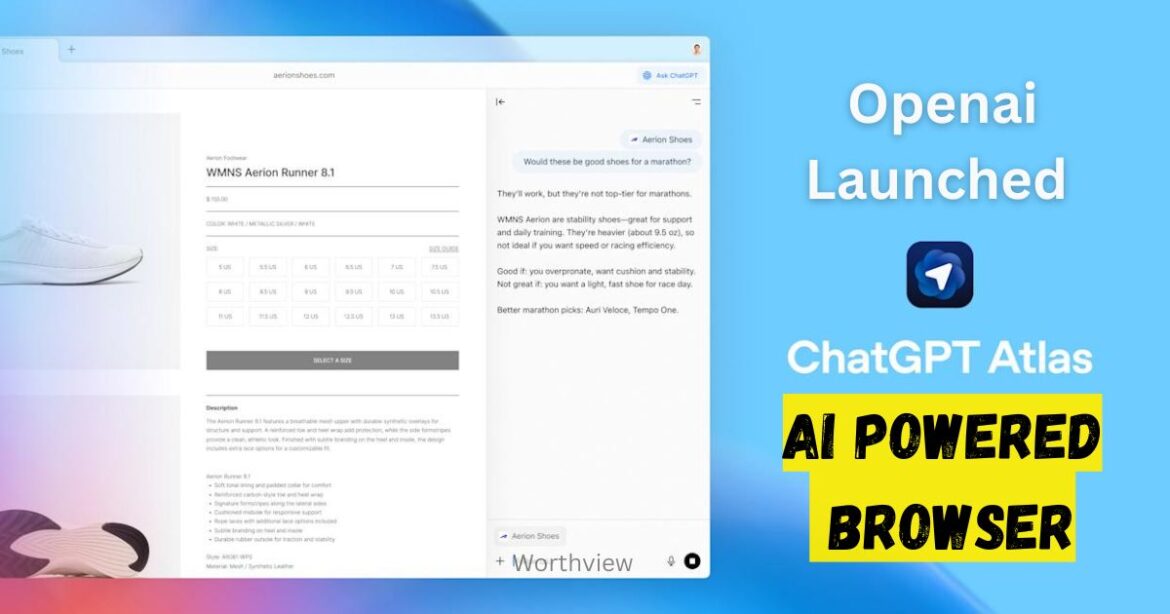
OpenAI has officially launched ChatGPT Atlas, a new web browser that blends traditional web browsing with AI-powered chat features. The browser is now available for macOS users worldwide, with Windows, iOS, and Android versions expected to roll out soon.
Atlas marks OpenAI’s most ambitious move yet — aiming to change how people use the internet by integrating its flagship chatbot, ChatGPT, directly into the browsing experience.
In short: ChatGPT Atlas could redefine how we use the web — where the browser not only shows you information but also helps you understand and act on it.
A Familiar Browser with Built-In AI
Built on the Chromium engine (the same technology that powers Google Chrome and Microsoft Edge), Atlas looks and functions like a standard browser — complete with tabs, bookmarks, and autofill options.
However, the major difference lies in the AI layer. Users can chat with ChatGPT alongside any webpage. For example, they can ask the chatbot to summarize an article, explain technical terms, or even compare information across sites — all without leaving the page.
Key Features
Chat interface built in: In any page you visit, you can ask the chatbot questions about what you’re seeing (summaries, explanations, comparisons).
“Agent Mode” (preview for paid users): The browser/AI can act “on your behalf” — e.g., filling out forms, planning, buying items, navigating sites automatically (with your permission).
Browser memory/context: Atlas can remember what you’ve been doing (sites visited, tabs open) so the chatbot can use that context to help you better. You have control over whether this is saved/used.
Familiar browser features maintained: Tabs, bookmarks, autofill for passwords etc. The idea is not to completely change the browser model, but to enhance it with AI.
The Agent Mode: Browsing with Assistance
One of the most talked-about features is “Agent Mode”, which is currently in preview for paid users. This allows the AI to take simple actions on the user’s behalf — such as filling forms, booking tickets, or shopping online — but only after getting explicit permission.
According to OpenAI, the feature aims to make browsing more efficient by letting users focus on decisions rather than repetitive tasks.
Privacy and Control
With great power comes great responsibility — and privacy concerns. Because Atlas can access browsing data to provide contextual answers, questions have been raised about data usage and storage.
OpenAI has stated that browser memory is optional, giving users full control over what is stored and when it’s deleted. The company says no personal data is shared without consent.
A Challenge to Google Chrome
Industry experts see Atlas as a direct challenge to Google Chrome, which has dominated the browser market for over a decade. If users spend more time in an AI-assisted browser, OpenAI could shift the way people search, read, and discover information online — potentially impacting traditional search engines and advertising models.
Tech analysts suggest this launch is part of OpenAI’s broader plan to move beyond chatbots and embed AI into daily tools, from work apps to browsers.
Early Reactions
Early testers have praised the clean interface and smooth integration of ChatGPT. However, some users noted that the “Agent Mode” still feels experimental, and not all web interactions are seamless.
Privacy advocates are also watching closely to see how OpenAI handles data transparency and user trust, given the browser’s deep access to online activity.
The Road Ahead
With Chrome, Safari, and Edge already dominating, OpenAI faces a steep challenge in convincing users to switch. But if Atlas delivers on its promise — simplifying browsing while adding powerful AI capabilities — it could become a serious competitor in the browser market.
For now, macOS users can download ChatGPT Atlas from OpenAI’s official website, while others wait for the next rollout.
Sources: