The Strait of Hormuz is a narrow waterway between Iran and Oman that connects the Persian Gulf to the open ocean. It is one of the world’s most important oil routes, with a large share of global oil and gas shipments passing through it daily. Tensions rise whenever conflict threatens this route because any disruption can quickly impact global energy prices and financial markets.
You’ve probably heard the name “Strait of Hormuz” in breaking news whenever tensions rise in the Middle East. But why does this narrow stretch of water matter so much to the global economy?
The answer is simple: energy. A major portion of the world’s oil and gas moves through this single route. If anything disrupts it, oil prices can spike within hours. In this article, we’ll explain what the Strait of Hormuz is, why it’s critical to global trade, and what the current crisis could mean for markets and countries like India.
What Is the Strait of Hormuz?
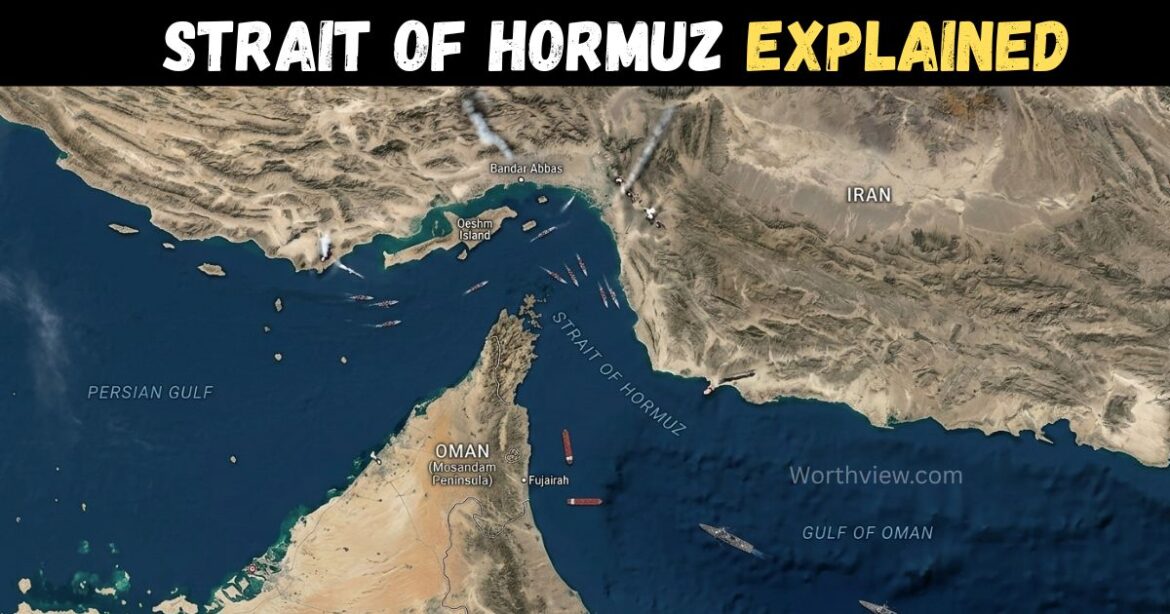
The Strait of Hormuz is a narrow shipping channel that connects the Persian Gulf to the Gulf of Oman and then to the open Indian Ocean.
At its narrowest point, the strait is only about 33 kilometers (21 miles) wide. However, the actual shipping lanes are even tighter — roughly 3 kilometers wide in each direction, separated by a buffer zone. That means a massive share of the world’s energy supply passes through a very small space.
It borders:
-
Iran to the north
-
Oman to the south
The strait is often called the world’s most important “oil chokepoint.” A chokepoint is a narrow passage where shipping traffic is concentrated. If it gets blocked, even briefly, global supply chains can be disrupted.
According to the U.S. Energy Information Administration (EIA), roughly 20% of the world’s total petroleum liquids consumption moves through the Strait of Hormuz daily. That’s about 17–20 million barrels per day in recent estimates.
In simple terms:
If this route slows down, the world feels it almost immediately.
Why Is the Strait of Hormuz So Important to the World?
The Strait of Hormuz is not just important — it is critical to global energy security.
According to the U.S. Energy Information Administration (EIA), around 17–20 million barrels of oil per day pass through this route. That equals roughly one-fifth of global oil consumption. No other chokepoint handles this much volume.
It’s not just crude oil. About 20–25% of the world’s liquefied natural gas (LNG) also flows through this strait. Major LNG exporter Qatar relies heavily on this passage.
Countries that depend on this route include:
- Saudi Arabia
- United Arab Emirates
- Kuwait
- Iraq
- Qatar
Large importers include:
- India
- China
- Japan
- European nations
For India alone, more than 60% of crude oil imports come from the Middle East — much of it passing through this strait.
When tensions rise here, oil markets react fast. Even rumors of disruption can push crude prices up by 3–10% in a single trading session. Insurance costs for oil tankers also increase immediately.
In simple terms:
If the Strait of Hormuz is threatened, fuel prices, inflation, stock markets, and shipping costs around the world can move within hours.
What Happens If the Strait of Hormuz Is Blocked?
If the Strait of Hormuz is blocked — even temporarily — the impact would be immediate and global.
Around 17–20 million barrels of oil per day move through this route. If shipments are disrupted, global supply drops overnight. Oil prices could spike sharply. In past tensions, crude prices have jumped 10% or more within days just on threat headlines.
A full closure could push oil well above normal trading ranges. Analysts often warn that prices could cross major psychological levels quickly, especially if the disruption lasts more than a few days.
Impact on Major Economies
- India: Imports over 80% of its oil needs. Higher oil means higher fuel prices and inflation.
- China: The world’s largest crude importer. Supply shock would affect manufacturing and exports.
- Japan and Europe: Highly dependent on Middle East energy flows.
Shipping insurance premiums would surge. Tanker companies may avoid the route entirely if military risk increases. That reduces available supply even further.
Military Consequences
The U.S. Navy’s United States Fifth Fleet patrols the region to ensure freedom of navigation. A blockade attempt would likely trigger a rapid military response from Western forces.
Historically, during the “Tanker War” phase of the Iran–Iraq War in the 1980s, attacks on oil vessels caused global alarm — but the strait was never fully closed.
A blockade would not just be a regional issue. It would be a global economic shock.
What Is the Current Crisis in 2026?
The Strait of Hormuz has escalated into a major flashpoint in early 2026 as tensions between Iran, United States, and Israel continue to rise following recent military strikes.
According to officials with the European Union’s naval mission Operation Aspides, multiple commercial vessels operating in the Gulf have received VHF radio transmissions stating that “no ship is allowed to pass the Strait of Hormuz.” These warnings are reported to come from Iran’s Islamic Revolutionary Guard Corps (IRGC), although Iran has not formally confirmed an official closure order.
Several major oil companies and tanker operators have reacted by suspending shipments through the strait, leading to vessels idling near ports such as Fujairah in the United Arab Emirates. The British Royal Navy has said Iran’s messages are not legally binding, but shipping firms and insurers are treating the risk seriously, adjusting routes and coverage accordingly.
Insurance costs for ships in the Gulf have already surged as war-risk premiums rise sharply, with some carriers facing up to 50% higher cover prices. Insurers are also issuing cancellation notices, which reflects deep concerns about safety and navigation in the region.
Even though the strait technically remains open, the combination of radio warnings, shipment suspensions, and insurance shifts has created a de facto slowdown that is disrupting global energy supply chains. Traders now see this area as unstable, and any further escalation could quickly push crude oil and LNG prices higher.
This tense situation shows how fragile global energy routes can be when geopolitical conflicts flare — even without an official statement from Tehran itself.
How This Affects India, Markets & the Global Economy
The tension around the Strait of Hormuz has immediate economic consequences — especially for energy-dependent countries.
Impact on India
India imports more than 80% of its crude oil needs, and a large share of that comes from the Middle East. Much of it passes through the Strait of Hormuz.
If shipments slow down:
- Oil prices rise
- Petrol and diesel prices increase
- Inflation pressures build
- The rupee can weaken
- Government subsidy burden increases
Even a $5–10 per barrel rise in crude can impact India’s trade deficit and fiscal balance.
Impact on Global Markets
Oil markets react first. When supply risk increases, Brent crude often spikes quickly. Higher oil prices mean:
- Rising transport costs
- Higher airline ticket prices
- Increased manufacturing expenses
- Food inflation due to logistics costs
Stock markets typically respond with volatility. Energy stocks may rise, while aviation, logistics, and consumer sectors often fall.
Impact on IT & Tech Sector
Higher oil prices increase global inflation. When inflation rises:
- Central banks delay rate cuts
- Interest rates stay higher
- Growth stocks (including IT companies) face pressure
That’s why geopolitical tension in the Middle East can indirectly affect tech-heavy stock markets in the U.S. and India.
In simple terms:
The Strait of Hormuz is thousands of kilometers away from most consumers — but its disruption can hit fuel prices, stock markets, and economic growth worldwide within days.
Conclusion
The Strait of Hormuz may look like just a narrow strip of water on a map — but it carries nearly one-fifth of the world’s oil supply every day.
That is why even radio warnings, military patrols, or shipping delays can shake global markets within hours.
Right now, the strait remains open. But rising tensions between Iran, United States, and Israel have increased the risk level. Insurance premiums are rising. Some shipments are slowing. Oil markets are reacting.
If the situation stabilizes, prices may cool down. If it escalates, the impact could be global — from fuel prices in India to stock markets in New York and London.
In today’s interconnected world, this narrow waterway is not just a regional issue. It is a global pressure point.
FAQ
1. Where is the Strait of Hormuz located?
The Strait of Hormuz lies between Iran (north) and Oman (south). It connects the Persian Gulf to the Gulf of Oman and then to the open Indian Ocean.
2️. How much oil passes through the Strait of Hormuz daily?
Around 17–20 million barrels of oil per day move through it. That equals roughly 20% of global oil consumption. It also carries about 20–25% of global LNG exports, making it the world’s most important energy chokepoint.
3️. Can Iran legally close the Strait of Hormuz?
The strait is considered an international waterway under maritime law. While Iran has repeatedly threatened to restrict passage, a full closure would likely trigger a strong international military response, particularly from the United States and allied naval forces.
4️. Has the Strait of Hormuz ever been closed before?
No. Even during the Iran–Iraq “Tanker War” in the 1980s, the strait was never fully closed. There were attacks on ships, but global shipping continued with naval protection.
5️. What would happen if the Strait of Hormuz is blocked?
Oil prices would likely spike sharply. Countries like India, China, and Japan would face supply disruptions. Global inflation would rise, and stock markets would become highly volatile.
6️. Why does the world react so quickly to news about this strait?
Because energy markets operate in real time. Even a rumor of disruption can push crude prices up within hours. Since fuel affects transport, food, manufacturing, and electricity costs, the economic impact spreads fast.
Related Posts
 Why Iran Is Under Attack: Operation Epic Fury and Israel’s Response Explained
 Israel’s Airstrike on Iran’s Evin Prison: A Symbolic Blow in an Escalating Conflict
 The U.S. Bombing of Iran in 2025: What’s Going On and Why It Matters
 Iran’s Supreme Leader Ayatollah Ali Khamenei Killed in Major U.S.-Israeli Airstrikes