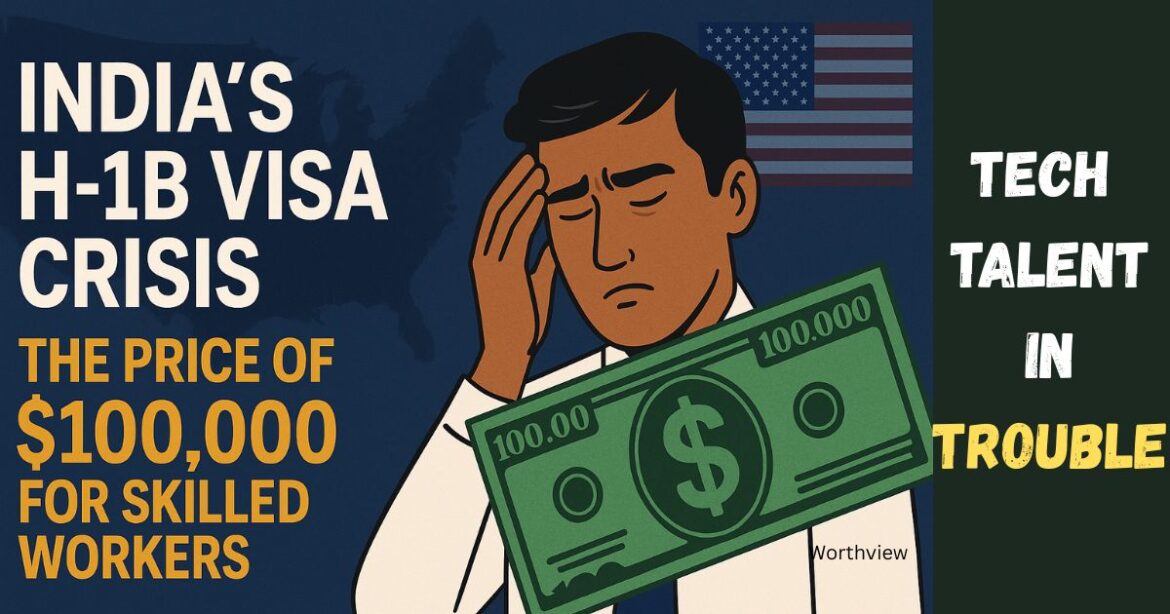
Starting September 21, 2025, the U.S. government has imposed a dramatic new $100,000 annual fee on employers applying for H-1B visas for foreign workers outside the United States. This unprecedented hike, signed into effect by former President Donald Trump, fundamentally changes the economics and accessibility of the H-1B visa program, which has long been relied upon by Indian professionals and U.S. tech firms.
What Has Changed?
The proclamation mandates that a $100,000 payment must accompany most new H-1B visa petitions filed by employers seeking to bring skilled foreign workers from abroad. Without this payment, visa applications will be denied. The rule currently does not affect visa extensions or status changes made inside the U.S. but creates significant travel risks for existing H-1B visa holders who plan to re-enter the country.
This fee applies for an initial period of 12 months and may be extended. It is coupled with plans by the Department of Labor to raise prevailing wage levels and prioritize hiring higher-paid workers through regulatory changes. The overall annual cap on H-1B visas remains unchanged at 65,000 plus 20,000 additional spots for U.S. advanced degree holders.
Impact on Indian Professionals
Indians constitute approximately 71% of all new H-1B visa approvals, primarily in computer-related and tech occupations. The new $100,000 fee poses a significant barrier for early-career and entry-level engineers, drastically reducing sponsorship opportunities. Many Indian IT services firms that frequently send junior and mid-level engineers to the U.S. are expected to shift more work offshore or focus on local Global Capability Centers.
Families of current visa holders face uncertainty amid complicated travel and visa renewal logistics, while employees worry about job mobility and long-term career prospects in the U.S. The steep cost incentivizes employers to seek only senior professionals or those in exempted sectors like healthcare and national security.
Previous Fee Structure
Before this change, overall H-1B visa petition costs were considerably lower, ranging roughly between $1,700 and $5,000 depending on employer size, fees such as filing charges, fraud prevention, and optional premium processing. Thus, the $100,000 fee represents a massive increase, likely to reduce the volume of applications and reshape the skilled migration landscape.
Corporate and Sectoral Effects
Big U.S. tech companies like Amazon, Microsoft, and Meta, heavy sponsors of H-1B workers, face increased costs, potentially leading to restrained hiring from abroad. While some exemptions may be possible for critical sectors, relief is discretionary and will require lobbying. Policy experts expect this will redistribute demand toward high-salary roles while making the pipeline for junior roles less accessible.
Conclusion
The new policy is a deliberate move to restrict entry-level foreign labor and encourage hiring of U.S. workers or only high-value, senior foreign talent. For Indian tech workers—the largest beneficiaries of the H-1B system—the restrictions introduce significant uncertainty and financial challenges in pursuing careers in the U.S. This change also signals a broader political and economic shift in American immigration and labor markets.
Frequently Asked Questions (FAQ)
Q: What is the new fee for H-1B visas starting September 21, 2025?
A: The new fee is $100,000 annually per H-1B visa petition filed for workers outside the U.S. by employers.
Q: Who has to pay this $100,000 fee?
A: U.S. employers filing new H-1B visa petitions for foreign workers outside the United States must pay the fee.
Q: Does the fee apply to extensions or current H-1B visa holders inside the U.S.?
A: No, the fee currently applies only to new petitions filed abroad, not extensions or status changes within the U.S.
Q: Why has this new fee been introduced?
A: The fee aims to discourage overuse of the program for entry-level roles, protect U.S. workers, and prioritize highly skilled and well-paid foreign employees.
Q: How does this affect Indian professionals?
A: Since Indians receive about 71% of H-1B visas, the fee significantly impacts Indian tech workers, especially juniors, reducing U.S. job opportunities.
Q: What were the previous H-1B visa fees?
A: Before, fees ranged from about $1,700 to $5,000, including filing, fraud prevention, and optional premium processing fees.
Q: Are there any exemptions to the new fee?
A: Exceptions may be granted at the discretion of immigration authorities, especially for national interest or specific sectors, but details are limited.
Q: How long will the new fee rule be in effect?
A: The initial proclamation applies for 12 months starting September 21, 2025, but it could be extended.
Q: What should current or prospective H-1B applicants do?
A: Consult immigration attorneys, and if outside the U.S., try to file or travel before the fee takes effect to avoid complications.
Q: How are U.S. companies reacting to this fee?
A: Major tech employers are concerned about increased costs, with some advising visa holders to return to the U.S. urgently before the fee begins.










One thought on “Tech Talent in Trouble: How the $100,000 H-1B Fee Hits Indian Workers Hard”
Comments are closed.