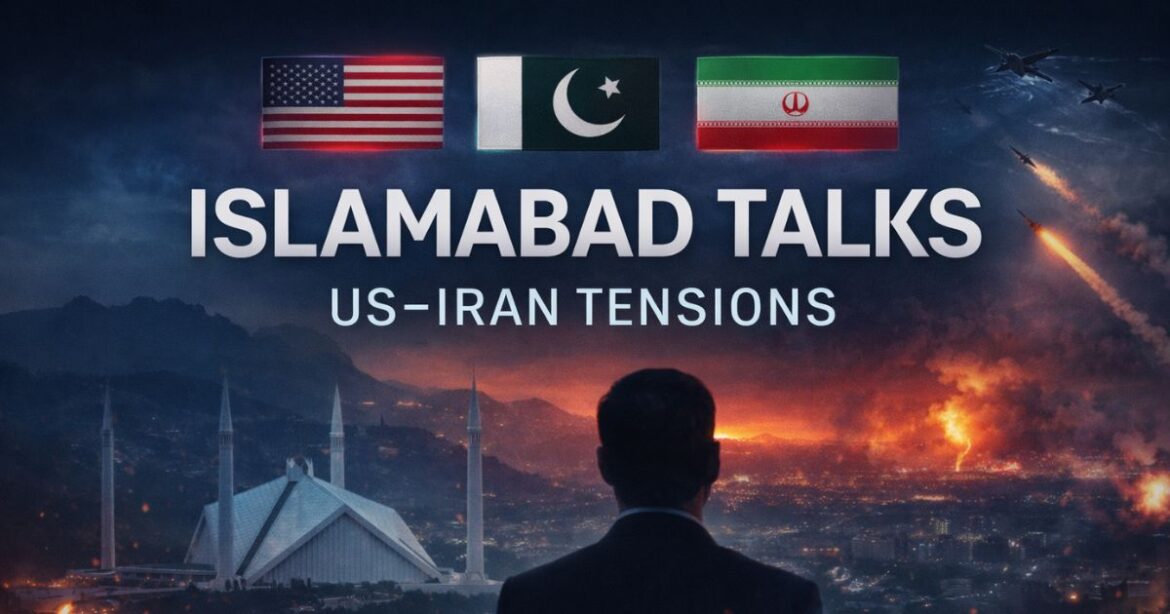
US-Iran peace talks in Islamabad, Pakistan ended on April 12, 2026 without an agreement after 21 hours of negotiations. The talks — the highest-level direct contact between the two countries since Iran’s 1979 Islamic Revolution — broke down primarily over Iran’s refusal to commit to abandoning its nuclear weapons program. A fragile two-week ceasefire remains in place, but the path to a lasting peace deal is now deeply uncertain.
What Were the US-Iran Islamabad Peace Talks and Why Did They Matter?
The world held its breath. For the first time since Iran’s 1979 Islamic Revolution — the event that shattered US-Iran relations for nearly half a century — senior officials from Washington and Tehran sat across a table from each other and talked directly.
The talks in Islamabad were the first direct face-to-face US-Iran negotiations in more than a decade, and the highest-level discussions since the 1979 Islamic Revolution. The outcome could determine the fate of the fragile two-week ceasefire and the reopening of the Strait of Hormuz — a chokepoint for about 20% of global energy supplies that Iran has blocked since the war began.
But 21 hours later, in the early hours of Sunday morning, Vice President JD Vance walked out of the Serena Hotel in Islamabad and delivered the news the world feared. No deal.
#WATCH | US-Iran peace talks | Islamabad, Pakistan: US Vice President JD Vance says, “…The bad news is that we have not reached an agreement. I think that is bad news for Iran much more than it’s bad news for the USA. So, we go back to the US having not come to an… pic.twitter.com/jWHpJYemYz
— ANI (@ANI) April 12, 2026
“…The bad news is that we have not reached an agreement. I think that is bad news for Iran much more than it’s bad news for the USA. So, we go back to the US having not come to an agreement…they have chosen not to accept our terms.” “
…Whatever shortcomings in the negotiation, it wasn’t because of the Pakistanis who did an amazing job and really tried to help us and Iranians bridge the gap and get to a deal. We have been at it now for 21 hours and we have had a number of substantive discussions with the Iranians. That’s the good news. The bad news is that we have not reached an agreement.
I think that is bad news for Iran much more than it’s bad news for the USA. So, we go back to the US having not come to an agreement…they have chosen not to accept our terms.”
Who Was at the Table? The US and Iran Delegations Explained
The United States sent a delegation of nearly 300 members, led by Vice President JD Vance, special envoy Steve Witkoff, and presidential adviser Jared Kushner.
The Iranian delegation of around 70 members was led by parliamentary speaker Mohammad Bagher Ghalibaf and Foreign Minister Abbas Araghchi.
Pakistani leadership — including Prime Minister Shehbaz Sharif, Foreign Minister Ishaq Dar, and Chief of Army Staff Asim Munir — served as intermediaries. Wikipedia
Behind the scenes, Chinese, Egyptian, Saudi, and Qatari officials were also present in Islamabad to indirectly facilitate talks WRTV — a sign of just how much the world was watching.
The Iranian delegation arrived dressed in black, mourning their late Supreme Leader Ayatollah Ali Khamenei and others killed in the war. The symbolism was deliberate.
What Did the US Demand From Iran?
The American side came with a 15-point proposal. The core demands, per reporting from Reuters, AP, and Iranian state media, were:
- A permanent nuclear weapons ban — Iran must give a long-term, binding commitment that it will never develop a nuclear weapon or the technology to build one quickly
- Reopening the Strait of Hormuz — full restoration of free passage for international shipping through the vital waterway
- Restricting Iran’s nuclear enrichment program — limiting the level and scale of uranium enrichment
- Ending support for regional proxy forces — curbing Iran’s backing of groups like Hezbollah in Lebanon and the Houthis in Yemen
- No compensation or reparations framework — the US rejected Iran’s demand for war damages
Vance made the nuclear commitment the non-negotiable centerpiece: “The simple fact is that we need to see an affirmative commitment that they will not seek a nuclear weapon, and they will not seek the tools that would enable them to quickly achieve a nuclear weapon. That is the core goal of the president of the United States.”
What Did Iran Demand in Return?
Iran’s delegation came with its own 10-point proposal and a list of what it called non-negotiable conditions. Iran’s state-linked Tasnim news agency outlined four core conditions presented to mediators: full sovereignty over the Strait of Hormuz, complete war reparations from the aggressor, unconditional release of blocked assets, and a durable ceasefire across the entire West Asia region.
Breaking it down further, Iran’s demands included:
- Sovereignty over the Strait of Hormuz — Tehran wants formal recognition of its control over the waterway, not just a reopening under US terms
- Full war reparations — compensation for the destruction caused by US-Israeli strikes since February 28
- Release of frozen assets — Iran’s billions in frozen funds held abroad must be unfrozen before any deal is signed
- Regional ceasefire including Lebanon — Israel must halt strikes on Hezbollah as a precondition, not an afterthought
- End to all sanctions — economic relief as part of any peace framework
- No nuclear restrictions beyond existing agreements — Iran insists it is not building a bomb and refuses to sign away rights it claims are civilian
Ghalibaf said upon arriving in Islamabad: “Our experience of negotiating with the Americans has always been accompanied by failure and breaches of commitments.” He warned that twice within less than a year, Iran had engaged in good faith talks only to face unexpected attacks.
Also read,
Why Did the Islamabad Talks Fall Apart?
The gap between these two lists was simply too wide to bridge in one weekend.
The ceasefire itself was already under strain, with Iran continuing to block most shipping through the Strait of Hormuz and deep disagreements over whether Lebanon was included in the truce.
Israel launched what was described as its most ferocious wave of strikes in Lebanon just hours after the ceasefire came into effect, killing at least 357 people and wounding more than 1,200. Iran said talks could not begin without a ceasefire in Lebanon, causing an international backlash. Vance described it as a “legitimate misunderstanding.”Iran called it a betrayal.
Vice President JD Vance gives an update in Pakistan:
“The simple fact is that we need to see an affirmative commitment that they will not seek a nuclear weapon, and they will not seek the tools that would enable them to quickly achieve a nuclear weapon.” pic.twitter.com/il4THN5DwV
— The White House (@WhiteHouse) April 12, 2026
Then came the nuclear wall. Iran wouldn’t sign a blanket commitment to never develop a weapon. The US wouldn’t move without it. Several Iranian media outlets said after Vance’s press conference that the talks failed because the US side was not realistic and had “excessive demands.”
Vance said the US left behind its “final and best offer” and would wait to see if Iran accepts it. He departed Islamabad immediately after his four-minute press conference.
What Was Trump Doing While the Talks Were Happening?
While Vance spent 21 hours at the negotiating table, Trump was at a UFC fight in Miami.
Secretary of State Marco Rubio was seen whispering to Trump from nearby seats at the arena, with the two exchanging words before Trump turned to the crowd and pumped his fist.
Earlier, Trump had told journalists: “We’re sweeping the strait. Whether we make a deal or not makes no difference to me.”
Trump repeatedly asserted the US emerges victorious regardless of outcome. “We totally defeated that country. Let’s see what happens. Maybe they make a deal. Maybe they don’t. From the standpoint of America, we win,” he said.
What Happens to the Ceasefire Now — and Could War Resume?
The ceasefire is still technically in place. But it is hanging by a thread.
Around a fifth of the world’s traded oil had typically passed through the Strait of Hormuz on over 100 ships a day. Only 12 have been recorded transiting since the ceasefire began. Global energy markets remain rattled. The economic bleeding hasn’t stopped.
US Navy destroyer ships conducted operations in the Strait of Hormuz on Saturday, beginning efforts to clear mines from the waterway — even as diplomats were still talking inside the hotel.
Russia urged all parties to adopt a “responsible approach.” France’s President Emmanuel Macron called on Iran to use the negotiations to achieve “lasting de-escalation.” The UN’s top humanitarian officials demanded an end to what they called widespread violations of international law.
Iran says the ball is in America’s court. The US says its final offer is on the table. Neither side is blinking.
What’s Next for US-Iran Relations After the Islamabad Breakdown?
The nuclear question — the one that has shadowed US-Iran relations for decades — remains the core obstacle. Iran insists it isn’t building a bomb. The US isn’t taking their word for it. Without resolution on that single point, every other agreement crumbles.
Watch whether Iran formally responds to Vance’s “final and best offer” in the coming days. Watch the Strait of Hormuz — if it stays closed, economic pressure on both sides will intensify fast. And watch Israel, whose continued strikes in Lebanon could torpedo any new round of diplomacy before it even starts.
The most historic US-Iran talks since 1979 just ended without a deal. The next move could determine whether this war gets colder — or gets a whole lot worse.