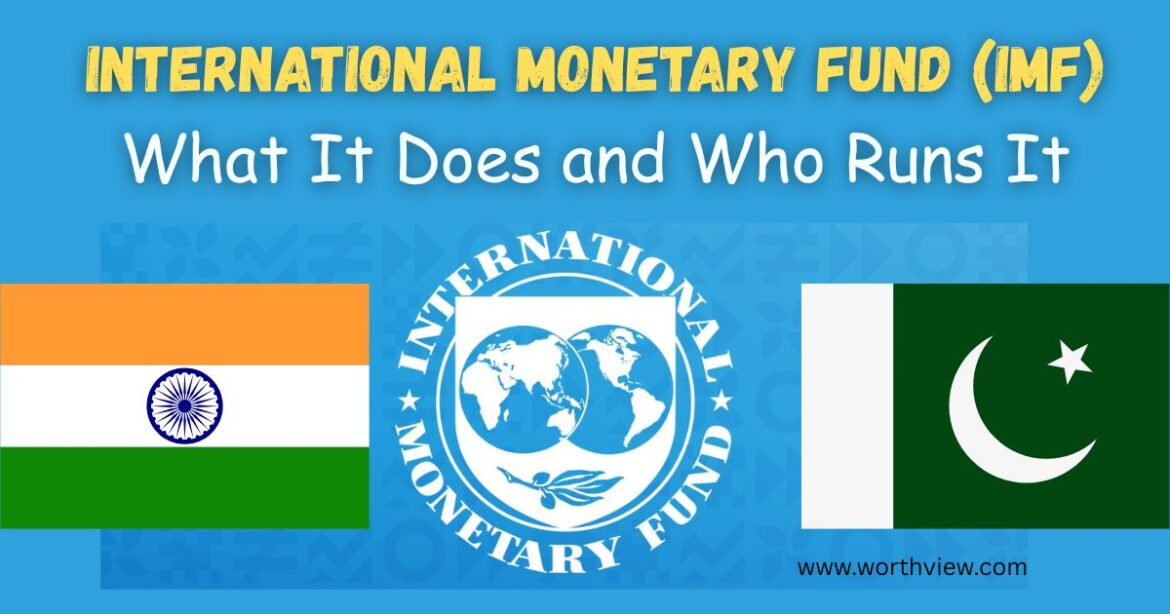
The International Monetary Fund (IMF) is one of the most powerful financial organizations in the world. But what exactly does it do? And which countries have the most say in its decisions?
Let’s break it down in simple words.
What is the IMF?
The International Monetary Fund (IMF) is like a global bank for countries. It helps nations manage their money, especially when they’re in trouble.
Basic Facts About the IMF
Full Name: International Monetary Fund (IMF)
Established: December 27, 1945
Headquarters: Washington, D.C., United States
Number of Member Countries: 190 (as of 2025)
Official Languages: English (working language), but documents are often translated into several others.
Purpose and Motto
-
Purpose:
To promote global monetary cooperation, secure financial stability, facilitate international trade, promote high employment and sustainable economic growth, and reduce poverty around the world. -
Motto (Unofficial but widely accepted mission statement):
“Working together to improve the lives of people everywhere.”
Main Functions of the IMF:
-
💰 Lends money to countries facing financial crises.
-
📊 Monitors the global economy and offers advice.
-
📚 Provides training and guidance on managing public finances.
-
🌍 Works to stabilize global financial systems.
Why Was the IMF Started?
The International Monetary Fund (IMF) was created in the aftermath of World War II, during a time when the global economy was in ruins. Countries were facing severe financial instability — currencies were collapsing, trade had broken down, and there was no reliable international system to help struggling nations.
To solve this, 44 countries came together in July 1944 at the Bretton Woods Conference in the United States. Their goal was to build a new world economic order that could:
- Prevent another Great Depression.
- Promote international cooperation.
- Stabilize exchange rates and support global trade.
The result? The birth of the IMF in 1945 — a global organization meant to be a safety net for countries during economic crises.
Its early role focused on:
- Helping countries maintain fixed exchange rates.
- Lending money to nations facing short-term balance of payments problems.
- Promoting growth and rebuilding war-torn economies.
What is a Quota in the IMF?
Each country in the IMF contributes money. This is called a quota. The larger the quota, the more votes and power that country has in IMF decisions.
Think of it like owning shares in a company — the more shares you have, the louder your voice is.
Which Country Has the Most Power?
🇺🇸 The United States is the most powerful member of the IMF.
-
It holds around 16.5% of the voting power.
-
Most major decisions in the IMF require 85% approval.
-
That means the U.S. has veto power — it can block any major proposal it disagrees with.
Top Countries by Voting Power in the IMF:
| Rank | Country | Approx. Voting Power |
|---|---|---|
| 1 | 🇺🇸 USA | 16.5% |
| 2 | 🇯🇵 Japan | ~6% |
| 3 | 🇨🇳 China | ~6% |
| 4 | 🇩🇪 Germany | ~5.3% |
| 5 | 🇬🇧 UK & 🇫🇷 France | ~4% each |
| 6 | 🇮🇳 India | ~2.6% |
| – | 🇵🇰 Pakistan | <0.3% |
So, India has moderate influence, while Pakistan has very little say in IMF matters.
Also read, India vs Pakistan Military Comparison: Who Holds the Upper Hand?
IMF’s Role in Conflicts Like India vs. Pakistan
The IMF is not a political or military body, so it does not take sides in wars or regional conflicts.
However, it can have an indirect impact:
-
Pakistan has borrowed money from the IMF over 20 times.
-
When tensions with India rise, Pakistan often increases its defense spending.
-
The IMF can pressure Pakistan to cut back military expenses and focus on the economy as a condition for loans.
This means the IMF can reduce the chances of war by limiting funds available for conflict.
IMF’s Financial Assistance to Pakistan
Amid these tensions, Pakistan’s economy remains fragile. The country is currently under a $7 billion Extended Fund Facility (EFF) program with the IMF, aimed at stabilizing its economy. On May 9, 2025, the IMF approved the first review of this program, releasing a $1 billion tranche to Pakistan. Additionally, discussions are underway for a $1.3 billion loan under the Resilience and Sustainability Facility (RSF) to support climate resilience initiatives.
India’s Stance on IMF Loans to Pakistan
India has expressed concerns over the IMF’s financial assistance to Pakistan, especially in light of the recent terrorist attacks. Indian officials argue that such funds could potentially be diverted to support activities that threaten regional stability. During the IMF board meeting on May 9, 2025, India formally rais
Summary
-
The IMF helps countries during financial crises.
-
The USA is the most powerful member with veto rights.
-
India has a medium-level influence; Pakistan has very low influence.
-
The IMF can indirectly affect conflicts by putting financial pressure on countries like Pakistan.
-
It does not take sides in political or independence movements.
Related Posts
 PM Modi on Operation Sindoor: A New Normal in India’s Fight Against Terrorism
 India and Pakistan announce ceasefire agreement after US-led talks
 Over 400 Drone Attacks: Pakistan’s Escalation Sparks Alarms Across Indian Borders
 India-Pakistan Tensions: Home Ministry Orders Nationwide Civil Defence Mock Drills on May 7