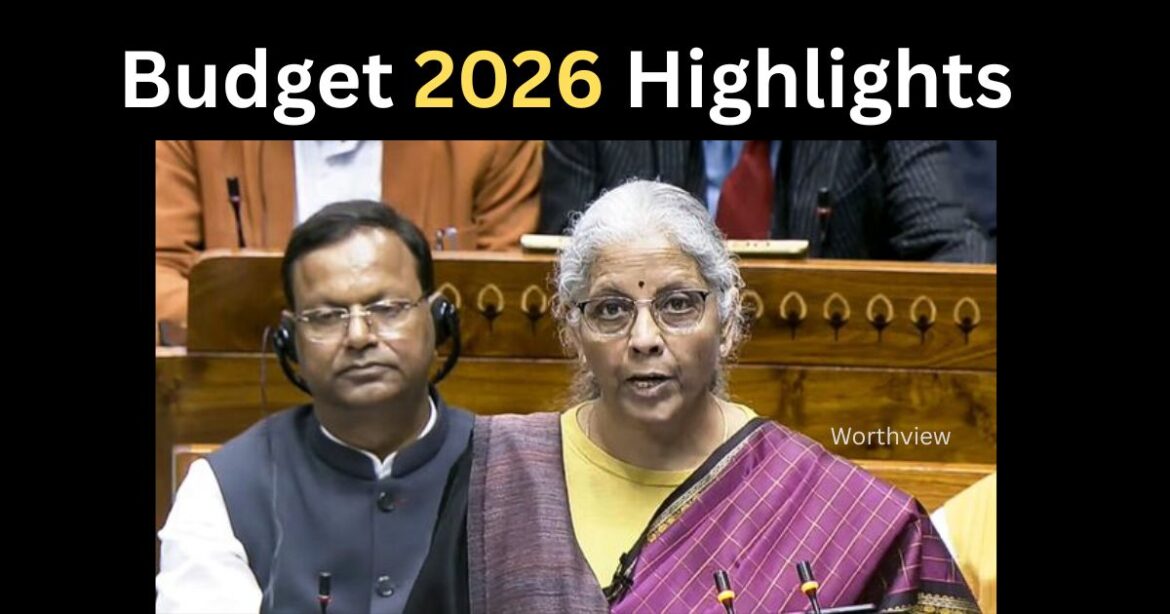
India’s Union Budget 2026–27, presented on February 1, 2026, by Finance Minister Nirmala Sitharaman, lays out a clear roadmap for sustaining economic growth while keeping public finances under control. The budget aligns closely with the government’s long-term Viksit Bharat vision, focusing on infrastructure expansion, manufacturing revival, MSME empowerment, and simplified taxation.
With India targeting a steady 7% growth trajectory, the budget balances people-centric initiatives with fiscal discipline, pegging the fiscal deficit at 4.3% of GDP.
Fiscal Targets: Capex Takes Centre Stage
One of the strongest signals from Budget 2026–27 is the continued emphasis on public capital expenditure.
-
Public capex for FY27 is raised to ₹12.2 lakh crore, a sharp jump compared to pre-pandemic levels.
-
Fiscal deficit is set at 4.3% of GDP, marginally lower than the revised estimate of 4.4% for FY26.
-
Debt-to-GDP ratio stands at 55.6%, with a medium-term target of 50±1% by 2030.
-
Total government expenditure for FY27 is pegged at ₹53.5 lakh crore.
This approach signals the government’s intent to drive growth through investment rather than consumption-heavy borrowing.
Infrastructure: Building Growth Corridors
Infrastructure remains the backbone of this budget.
Key announcements include:
-
Seven high-speed rail corridors, including Mumbai–Pune, Delhi–Varanasi, and Hyderabad–Bengaluru.
-
A new freight corridor from Dankuni to Surat to ease logistics bottlenecks.
-
Development of 20 national waterways and a coastal cargo scheme to raise inland shipping’s share to 12% by 2047.
-
₹20,000 crore allocation for Carbon Capture, Utilisation and Storage (CCUS) in the energy sector.
These measures aim to lower logistics costs and create long-term employment.
Manufacturing & MSMEs: The Growth Engine
The budget gives a strong push to domestic manufacturing and small businesses.
Highlights:
-
Biopharma SHAKTI scheme with an outlay of ₹10,000 crore.
-
India Semiconductor Mission (ISM) 2.0 and electronics manufacturing support raised to ₹40,000 crore.
-
Revival of 200 legacy industrial clusters.
-
₹10,000 crore SME Growth Fund for MSMEs.
-
Mandatory TReDS onboarding for CPSEs to improve MSME cash flows.
-
Introduction of “Corporate Mitras” to help MSMEs with compliance in Tier-II and Tier-III cities.
Tax Reforms: Simpler Laws, Selective Tightening
Tax rationalisation is another key theme.
-
New Income Tax Act, 2025 to replace the 1961 Act from April 2026, promising simpler language and fewer forms.
-
TCS reduced to 2% on overseas tours and education/medical expenses under LRS.
-
STT increased on stock market derivatives:
-
Futures: 0.05%
-
Options: 0.15%
-
-
Safe harbour rate for IT services set at 15.5% for turnover up to ₹2,000 crore.
-
Duty exemptions announced for cancer drugs, fisheries, and certain personal imports.
Agriculture & Social Inclusion
The budget blends technology with inclusivity.
Key initiatives:
-
Bharat-VISTAAR AI platform for real-time farm advisory.
-
Support for cashew, cocoa, coconut, and high-value horticulture.
-
Development of 500 reservoirs to improve irrigation.
-
SHE-Marts for women entrepreneurs.
-
Expanded support for Divyangjan, NIMHANS-2 for mental health, and Purvodaya for the eastern industrial corridor.
What Becomes Costlier
Consumers and investors should brace for higher costs in certain areas:
-
Stock market derivatives due to higher STT on futures and options.
-
Tobacco products such as cigarettes, bidis, pan masala.
-
Imported luxury goods including premium watches, alcohol, cosmetics, perfumes, and foreign-built cars.
-
Professional coffee machines due to withdrawal of BCD exemptions.
-
Certain fertilizers like Ammonium Phosphate.
-
Imported cameras and filming equipment.
-
Gold and silver jewellery, as duties on related items have been adjusted.
📉 What Gets Cheaper
Some relief comes through lower import duties and exemptions:
-
Smartphones and electronics due to reduced BCD on components.
-
Electric vehicles (EVs) and battery-related imports.
-
Life-saving cancer drugs (10 specified drugs get full duty exemption).
-
Medical equipment like X-ray and cancer treatment machines.
-
Gold and silver findings used in jewellery making.
-
Dairy and fisheries machinery.
-
Agricultural inputs such as sprinklers and select fertilizers.
Union Budget 2026–27 stays consistent with the government’s post-pandemic strategy: invest heavily in infrastructure and manufacturing, simplify compliance, and gradually rein in fiscal deficit. While traders and luxury consumers may feel the pinch, MSMEs, healthcare, electronics, and long-term investors stand to gain.
In short, this is a steady, reform-oriented budget—not flashy, but firmly focused on building India’s economic foundation for the next decade.