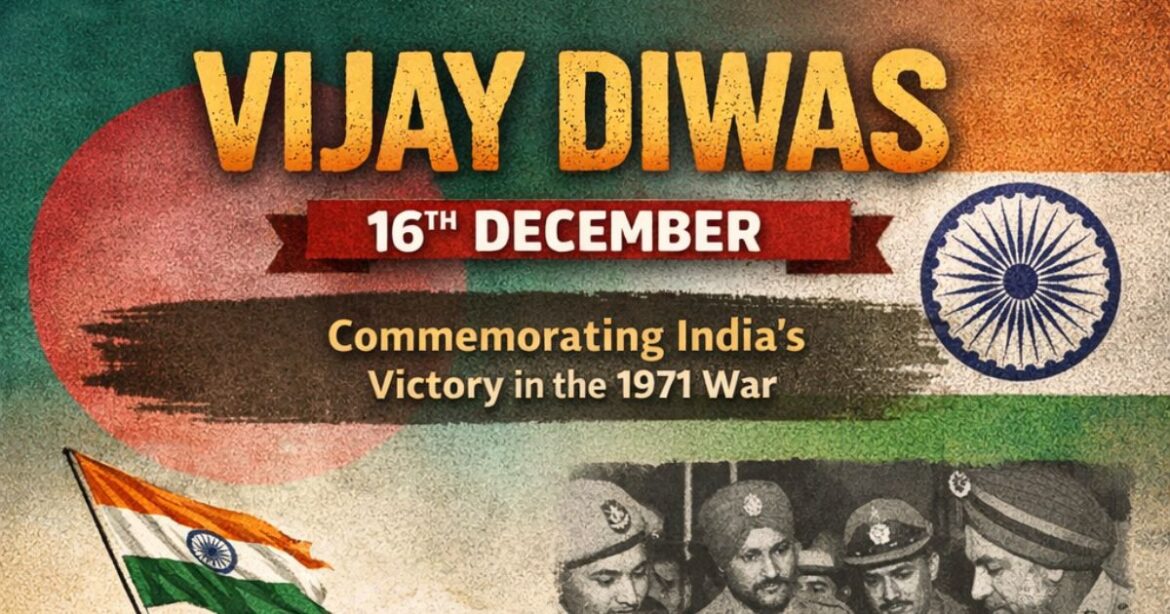
Every year on December 16, India observes Vijay Diwas, a day that marks one of the most significant military victories in the nation’s history. It is a moment of pride, remembrance, and gratitude — honoring the courage of the Indian Armed Forces and remembering a decisive event that reshaped South Asian history.
What is Vijay Diwas?
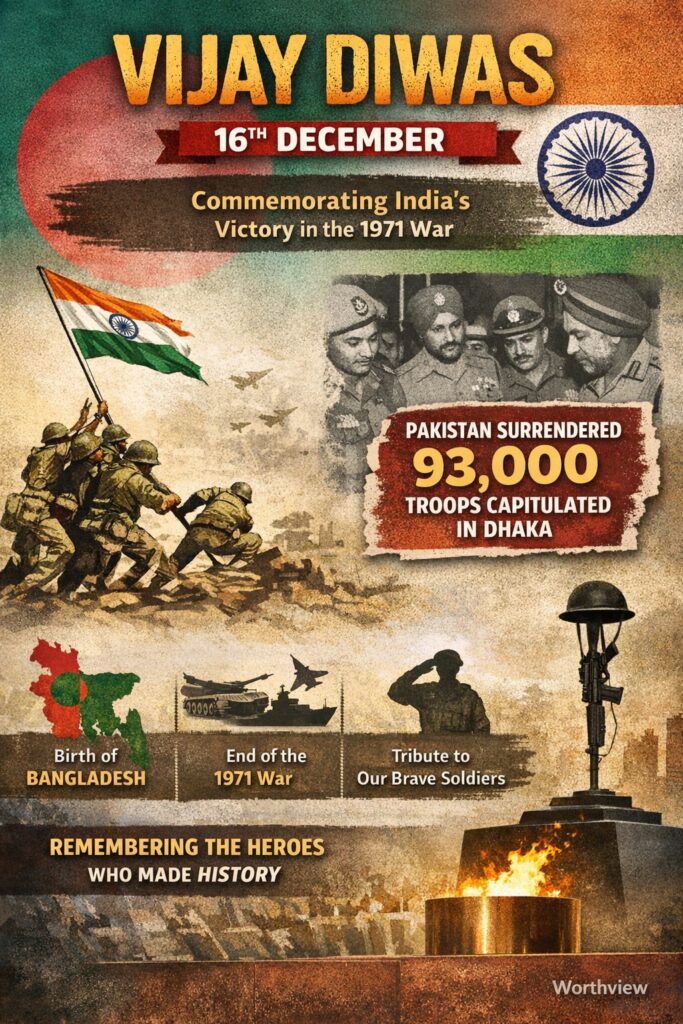
Vijay Diwas, meaning “Day of Victory”, commemorates India’s victory over Pakistan in the 1971 Indo-Pak War. This war lasted just 13 days, making it one of the shortest yet most impactful wars in modern history. The conflict ended with a decisive Indian victory and led to the creation of Bangladesh as an independent nation.
Why is Vijay Diwas Celebrated on December 16?
On December 16, 1971, the Pakistan Army formally surrendered to the Indian Armed Forces in Dhaka (then East Pakistan). Around 93,000 Pakistani soldiers laid down their arms, marking one of the largest military surrenders since World War II.
This historic surrender officially ended the war and confirmed India’s strategic and military dominance during the conflict. December 16 became a symbol of courage, leadership, and unity — and is remembered every year as Vijay Diwas.
Also read, List of Wars Between
India and
Pakisthan
The 1971 War: A Turning Point in History
The war was triggered by the humanitarian crisis in East Pakistan, where millions of refugees fled into India due to political oppression and violence. India intervened after months of diplomatic efforts failed. Under the leadership of Prime Minister Indira Gandhi and the brilliant military strategy of General Sam Manekshaw, India launched a coordinated operation involving the Army, Navy, and Air Force.
The result was swift and decisive:
-
East Pakistan was liberated
-
Bangladesh was born as a new nation
-
India emerged as a strong regional power
Background of the 1971 Indo-Pak War
The roots of the 1971 war go back to the political crisis in East Pakistan (present-day Bangladesh). Despite winning the 1970 elections, the leaders of East Pakistan were denied power by the ruling establishment in West Pakistan. This led to widespread protests, violence, and a brutal military crackdown.
As the situation worsened, millions of civilians fled to India as refugees, creating a massive humanitarian crisis. After months of diplomatic efforts and rising tensions along the borders, India was left with no option but to intervene militarily to protect regional stability and human lives.
India’s Military Strategy and Leadership
One of the biggest reasons behind India’s swift victory was clear strategy and strong leadership. The Indian Armed Forces executed a well-coordinated, three-front operation involving the Army, Navy, and Air Force.
-
The Indian Air Force quickly established air superiority.
-
The Indian Navy blockaded key ports, cutting off supplies.
-
The Indian Army advanced rapidly on land with precise planning.
Field Marshal Sam Manekshaw, the Chief of the Army Staff, played a crucial role by insisting on proper preparation before launching the war. His leadership ensured minimal casualties and a fast, decisive outcome.
The Historic Surrender in Dhaka
The war reached its climax on December 16, 1971, when Pakistani forces in East Pakistan realized defeat was inevitable. In a historic moment, Lieutenant General A. A. K. Niazi of Pakistan signed the Instrument of Surrender before Indian officials in Dhaka.
Approximately 93,000 Pakistani soldiers surrendered, marking one of the largest capitulations in modern military history. This event not only ended the war but also formally confirmed the birth of Bangladesh as a sovereign nation.
The surrender stands as a symbol of India’s military strength and moral resolve.
Why Vijay Diwas Matters to India
Vijay Diwas is not just about military success. It is about:
- Honoring the sacrifices of Indian soldiers
- Remembering the bravery and discipline of the Armed Forces
- Paying tribute to the martyrs who gave their lives
- Celebrating India’s role in defending justice and humanity
It serves as a reminder of what unity, planning, and courage can achieve in the face of adversity.
How Vijay Diwas is Observed
Across India, Vijay Diwas is observed with solemn respect and pride. The day includes:
- Wreath-laying ceremonies at war memorials
- Tributes by senior military officials
- Remembrance events for veterans and martyrs
- Educational programs highlighting the 1971 war
The National War Memorial in New Delhi becomes a focal point of commemoration, where leaders and citizens honor fallen heroes.
A Day to Remember the Heroes
Vijay Diwas reminds us that freedom and peace come at a cost. The bravery shown in 1971 continues to inspire generations of Indians. It is a day to remember that history was shaped not just by weapons, but by sacrifice, strategy, and an unbreakable spirit.
As India remembers December 16, it salutes the heroes who made history — and ensures their legacy lives on.