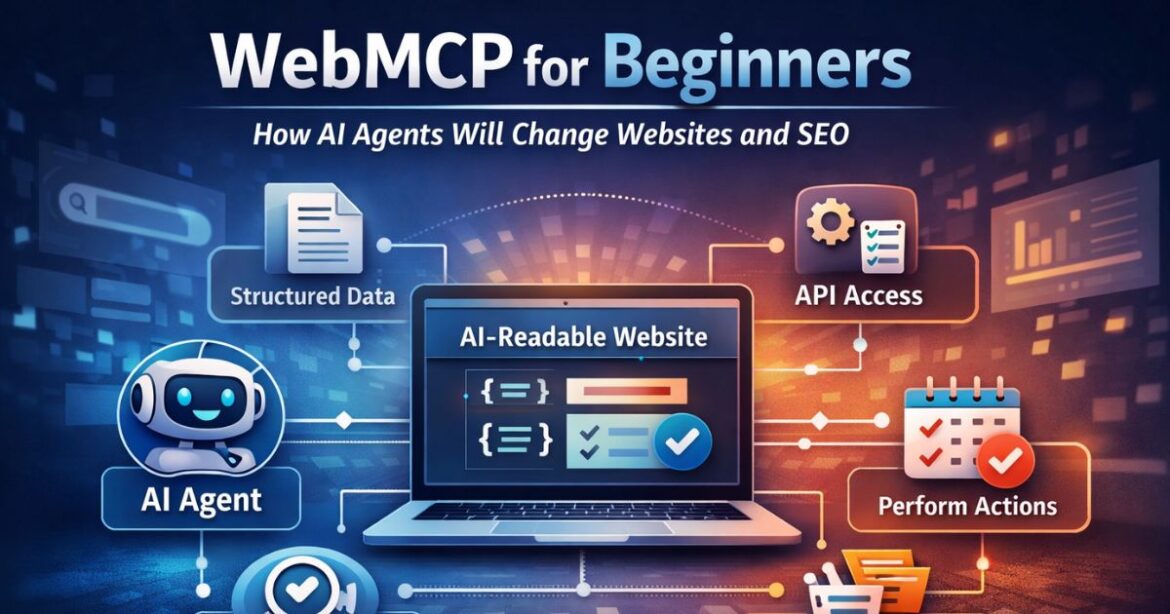
WebMCP (Web Model Context Protocol) is a new way of building websites so that AI agents can directly understand, access, and interact with them.
For the last 30 years, websites were built for one type of visitor: humans. You design the layout, write the content, and make it look good so that real people click, scroll, and take action.
But something is changing fast in 2026. A new type of visitor is arriving — one that does not scroll, does not look at your beautiful banner images, and does not care about your font choice. This new visitor is an AI agent.
What are AI agents?
AI agents are software programmes powered by large language models (like ChatGPT or Claude) that can browse the web, fill out forms, book appointments, compare prices, and complete tasks on behalf of a human user. Instead of a person typing into Google and clicking through ten tabs, the agent does all of that automatically.
The question is: Is your website ready for these new visitors?
That is exactly what WebMCP is about. In this article, we break down what WebMCP is, why it matters, and — most importantly — what it means for your website and your SEO strategy.
⚡ TL;DR (Quick Summary)
- WebMCP is a new way of building websites for AI systems
- AI agents can read, understand, and interact with websites
- Search is moving from clicking links → getting direct answers
- SEO is shifting from ranking pages → being included in AI responses
1. What Is WebMCP? The Simple Explanation
WebMCP stands for Web Model Context Protocol. It is a proposed standard — developed jointly by Google Chrome and Microsoft Edge teams, with oversight from the W3C (the international body that sets web standards) — that lets websites declare their capabilities as structured, callable tools for AI agents.
Here is a simple way to think about it:
🏪 The Shop with No Signs Analogy
Imagine a shop where everything is behind closed doors with no labels. A human can wander around, ask questions, and eventually figure out where things are.
But an AI agent? It gets confused. It takes screenshots of the doors, tries to guess what is inside, sometimes gets it right, sometimes fails.
WebMCP is like putting proper labels and signs on every door — so AI agents instantly know what is where and can get things done reliably.
Without WebMCP, an AI agent visiting a travel booking site has to:
- Take a screenshot of the page
- Try to identify where the ‘Search Flights’ form is
- Attempt to fill in each field one by one
- Hope that the page does not change or break mid-way
With WebMCP, the website simply tells the agent: ‘Here is a tool called search_flights. It needs a departure city, arrival city, and date. Call it and I will give you results.’
The agent calls the function. Gets the data. Moves on. Clean, fast, and reliable.
2. Where Did WebMCP Come From?
You may already know about MCP — Model Context Protocol — which Anthropic introduced in late 2024. MCP allows AI assistants like Claude to connect to tools and services on the backend (think: reading your Google Drive, fetching from a database, or calling an API).
WebMCP takes the same concept and brings it into the browser itself. Instead of a backend server handling tool calls, the webpage does it — directly in the browser tab where the user is already sitting.
| MCP (Original) | WebMCP (Browser-native) |
| Works on the backend / server side | Works inside the browser tab (client-side) |
| Requires developer setup and hosting | Simple HTML attributes or a few lines of JavaScript |
| Used by developers building AI apps | For any website owner to make their site agent-ready |
| No visual UI for the user | User stays in control — sees what the agent is doing |
| Available now, widely adopted | Early preview (Chrome 145+), broader support mid-to-late 2026 |
WebMCP was announced by the Chrome team on February 10, 2026, and is currently available as an early preview for Chrome Canary users. Both Google and Microsoft are building it together — a strong signal that this is going to be mainstream, not a niche experiment.
3. How Does WebMCP Actually Work?
WebMCP gives web developers two ways to make their site agent-ready. You do not need to be a hardcore developer to understand these — let us walk through both.
Method 1: The Declarative API (The Easy Way — Just HTML)
If your website already has standard HTML forms — a search box, a contact form, a booking page — you can make them agent-compatible by adding just two extra attributes to the form tag.
|
That is it. The browser reads these attributes and automatically translates them into a structured schema that any WebMCP-capable AI agent can understand and use.
The key thing to note: the user is still in control. By default, the AI fills in the fields — but the user still has to click ‘Submit’. The agent assists; it does not take over.
Method 2: The Imperative API (For Complex Actions — Uses JavaScript)
For more complex tasks — like adding items to a cart, processing a multi-step checkout, or triggering backend logic — developers can register JavaScript functions as tools that agents can call directly.
|
This is more technical — but for e-commerce sites, SaaS dashboards, and service platforms, it opens up powerful agent-driven workflows.
4. Why Does This Matter for SEO?
Now we come to the most important question for website owners and SEO professionals: How does WebMCP change the game for organic search and discoverability?
The honest answer: profoundly. And the shift is already beginning.
The Old SEO Model: Rank, Get Clicked, Convert
Traditional SEO has three steps. You optimise your content and technical structure to rank in Google. A user sees your link and clicks. They land on your site and (hopefully) convert. Your traffic and revenue depend on that click happening.
The New AI-Agent Model: Rank, Get Discovered by Agent, Agent Acts
With AI agents increasingly browsing the web on behalf of users, the click itself is no longer guaranteed. A user might say to their AI assistant: ‘Book me the cheapest flight from Hyderabad to Delhi next Friday.‘ The agent browses multiple sites, compares options, and completes the booking — all without the user ever ‘clicking’ in the traditional sense.
If your airline or travel site is not agent-readable, the agent will skip you and use a competitor that is.
You lose the booking even if you rank first on Google.
🔑 The New Rule of Discoverability
Being found is no longer enough. Being usable by agents is the new competitive edge.
WebMCP is the technical foundation that makes your site ‘agent-usable‘.
The Responsive Design Parallel — A Lesson from History
Here is a useful comparison for SEOs who remember the mobile era. When smartphones took off around 2010–2014, Google announced that mobile-friendly sites would rank higher.
The sites that implemented responsive design early captured mobile traffic and maintained their rankings. Sites that ignored it lost traffic significantly.
WebMCP is following the same trajectory. The sites that make themselves agent-ready first will capture agentic traffic as AI browsing grows. The laggards will lose visibility — not from a Google penalty, but from simply being invisible to AI agents.
AEO — Agent Experience Optimisation
Some in the industry are already calling this AEO (Agent Experience Optimisation) — a natural evolution beyond AEO (Answer Engine Optimisation). Just as we optimised for featured snippets and voice search answers, we now need to optimise for agent interactions.
What does AEO for WebMCP look like in practice?
- Clean, well-structured HTML forms with clear field labels
- Descriptive toolname and tooldescription attributes that tell agents exactly what each function does
- Structured data (schema.org markup) that helps agents understand your content context
- Clear page purpose — agents, like Googlebot, favour pages that clearly signal what they do
- Fast-loading pages — agents are impatient; slow sites get abandoned
5. What Types of Websites Benefit Most from WebMCP?
Not all websites will feel the impact of WebMCP equally. Here is a quick breakdown of who needs to pay attention most urgently:
| High Priority (Act Now) | Medium Priority (Watch & Prepare) |
| E-commerce stores (search, cart, checkout) | Content blogs and news sites |
| Travel booking platforms | Portfolio and personal websites |
| Restaurant and food delivery sites | Educational course websites |
| Healthcare appointment booking | Community forums |
| SaaS dashboards and productivity tools | Non-transactional informational sites |
| Banking and financial services | Social networks (have own agent strategies) |
If your site involves any kind of transaction, search, or booking, WebMCP should be on your 2026 technical roadmap.
For pure content sites like WorthView, the immediate priority is still strong AEO fundamentals — structured data, clear headings, FAQ schema — which align with the broader shift towards machine-readable web content.
6. Is My Website Already WebMCP-Ready?
Here is the good news: if your site already uses clean, well-structured HTML, you are partially there. The declarative API requires minimal changes.
A quick self-assessment checklist:
|
The core message: WebMCP does not ask you to rebuild your site. It asks you to describe it better — to machines. That is not very different from what good SEO has always asked of us.
7. The India Context — Why Indian Website Owners Should Pay Attention
India is one of the fastest-growing markets for AI adoption, with millions of new internet users and a booming digital economy in e-commerce, fintech, travel, and healthcare. Indian platforms like Flipkart, MakeMyTrip, Practo, and Zepto operate in exactly the verticals where AI agent interactions will be most common.
As Indian consumers increasingly use AI assistants (both global tools like ChatGPT, Gemini, and Perplexity, and emerging Indian AI products), websites that are agent-ready will have a significant competitive advantage in capturing this next wave of digital traffic.
For Indian SEO professionals and digital marketers, the opportunity is clear: position yourself and your clients ahead of this curve now, before it becomes a standard requirement — much like how those who implemented AMP or Core Web Vitals early gained a head start.
🎯 The Bottom Line
WebMCP is not a distant future concept. It launched in early preview in February 2026, with
full Chrome and Edge support expected by mid-to-late 2026.
For beginners, the key things to remember:
- AI agents are already browsing the web on behalf of users.
- WebMCP gives your website a way to communicate directly with these agents.
- Sites that are agent-ready will capture traffic that others miss.
- The technical lift is low — especially if your site already uses clean HTML forms.
- For SEO professionals, AEO (Agent Experience Optimisation) is the new frontier.
The shift from human-first to agent-inclusive web design has begun.
The question is not whether to adapt — it is how soon.
Frequently Asked Questions (FAQ)
Q: What does WebMCP stand for?
A: WebMCP stands for Web Model Context Protocol. It is a proposed browser-level web standard that allows websites to expose their features and functions as structured tools that AI agents can understand and use directly.
Q: Is WebMCP available right now?
A: Yes, but in limited early preview. WebMCP is available for Chrome Canary (experimental) users as of February 2026. Broader support across Chrome and Edge is expected by mid-to-late 2026.
Q: Do I need to be a developer to implement WebMCP?
A: For basic implementation, no. The Declarative API only requires adding two HTML attributes (toolname and tooldescription) to existing form elements. The more advanced Imperative API requires JavaScript, so developer involvement is needed for complex workflows.
Q: How is WebMCP different from regular MCP?
A: Regular MCP (Model Context Protocol) works on the backend — it connects AI models to tools and services through server-side integrations. WebMCP works inside the browser tab itself, letting any webpage expose its capabilities to browser-based AI agents without backend changes.
Q: Will WebMCP replace SEO?
A: No, WebMCP will not replace SEO. It extends it. Traditional SEO (ranking in search engines for human visitors) remains important. WebMCP adds a new dimension — agent-readiness — that ensures AI agents can also find and use your site effectively. Think of it as SEO plus AEO (Agent Experience Optimisation).
Q: Is WebMCP relevant for Indian websites?
A: Absolutely. As AI agent usage grows rapidly among Indian internet users, websites in e-commerce, travel, healthcare, and fintech will face increasing pressure to be agent-ready. Early adopters in India will have a meaningful competitive advantage in capturing agentic traffic.
Q: Does WebMCP pose any security risks?
A: The security story for WebMCP is still maturing. The specification includes user consent requirements — agents cannot automatically submit forms without user approval by default. However, as with all emerging web standards, security best practices will evolve as adoption grows. Website owners should follow official W3C and browser vendor guidance.





Hi there! I’m Sethu, your go-to guy for all things tech, travel, internet, movies, and business tips. I love sharing insights and stories that make life more interesting. Let’s explore the world together, one article at a time!