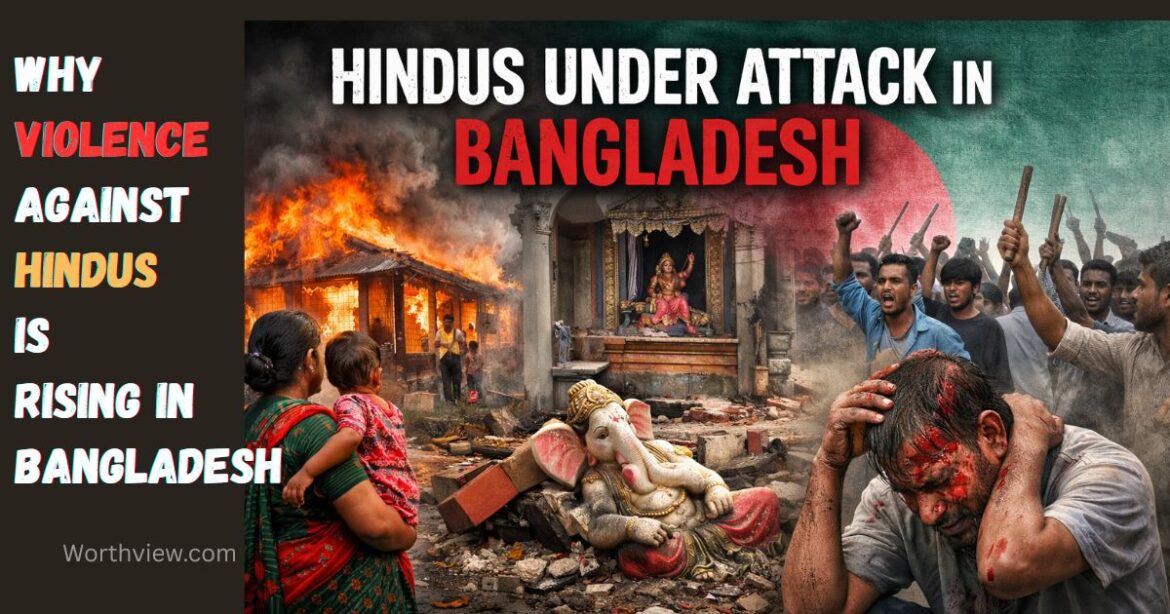
In recent weeks, disturbing news has been coming out of Bangladesh. Reports of Hindu homes being burned, temples vandalized, and even brutal mob killings have shocked many people, especially in India and among the global Hindu community.
What makes this issue serious is not just one or two incidents. It is the pattern. Multiple attacks across different regions, fear spreading among minority families, and a sense that law and order is struggling to keep up.
This is not about blaming an entire country or its people. Bangladesh has many citizens who strongly believe in peace and coexistence. But when violence targets a religious minority, it becomes a human rights issue — not just a local problem.
The key question is simple:
What is really happening, why is it happening now, and who is being affected the most?
This article looks at the facts, the background, and the deeper reasons behind the violence — in clear, easy-to-understand language
Who Are Hindus in Bangladesh? (Quick Background)
To understand today’s violence, we first need to understand who the Hindus of Bangladesh are and why their situation is sensitive.
Hindus are not outsiders in Bangladesh. They have lived in this land for thousands of years, long before modern borders existed. Temples, festivals, literature, and traditions of Bengali Hindus are deeply woven into the region’s culture.
A look at the numbers
- In 1947, when India was partitioned, Hindus made up around 28–30% of the population in what was then East Pakistan.
- By 1971, during the Bangladesh Liberation War, the Hindu population had already reduced due to violence and displacement.
- Today, Hindus make up about 7–8% of Bangladesh’s population.
This steady decline did not happen overnight. It happened because of:
- Repeated communal violence
- Property loss and insecurity
- Migration to India over decades
Their role in society
Hindus in Bangladesh are:
- Farmers, teachers, doctors, artists, shop owners
- Strong contributors to education, culture, and economy
- Largely peaceful and community-oriented
Despite being a minority, many Hindu families have lived in the same villages for generations. For them, Bangladesh is home — not a temporary place.
Why minorities become vulnerable
In any country, when politics becomes unstable or emotions run high, minority communities are often the first to suffer. They have:
- Less political power
- Less protection during chaos
- Fear of speaking out
This background is important because today’s violence is not happening in isolation. It is affecting a community that has already been shrinking and living with insecurity for decades.
What Exactly Is Happening on the Ground?
On the ground, the situation for many Hindus in Bangladesh has become tense and frightening.
Over the past few months, several incidents have been reported from different parts of the country. These are not isolated to one town or one district. That is what worries observers and human rights groups.
Types of incidents being reported
Across various regions, reports include:
Hindu homes being set on fire
Temples vandalized or damaged
Hindu individuals attacked by mobs
Families forced to flee overnight
Threats after rumors or accusations
In some cases, entire neighborhoods were affected. Families escaped with only the clothes they were wearing. Shops were destroyed. Livelihoods built over years were lost in hours.
Mob violence and fear
One of the most alarming trends is mob violence.
Small groups quickly turn into large crowds. Once mobs form, police often arrive late or struggle to control the situation. Victims say attacks happen suddenly — sometimes late at night, sometimes during festivals or public gatherings.
For Hindu families, the fear is not just physical harm. It is also:
- Fear of being targeted again
- Fear of false accusations
- Fear of reporting incidents
Many victims choose silence because speaking out can make them targets again.
Not just property — human lives
In some of the worst cases, people have lost their lives. Lynching incidents have shocked both Bangladesh and neighboring countries. These are not accidents. They are brutal acts that show how quickly law and order can collapse when hatred spreads.
A climate of insecurity
Even in areas where no attack has happened yet, fear is real. Families are:
- Avoiding religious gatherings
- Sending women and children to relatives’ homes
- Locking temples or limiting access
This climate of insecurity is slowly changing daily life for ordinary people who simply want to live peacefully.
How Did the Violence Start? (Immediate Triggers)
In many recent cases, the violence did not begin with large planned attacks. Instead, it started with small triggers that quickly spiraled out of control.
1. Political Shocks: The Death of Sharif Osman Hadi
A major turning point in the recent wave of violence was the death of Sharif Osman Hadi, a prominent leader of the 2024 youth uprising. Hadi died on December 18, 2025, in a Singapore hospital following an assassination attempt in Dhaka.
His death acted as a massive catalyst for nationwide chaos:
- Targeting Media and Culture: Mobs, fueled by grief and anger, attacked the offices of major newspapers like Prothom Alo and The Daily Star, as well as the famous cultural center Chhayanaut.
- Diplomatic Tensions: Rumors that the killers were linked to India led protesters to target diplomatic missions.
- Retribution: In the heat of this political anger, minority communities were often caught in the crossfire as “mob justice” replaced the rule of law.
2. Rumors and blasphemy allegations
One of the most common triggers has been allegations of blasphemy — claims that someone insulted Islam, the Quran, or religious beliefs.
Often:
- The allegation spreads through word of mouth or social media
- No proper verification happens
- Anger builds quickly
- Mobs gather within hours
In several cases, later investigations found no solid proof that the accused person had done anything wrong. But by then, damage was already done.
The Lynching of Dipu Chandra Das:
On December 18, 2025, a Hindu garment worker named Dipu Chandra Das was beaten to death and his body set on fire by a mob in Mymensingh. While initial claims cited “blasphemy,” later investigations suggest the killing may have been a workplace conspiracy fueled by personal rivalry.
“Then they poured kerosene on him and set him on fire. His burned body was left outside. They tied the burnt torso and head outside. It was horrible,”
the grieving father told NDTV.
Social media has played a powerful and dangerous role.
A single post, screenshot, or edited image can:
- Go viral within minutes
- Be shared without fact-checking
- Fuel emotional reactions
In emotionally charged environments, misinformation spreads faster than truth. Once a crowd is angry, logic and law often take a back seat.
4. Local disputes turning communal
Not all incidents begin as religious issues.
Sometimes:
- Land disputes
- Business rivalries
- Personal arguments
…are given a religious color to mobilize mobs. When religion enters the picture, conflicts become more intense and harder to control.
Why things escalate so fast
Several factors help violence spread quickly:
- Delayed police response
- Fear of confronting large mobs
- Political uncertainty
- Lack of accountability in earlier incidents
When people believe they can act without consequences, violence becomes easier.
A pattern seen before
Journalists and rights groups note that these triggers are not new. Similar patterns were seen in past attacks in Bangladesh — rumors, anger, mobs, destruction, and then silence.
The real problem is not just the trigger. It is the environment where such triggers can easily turn into violence.
The Road Ahead: How to Protect Bangladesh’s Minorities?
While the current situation is dire, there is a growing consensus among international observers, human rights groups, and the interim government on what needs to happen next. To move from “mob rule” back to the “rule of law,” several solutions have been proposed:
1. Establishing a Ministry of Minority Affairs
The most consistent demand from the Hindu community is the creation of a dedicated Ministry of Minority Affairs.
-
Why it matters: Currently, minority issues are often handled by various departments without a central authority.
-
The Goal: A dedicated ministry would give minorities a seat at the table, allowing them to report safety concerns directly to the government and ensuring resources are set aside specifically for their protection.
2. The Minority Protection Act
Legal experts are pushing for a new Minority Protection Act. This law would create “Fast-Track Tribunals” to quickly prosecute those who participate in mob violence or lynchings. The goal is to end the “culture of impunity” where attackers believe they will never face a judge.
3. Combating “Digital Hate”
As we have seen with the case of Dipu Chandra Das, social media is often where the spark for violence begins. The interim government has discussed new Cyber Protection Ordinances to monitor and stop the spread of fake news and blasphemy rumors before they reach the streets.
4. International Monitoring and Elections
The United Nations and world leaders have stressed that the safety of minorities is the biggest test for the upcoming February 2026 elections. UN Secretary-General António Guterres has urged the interim government to:
-
Conduct “thorough and transparent investigations” into recent lynchings.
-
Ensure all citizens, regardless of religion, can participate safely in the democratic process.
-
Prevent the use of “retaliation and revenge” as political tools.
Conclusion: A Test for New Bangladesh
The “July Revolution” of 2024 promised a country built on equality and justice. However, for that promise to be kept, the government must move beyond statements of “concern” and take concrete action. Protecting the Hindu community is not just about religious freedom; it is about proving that the new Bangladesh can be a home for everyone.
Related Posts
 India Slashes Excise Duty on Petrol and Diesel: What Changed, What Did Not, and What It Means for You
 Battle of Galwan 2020: What Happened, Why It Matters, and What India Should Remember
 Vijay Diwas: Why India Remembers December 16 as a Historic Victory Day
 🇺🇸 US Hits 🇮🇳 India With 50% Tariff Over Russian Oil: What It Means for Trade, Economy & Diplomacy