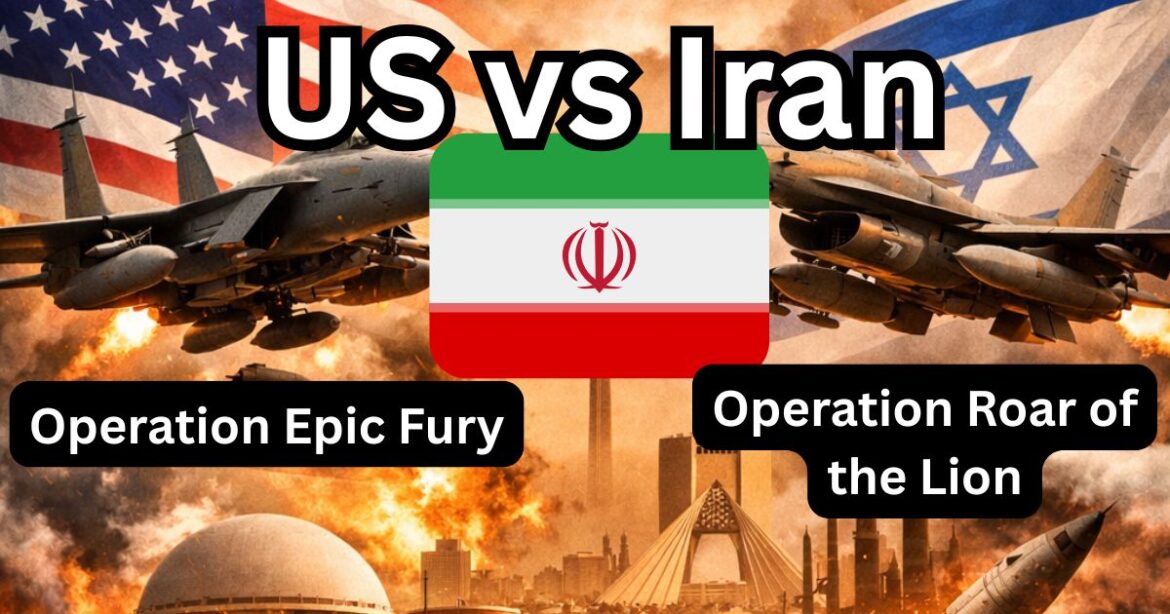
Iran is under attack because the United States and Israel say its nuclear and missile programs pose an immediate security threat. The U.S. military campaign is called Operation Epic Fury, named by the Pentagon, while Israel is conducting its own coordinated strikes under separate operation names. Iran has responded with missile attacks, raising fears of wider conflict in the Middle East.
Many people are confused right now. Why is Iran being attacked? Who started it? Is this a full war between the U.S., Israel, and Iran? And what does “Operation Epic Fury” even mean?
This article breaks it down in simple terms. We’ll explain what Operation Epic Fury is, what Israel is doing separately, why the strikes happened, and what this could mean for the region and the world.
What Is “Operation Epic Fury” and Who Launched It?
Operation Epic Fury is the official name given by the Pentagon,
which is the headquarters of the United States Department of Defense, for the current U.S. military campaign targeting Iran.
In simple terms, this is the American side of the coordinated military action against Iranian targets. According to U.S. officials, the operation is aimed at weakening Iran’s nuclear infrastructure, missile systems, and military facilities that Washington believes threaten regional stability.
The decision comes after long-running tensions between the United States and Iran. For years, the U.S. has accused Iran of advancing its nuclear program beyond peaceful energy use. Iran says its nuclear program is for civilian energy. The U.S. and Israel say it could quickly turn into weapons development.
Operation Epic Fury reportedly involves precision airstrikes, intelligence coordination, and defensive positioning in the region. U.S. officials describe it as a targeted operation — not an invasion — focused on specific military and strategic sites.
Naming military operations is common practice in the U.S. It helps define scope, structure communication, and signal seriousness. By publicly naming it, Washington is sending a clear message: this is a formal and deliberate military campaign, not a limited covert strike.
The bigger question now is whether this remains controlled — or escalates further.
Israel’s Military Campaign: What Is “Roar of the Lion”?
Alongside Operation Epic Fury, Israel is carrying out its own military campaign against Iran. Israeli officials have referred to their operation as “Roar of the Lion.” While the U.S. operation is led by the Pentagon, Israel’s actions are directed by the Israel Defense Forces (IDF).
Israel says the strikes are focused on preventing what it calls an “existential threat.” The government of Israel has long argued that Iran’s nuclear and ballistic missile programs directly threaten Israeli security. Iranian leaders have repeatedly criticized Israel’s existence, which Israel cites as a major security concern.
Under “Roar of the Lion,” Israeli forces are believed to be targeting missile facilities, air defense systems, and strategic military infrastructure inside Iran. Israel has a history of conducting preemptive strikes when it believes a threat is imminent. Officials describe this campaign as necessary to stop Iran from reaching a point where it could deploy nuclear weapons or long-range missile systems against Israeli territory.
Unlike the U.S., which frames its action in broader regional security terms, Israel’s justification is more direct: national survival. The Israeli government says waiting would increase the danger.
The coordination between the U.S. and Israel signals a rare moment of synchronized military action. But Israel is making it clear that its security decisions are ultimately independent — even if allies are involved.
Now the focus shifts to why both countries felt this moment required military force.
Why the U.S. and Israel Say They Attacked Iran
The main reason given by the United States and Israel is Iran’s nuclear and missile programs.
Iran’s nuclear program is managed by the Atomic Energy Organization of Iran. Tehran says its uranium enrichment is for civilian energy and medical research. However, U.S. and Israeli officials argue that Iran has enriched uranium to levels close to weapons-grade. Weapons-grade uranium can be used to build a nuclear bomb.
Another concern is Iran’s ballistic missile development. A ballistic missile is a long-range missile that travels high into the atmosphere before striking its target. Israel says these missiles could carry heavy warheads and potentially nuclear payloads in the future.
Tensions have been building for years. Talks meant to revive the Joint Comprehensive Plan of Action (JCPOA) failed to produce a lasting solution. The U.S. previously withdrew from the deal in 2018, and since then, both sides have accused each other of violating commitments.
According to U.S. and Israeli leaders, intelligence reports suggested Iran was moving closer to a critical nuclear threshold. They describe the strikes as “preemptive” — meaning action taken before a perceived threat becomes immediate.
Iran strongly denies building nuclear weapons and calls the attacks illegal aggression.
This clash of narratives is at the heart of the conflict — security threat versus sovereignty violation.
Risk of a Wider War
The U.S.–Israel strikes on Iran raise a real risk that the conflict could spread beyond just targeted attacks. Many experts warn this isn’t just a short, limited strike — it could ignite broader regional instability.
One reason is that Iran isn’t isolated. Tehran has strong political and military relationships with several groups and countries in the Middle East. Forces like Hezbollah in Lebanon and other Iran-aligned armed groups in places such as Iraq and Yemen could react if the conflict deepens. That could draw in fights on multiple fronts.
Another risk comes from the strategic importance of the region. Oil shipping lanes run through the nearby Gulf waters — areas that Iran and its allies could target next. Any attacks on these routes or on military bases of allies might force more countries into the conflict.
Even governments are preparing for the fallout. Some nations have already moved diplomats and warned citizens to avoid travel in the broader Middle East, recognizing that instability may spread.
In short, what started as a focused military operation could expand quickly. Analysts say that once major powers are involved and diplomatic talks fail, the chances of a larger war increase — especially when regional allies and proxies are ready to respond.
This possibility — of escalation from targeted strikes to a wider regional war — is now a central concern for global leaders and communities monitoring the situation.
Conclusion
The attacks on Iran under Operation Epic Fury and Israel’s parallel military campaign mark one of the most serious escalations in Middle East tensions in recent years.
The United States says the goal is to stop a growing nuclear and missile threat. Israel says it is acting to protect its national survival. Iran says its sovereignty has been violated. Each side believes it is acting in defense.
Right now, the biggest concern is not just the strikes themselves — but what happens next. If the conflict stays limited, it may remain a short military episode. But if more countries or regional groups become involved, it could reshape the balance of power in the Middle East.
The coming days will determine whether this becomes a contained confrontation — or something much bigger.
FAQ
1. What is Operation Epic Fury?
Operation Epic Fury is the official name given by the United States Department of Defense for the current U.S. military campaign targeting Iranian military and nuclear-related infrastructure. It represents the American side of coordinated strikes alongside Israel.
2. What is Israel’s “Roar of the Lion” operation?
“Roar of the Lion” is the name used for Israel’s military campaign against Iran. It is directed by the Israel Defense Forces (IDF). Israel says the goal is to prevent Iran from reaching advanced nuclear and missile capability that could threaten Israeli territory.
3. Is this officially a war between the U.S., Israel, and Iran?
As of now, there has been no formal declaration of war. However, direct military strikes between countries significantly increase the risk of open war. Many experts describe the situation as a high-level military escalation rather than a declared war.
4. Why is Iran’s nuclear program so controversial?
Iran’s nuclear activities are overseen by the Atomic Energy Organization of Iran. Iran says its program is for peaceful energy use. The U.S. and Israel believe Iran could be moving closer to weapons-grade uranium enrichment, which could be used to build nuclear weapons.
5. Could this conflict spread to other countries?
Yes, that is one of the biggest concerns. The Middle East has complex alliances and armed groups. If regional actors get involved, the conflict could expand beyond direct strikes between the U.S., Israel, and Iran.
Enjoy Worthview?
Add Worthview as a Preferred Source on Google to see more of our stories in Search.

Worthview Editorial Team is the shared byline for content created collaboratively by Worthview’s editors and contributors. Since 2008, we’ve published thousands of articles across technology, AI, finance, health, home, travel, and lifestyle. Our editorial process emphasizes original research, reputable sources, regular content updates, and clear attribution. Articles covering higher-trust topics, including health and finance, may also undergo review by qualified subject-matter experts.






One thought on “Why Iran Is Under Attack: Operation Epic Fury and Israel’s Response Explained”
Comments are closed.