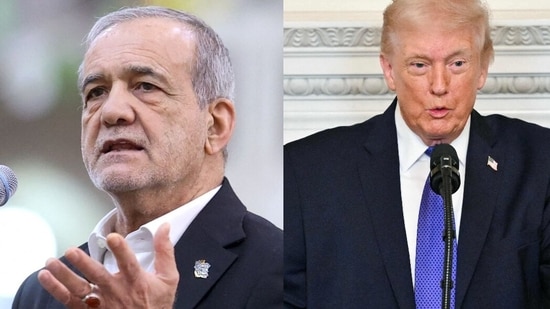
Iranian President Masoud Pezeshkian delivered a defiant televised address on Saturday, declaring that the United States and Israel would “take their dreams of our unconditional surrender to the grave” — a direct rebuke of President Donald Trump’s ultimatum issued less than 24 hours earlier. The exchange marks a dramatic hardening of rhetoric as the US-Israeli military campaign against Iran enters its eighth day with no signs of a ceasefire.
The War So Far
What began on the night of February 28, 2026, as a joint US-Israeli military operation — codenamed Operation Epic Fury — has rapidly expanded into a multi-front regional conflict. Within hours of the first strikes, the US released a statement framing the campaign as an effort to dismantle Iran’s nuclear program, eliminate its missile capabilities, and ultimately achieve regime change.
The opening salvo included one of the most consequential acts in recent geopolitical history: the killing of Supreme Leader Ayatollah Ali Khamenei in a targeted airstrike on Tehran. Iranian state media confirmed Khamenei’s death in the early hours of March 1. His wife, Mansoureh Khojasteh Bagherzadeh, was later confirmed to have also died from injuries sustained in the same strike. The killing has thrown Iran’s political succession into uncertainty. Khamenei’s son, Mojtaba Khamenei, has emerged as a leading candidate to succeed him — a prospect Trump publicly rejected this week, calling Mojtaba an “unacceptable” choice and declaring his intention to play a direct role in selecting Iran’s next leader.
Since Khamenei’s death, a three-person leadership council has assumed power: President Pezeshkian — considered a relative moderate — alongside hardline judiciary chief Gholamhossein Mohseni Ejei and senior cleric Alireza Arafi.
The US-Israeli Position
Trump’s administration has been unambiguous about its goals. In an eight-minute video statement on Truth Social released at 2:30 AM EST on February 28, Trump declared that the purpose of the strikes was effectively regime change. He cited Iran’s history of supporting proxy groups such as Hamas and Hezbollah, the killing of protesters, and its alleged pursuit of nuclear weapons as justifications. Trump urged members of the Islamic Revolutionary Guard Corps (IRGC) to “lay down your weapons and have complete immunity, or in the alternative, face certain death.”
“There will be no deal with Iran except UNCONDITIONAL SURRENDER!… IRAN WILL HAVE A GREAT FUTURE. ‘MAKE IRAN GREAT AGAIN (MIGA!).’” – President Donald J. Trump 🇺🇸 pic.twitter.com/H2HKkBVkww
— The White House (@WhiteHouse) March 6, 2026
On Friday, Trump intensified his position. “There will be no deal with Iran except UNCONDITIONAL SURRENDER!” he wrote on Truth Social, adding that after surrender and the installation of acceptable new leadership, the US and allies would “work tirelessly to bring Iran back from the brink of destruction, making it economically bigger, better, and stronger than ever before.”
On the military front, US Central Command says it has now struck more than 3,000 targets in Iran since the campaign began. Israel’s army chief of staff, Eyal Zamir, claims Israel has destroyed 80% of Iran’s air defenses and at least 60% of its ability to launch ballistic missiles. US officials also say Iran’s ballistic missile attacks have fallen by 90% and drone attacks by 83% compared to the first day of fighting. On Friday, the US struck what it described as an Iranian “drone carrier” at sea, and earlier in the week, a US submarine sank the Iranian frigate Iris Dena in the Indian Ocean off the coast of Sri Lanka — killing at least 87 sailors.
Israel has also opened a second front, launching heavy strikes on Beirut’s southern suburbs after Hezbollah resumed missile and drone attacks on northern Israel on March 2 — its first offensive action since the ceasefire of late 2024. The UN’s human rights chief, Volker Türk, warned that Lebanon is becoming “a key flashpoint” and called for an immediate cessation of hostilities.
Israeli Prime Minister Benjamin Netanyahu addressed the Iranian people directly in Farsi, urging them to “come to the streets, come out in your millions, to finish the job, to overthrow the regime of fear.”
Iran’s Response
Iran has refused to yield. In his televised address Saturday, Pezeshkian made clear that Tehran will continue resisting. According to state media, he said: “We will never surrender in the face of excessive demands because we have the power to change the situation.”
Iran’s military has continued retaliatory strikes not only against Israel but against Gulf states hosting US military bases, including Saudi Arabia, Kuwait, Jordan, and the United Arab Emirates. On Saturday, Saudi Arabia’s air defenses intercepted drones east of Riyadh and ballistic missiles targeting a military base south of the capital. Dubai’s international airport briefly suspended operations due to the threat. Iran also launched a hybrid drone and missile attack on Tel Aviv overnight Thursday, with CNN teams on the ground reporting what appeared to be cluster warheads in the skies above central Israel.
Iran’s military has also moved to strangle regional energy flows. A senior IRGC official warned that no oil will leave the Strait of Hormuz and that any ship transiting the strait risks being set ablaze. Shipping giant Maersk became the second major company to suspend Middle East operations, and oil storage tanks across the region are filling up as exports have effectively halted. Brent crude has surged to $91 per barrel — its highest level since October 2023 — while US oil prices are up 31% week-on-week.
Iran’s foreign minister has warned European nations that if they join the US-Israeli coalition, they will be considered “legitimate targets” for retaliation. Ali Larijani, secretary of Iran’s Supreme National Security Council, stated that Iranian forces are “waiting” for a potential US ground invasion and threatened to inflict mass casualties on any invading troops.
Despite heavy losses, a large pro-regime rally took place in Tehran after Friday prayers, demonstrating the government’s continued ability to mobilize its core support base.
The Human Cost
The toll has been severe on all sides. Iranian state media reported a death toll exceeding 1,045 by day six of the conflict, with more than 6,000 wounded. The World Health Organization confirmed that 13 healthcare sites in Iran have been struck. Iran’s Ministry of Foreign Affairs has accused the US and Israel of hitting 33 civilian locations, including hospitals, schools, a sports arena at Tehran’s Azadi complex, the Tehran Grand Bazaar, and the historic Golestan Palace complex.
In Israel, Iranian missile debris has ignited fires in central Israeli cities and eight Israeli soldiers have been wounded by Hezbollah fire. ACLED records more than 90 Iranian attempted strikes against Israel between February 28 and March 4, with around 20 directly impacting civilian areas and killing at least 10 people.
Six US service members have been killed in the conflict. A dignified transfer is taking place Saturday at Dover Air Force Base, with President Trump and Vice President JD Vance expected to attend.
The cost of the first 100 hours of Operation Epic Fury has been estimated by the Center for Strategic and International Studies at $3.7 billion — roughly $891 million per day — with most of that spending unbudgeted.
Regional and Global Fallout
The conflict has drawn in an expanding cast of actors. Russia has reportedly been providing Iran with intelligence on the locations of American warships and aircraft. Ukraine, meanwhile, has been asked by the US for assistance in countering Iranian drones; President Zelensky confirmed he accepted the request. Iraqi Kurdish forces are reportedly on standby to potentially join cross-border operations against Iran. Qatar has deployed air defenses and shot down two Iranian Su-24 bombers — the first nation to shoot down an Iranian aircraft in the conflict.
The UN Secretary-General has issued an urgent plea for “serious diplomatic negotiations,” warning that “the situation could spiral beyond anyone’s control.” European governments are divided: some have deployed defensive military assets, while others are pushing for diplomacy.
Egypt’s President el-Sisi has warned his country is in a “state of near-emergency” as war drives up prices. Analysts warn of potential global inflation and recession risk if Strait of Hormuz closures persist.
What Comes Next
With Trump ruling out negotiations short of full capitulation, and Iran’s leadership vowing continued resistance, a diplomatic off-ramp appears distant. The question of who will succeed Khamenei — and whether Iran’s IRGC and political establishment can remain cohesive under sustained military pressure — may ultimately determine how this conflict ends.
For now, both sides show every sign of digging in.
Sources: CNN, Al Jazeera, NPR, Wikipedia (2026 Iran War), ACLED, House of Commons Library, UN News
Enjoy Worthview?
Add Worthview as a Preferred Source on Google to see more of our stories in Search.

Worthview Editorial Team is the shared byline for content created collaboratively by Worthview’s editors and contributors. Since 2008, we’ve published thousands of articles across technology, AI, finance, health, home, travel, and lifestyle. Our editorial process emphasizes original research, reputable sources, regular content updates, and clear attribution. Articles covering higher-trust topics, including health and finance, may also undergo review by qualified subject-matter experts.






One thought on ““We Will Never Surrender”: Iran Defies US Ultimatum as War Enters Eighth Day”
Comments are closed.