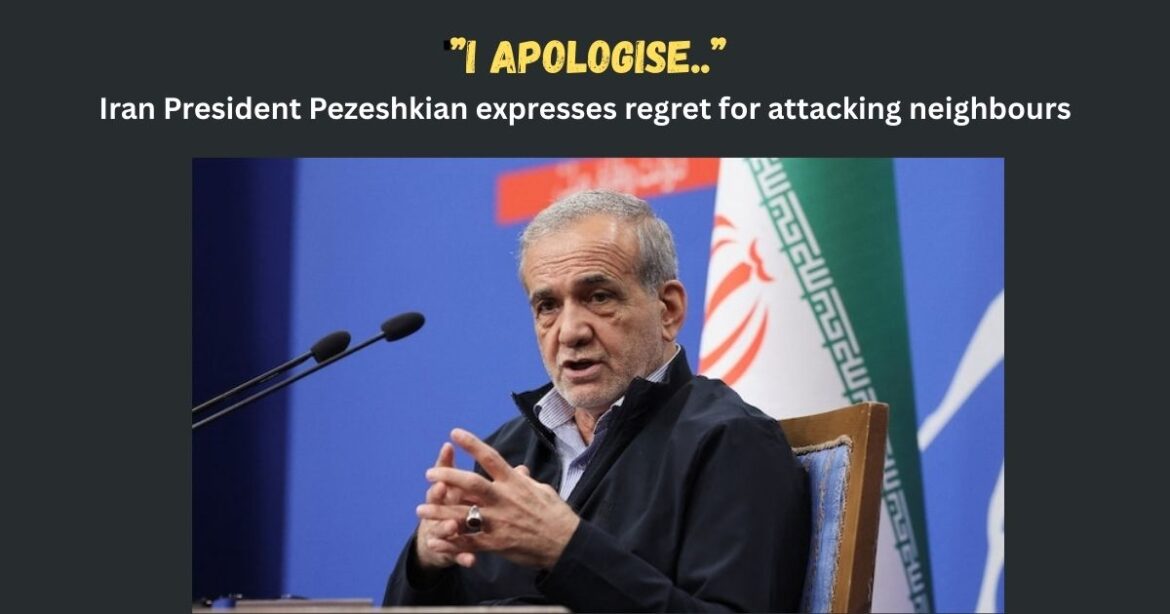
In one of the most striking diplomatic moments of the eight-day-old war, Iranian President Masoud Pezeshkian went on state television Saturday to apologise to neighbouring Gulf nations for the wave of missile and drone strikes Iran had unleashed on their soil — even as Israeli jets turned Tehran’s busiest airport into a fireball.
“I must apologise on my own behalf and on behalf of Iran to the neighbouring countries that were attacked by Iran,” Pezeshkian said in a prerecorded address. “We do not intend to attack neighbouring countries. They are our brothers.”
He announced that Iran’s interim leadership council had ordered the armed forces to cease all strikes against neighbours unless an attack on Iran first originates from those countries — a significant climb-down after a week of Iranian missiles raining down on Saudi Arabia, the UAE, Bahrain, Kuwait, Qatar and Oman, all of which host US military assets.
The apology came after repeated interceptions and near-misses that rattled the Gulf. On Saturday morning alone, Saudi Arabia shot down four drones heading toward the Shaybah oil field in the Empty Quarter desert. Dubai’s international airport — one of the world’s busiest — briefly suspended all flights, telling passengers: “Please do not go to the airport.” Emirates later resumed operations roughly 30 minutes after the suspension.
Tehran Burns
The diplomatic gesture arrived against a backdrop of destruction. In the early hours of Saturday, more than 80 Israeli Air Force fighter jets conducted what the IDF called a “broad-scale wave of strikes” on Tehran and central Iran, dropping 230 bombs on military targets across the capital.
Viral footage showed Tehran’s Mehrabad International Airport engulfed in flames, with thick plumes of smoke rising into the night sky and aircraft on the tarmac burning. The IDF said its jets “targeted and dismantled” Iranian air defence and detection systems at the airport. Explosions were also reported in Kermanshah, a city housing several missile bases.
Among the other targets struck overnight: an underground ballistic missile storage and production facility, a second missile launch site, and Imam Hossein University — the IRGC’s military academy, which the IDF claimed was being used as an emergency command centre.
Iranian state media simultaneously reported that Iran had fired another round of missiles at Israel, triggering the latest Israeli response. The exchange has become grimly routine over the past week.
The Bigger Picture
The dual image of Saturday — an Iranian president apologising to neighbours while his capital burns — captures the impossible position Tehran now finds itself in.
Pezeshkian is one of three members of an emergency leadership council holding power since Supreme Leader Ayatollah Ali Khamenei was killed in a US-Israeli airstrike on February 28. He is considered the council’s relative moderate, and Saturday’s address appeared designed to stop Iran’s conflict from spreading into a wider regional war that could draw Gulf states into active hostilities.
Yet even as he extended the olive branch, Pezeshkian reiterated that Iran would “never surrender” to the US and Israel — directly dismissing Trump’s demand, posted Friday on Truth Social, for Iran’s “UNCONDITIONAL SURRENDER” as a precondition for any talks.
Israel and the US, meanwhile, show no signs of easing pressure. The US State Department approved a fresh $151.8 million arms package for Israel on Saturday, covering 12,000 one-thousand-pound bomb bodies. US Treasury Secretary Scott Bessent told Fox Business that “tonight will be our biggest bombing campaign” in Iran.
Iran says at least 1,332 civilians have been killed since the war began. In Lebanon, the health ministry reports 217 people killed and nearly 800 wounded since Israel and Hezbollah resumed fighting on Monday.
Whether Pezeshkian’s apology marks the beginning of a diplomatic off-ramp — or simply a tactical move to prevent Iran from fighting on too many fronts at once — remains to be seen. For now, the fires at Mehrabad say more than any speech could.
Enjoy Worthview?
Add Worthview as a Preferred Source on Google to see more of our stories in Search.

Worthview Editorial Team is the shared byline for content created collaboratively by Worthview’s editors and contributors. Since 2008, we’ve published thousands of articles across technology, AI, finance, health, home, travel, and lifestyle. Our editorial process emphasizes original research, reputable sources, regular content updates, and clear attribution. Articles covering higher-trust topics, including health and finance, may also undergo review by qualified subject-matter experts.