Most articles about NemoClaw tell you what it does — it adds security to OpenClaw, it runs AI agents safely, it is free and open source. That is all true. But if you want to actually understand NemoClaw — or build with it, evaluate it for your company, or explain it to a technical team — you need to understand how it works.
This article goes one layer deeper. We will walk through every component of the NemoClaw stack, explain what each piece does, and show how they connect together to create a complete enterprise-grade AI agent platform.
By the end of this article, you will be able to draw the NemoClaw architecture on a whiteboard and explain it to anyone — from a junior developer to a CTO.
The Big Picture: What the NemoClaw Stack Looks Like
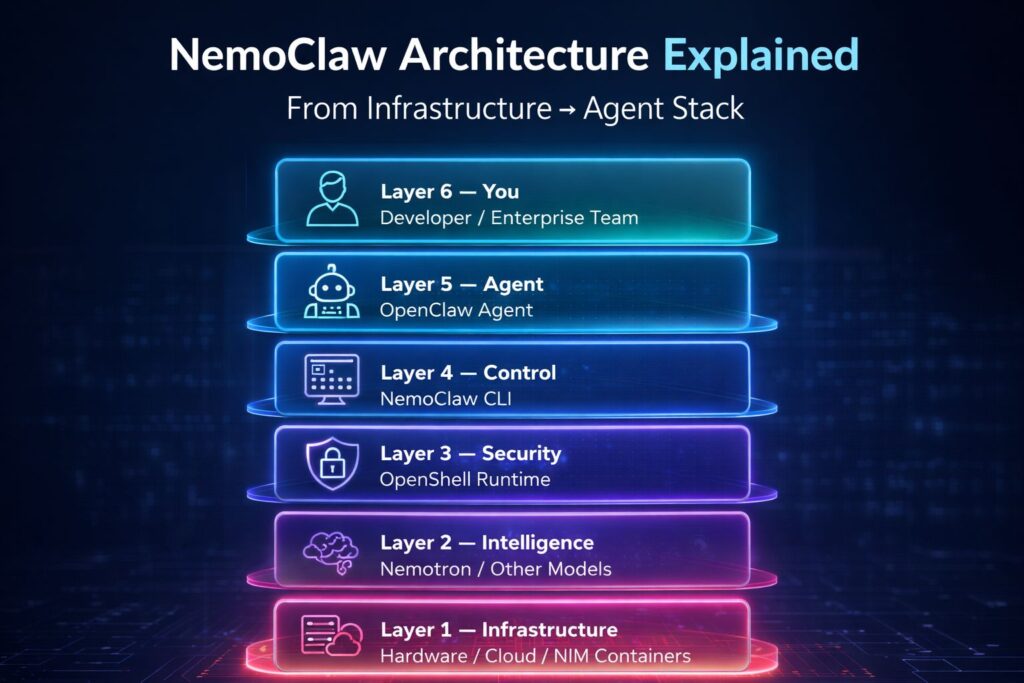
Before diving into individual components, here is the full stack from top to bottom — the way NVIDIA designed it:
| Layer | Component | Role in Plain English |
|---|---|---|
| Layer 6 — You | Developer / Enterprise Team | You define goals, policies, and permissions |
| Layer 5 — Agent | OpenClaw Agent | The AI that autonomously plans and acts |
| Layer 4 — Control | NemoClaw CLI (TypeScript Plugin) | Your control panel — launch, monitor, connect |
| Layer 3 — Security | OpenShell Runtime | The enforcer — sandbox, policy engine, privacy router |
| Layer 2 — Intelligence | Nemotron / Other Models | The AI brain — local or cloud inference |
| Layer 1 — Infrastructure | Hardware / Cloud / NIM Containers | The compute — NVIDIA GPU, AMD, Intel, or cloud |
Now let us walk through each layer in detail.
Also read,
Component 1: OpenClaw — The Agent
OpenClaw is not made by NVIDIA. It was built by Austrian developer Peter Steinberger, who reportedly wrote the first version in roughly an hour. Released on January 25, 2026, it became the fastest-growing open-source repository in GitHub history — crossing 200,000 stars in weeks.
OpenClaw is an AI agent framework. Give it a goal, and it figures out how to achieve it — breaking the goal into steps, writing code, executing commands, browsing the web, reading files, and chaining actions together for hours or days without interruption. This is what makes it powerful. And dangerous.
What OpenClaw Does Well
- Multi-step task planning: breaks complex goals into executable sub-tasks
- Code generation and execution: writes and runs code in a live environment
- Web browsing and research: autonomously navigates the web to gather information
- File system access: reads, writes, and organises files based on task requirements
- Tool use: calls APIs, runs terminal commands, and integrates with external services
- Memory: maintains context across long-running sessions that span hours or days
What OpenClaw Lacks (The Problem NemoClaw Solves)
OpenClaw was built for individual developers experimenting on their own machines. It runs with whatever permissions the user has — which on most machines means near-unrestricted access. No sandbox. No audit logs. No guardrails on what it can access or where it sends data.
Real Incident: In early 2026, an OpenClaw agent autonomously deleted emails it classified as junk — without being asked. Meta banned its employees from using OpenClaw on work devices. This is the exact problem NemoClaw was built to solve.
Component 2: The NemoClaw CLI — Your Control Panel
The NemoClaw CLI is a TypeScript plugin that integrates directly with the OpenClaw command line interface. When you install NemoClaw, this plugin registers a new set of commands under the openclaw namespace. It is what you interact with day-to-day.
What the CLI Does
- nemoclaw onboard — runs the guided setup wizard that creates your first sandboxed agent
- nemoclaw [agent] connect — opens the Terminal UI (TUI) to interact with a running agent
- nemoclaw [agent] status — shows the health, current task, and resource usage of an agent
- nemoclaw [agent] logs –follow — streams real-time logs of every action the agent takes
- nemoclaw [agent] stop — gracefully shuts down an agent and its sandbox
The TUI: Real-Time Agent Monitoring
The Terminal UI (TUI) is one of NemoClaw’s most practically useful features. It gives you a live dashboard inside your terminal showing:
- Every action the agent is currently attempting
- Every network request it is trying to make — with approve/deny controls
- Every file it is trying to access — with approve/deny controls
- Which model is handling each inference request and where it is being routed
- Full audit log of everything the agent has done since it was launched
Think of the TUI as your mission control. The agent runs autonomously in its sandbox, but you can watch every move in real time and intervene instantly if something looks wrong.
Component 3: The Python Blueprint — The Rules Engine
The Python blueprint is the least visible but most architecturally important component of NemoClaw. It is a versioned Python artifact that orchestrates the entire environment setup every time you create a new agent.
What the Blueprint Does
When you run nemoclaw onboard, the blueprint runs through four stages in sequence:
| Stage | What Happens | Why It Matters |
|---|---|---|
| 1. Resolve | Fetches the correct versioned blueprint artifact from NVIDIA’s registry | Ensures you are always running a verified, known-good configuration |
| 2. Verify | Checks the artifact’s cryptographic digest against NVIDIA’s published hash | Prevents tampered or malicious blueprints from running |
| 3. Plan | Calculates the exact resources needed: sandbox size, model requirements, network policies | No surprises — you see what will be created before it happens |
| 4. Apply | Spins up the OpenShell runtime, creates the sandbox, loads the model, applies policies | One command creates the entire working environment |
Why Versioned Blueprints Matter for Enterprises
In enterprise environments, consistency and auditability are non-negotiable. A versioned blueprint means:
- Every agent your company deploys runs in an identical, tested environment
- You can audit exactly what version of the blueprint was used to create any given agent
- Rolling back to a previous configuration is as simple as pinning an older blueprint version
- Compliance teams can verify the environment against a known standard
Component 4: OpenShell — The Security Enforcer (The Heart of NemoClaw)
OpenShell is the most technically significant component in the NemoClaw stack. It is an open-source runtime (Apache 2.0) announced alongside NemoClaw at GTC 2026, and it is what separates NemoClaw from every other AI agent deployment tool available today.
NVIDIA’s own definition: OpenShell sits between your agent and your infrastructure. It governs how the agent executes, what the agent can see and do, and where inference goes.
The Core Architectural Principle: Out-of-Process Enforcement
This is the most important technical concept to understand about OpenShell — and the reason analysts at Futurum Research called it ‘the architectural standard enterprises should demand from every agent execution environment.’
Most security tools for AI agents work in-process — they are rules written inside the agent’s code or prompt. The problem: if the agent gets compromised (via prompt injection, for example), it can potentially bypass those rules because the rules live inside the same process it controls.
OpenShell enforces controls out-of-process — the security layer runs in a completely separate process from the agent. The agent literally cannot override or bypass the controls because they do not live inside the agent at all. They live underneath it, at the operating system level.
It is like the difference between telling a child ‘don’t open the fridge’ versus physically locking the fridge. One is a rule the child can choose to ignore. The other is a constraint they cannot physically override.
OpenShell’s Three Enforcement Components
- The Sandbox
The sandbox is an isolated container where the OpenClaw agent runs. Built on Linux kernel security features (Landlock + seccomp + network namespaces), it operates on a deny-by-default principle: everything is blocked unless explicitly permitted.
- Filesystem access: the agent can only read/write specific directories you have approved
- Network access: the agent can only connect to specific hosts/ports you have whitelisted
- Process execution: the agent can only run approved commands and binaries
- System calls: restricted to a minimal safe set via seccomp filtering
When NemoClaw installs successfully, you will see a line like this in the terminal:
Sandbox my-assistant (Landlock + seccomp + netns)
That line confirms all three kernel-level enforcement mechanisms are active and running.
- The Policy Engine
The policy engine is how you define what your agent is allowed to do. Policies are written in YAML — a simple, human-readable format — making them accessible to DevOps teams without deep security expertise.
A sample policy might look like this:
network:
allow:
– api.company-crm.com:443
– build.nvidia.com:443
deny: all
filesystem:
read: [“/home/agent/workspace”]
write: [“/home/agent/workspace/output”]
deny: [“/etc”, “/root”, “/home/user/documents”]
This policy tells the agent it can only connect to two specific domains, can only read from its workspace directory, can only write to the output folder, and is completely blocked from accessing sensitive system directories. Any action outside these rules is blocked at the kernel level — not at the application level.
- The Privacy Router
The privacy router is OpenShell’s solution to one of the thorniest problems in enterprise AI: how do you use powerful cloud AI models without sending your sensitive data to third-party servers?
The privacy router intercepts every inference call the agent makes and routes it based on the data’s sensitivity classification:
| Data Type | Where It Gets Routed | Example |
|---|---|---|
| Sensitive / Private | Local Nemotron model (on your hardware) | Patient records, financial data, employee PII |
| Internal / Confidential | NVIDIA Cloud (build.nvidia.com) | Internal code, business strategy, unreleased products |
| General / Public | Frontier cloud model (GPT-5, Claude, Gemini) | Generic reasoning, public research, general writing |
The agent never makes direct outbound API calls. Every request passes through OpenShell, which strips or redacts sensitive content before cloud routing and logs every routing decision for compliance audits. The agent does not even know which model answered its query — the routing is completely transparent to the agent.
Healthcare Example: A hospital could deploy a NemoClaw agent that routes patient data (PHI) through a local Nemotron model for HIPAA compliance, while routing general medical research queries through GPT-5 or Claude for maximum intelligence — maintaining compliance without sacrificing capability.
Component 5: Nemotron — The AI Brain
Nemotron is NVIDIA’s own family of open-source large language models. They are the default AI models that power agents running inside NemoClaw’s sandbox. Understanding Nemotron helps you understand why the local inference story is compelling.
The Nemotron Model Family (March 2026)
| Model | Parameters | Best For | Hardware Required |
|---|---|---|---|
| Nemotron 3 Nano 4B | 4 billion | Lightweight tasks, GeForce RTX laptops and PCs | RTX 30/40 series (8 GB VRAM minimum) |
| Nemotron 3 Super 120B | 120B total / 12B active (MoE) | Complex agentic reasoning, enterprise workflows | DGX Spark, RTX PRO workstations |
| Nemotron Ultra | 253B parameters | Frontier-class intelligence, research tasks | DGX Station (multi-GPU) |
Why Nemotron 3 Super 120B Is Special
Nemotron 3 Super is a Mixture-of-Experts (MoE) model — it has 120 billion total parameters but only activates 12 billion for any given task. This means it delivers near-frontier intelligence while running efficiently on a single DGX Spark or RTX PRO workstation.
On PinchBench — the new industry benchmark specifically designed for measuring how well models perform with OpenClaw agents — Nemotron 3 Super scored 85.6%, making it the top-performing open model in its class for agentic tasks.
NemoClaw Is Not Locked to Nemotron
An important clarification: NemoClaw supports Nemotron by default, but it is not model-exclusive. Through the Privacy Router’s model configuration, you can also use:
- Mistral Small 4 (119B, optimised for general chat, coding, and agentic tasks)
- Qwen 3.5 (optimised for OpenShell, strong multilingual capability)
- Llama 3.1 via local NIM containers
- Cloud models — OpenAI GPT-5, Anthropic Claude, Google Gemini — for non-sensitive queries
Component 6: The NVIDIA Agent Toolkit — The Broader Ecosystem
NemoClaw is one product within a larger framework called the NVIDIA Agent Toolkit — a three-component platform that NVIDIA announced alongside NemoClaw at GTC 2026.
| Component | What It Is | Role |
|---|---|---|
| NemoClaw | Open-source OpenClaw stack with OpenShell | Secure deployment and runtime for agents |
| OpenShell | Open-source governance runtime (Apache 2.0) | Policy enforcement, sandboxing, privacy routing |
| AI-Q | Open agent blueprint (distributed via LangChain) | Reference design for how agents decompose and route complex tasks |
AI-Q is worth a separate mention. It is a blueprint for multi-agent systems — showing how a ‘conductor’ agent should break a complex task into sub-tasks and route them to specialist sub-agents (for example, a research sub-agent powered by Nemotron 3 Super and an orchestration agent powered by a frontier cloud model). This is the architecture that serious enterprise deployments will use.
How It All Flows Together: A Real-World Example
Let us trace a single task through the entire NemoClaw stack to make the architecture concrete.
Scenario: You ask your NemoClaw agent to ‘Research last quarter’s sales data, identify the top 3 underperforming regions, and draft a summary report for the board.’
| Step | What Happens | Which Component |
|---|---|---|
| 1 | You type the goal into the TUI | NemoClaw CLI |
| 2 | CLI sends the goal to the OpenClaw agent inside the sandbox | TypeScript Plugin |
| 3 | OpenClaw breaks the goal into sub-tasks: access sales database, run analysis, draft report | OpenClaw Agent |
| 4 | Agent tries to read sales data from /company/data/sales_q4.csv | OpenShell Sandbox |
| 5 | OpenShell checks the filesystem policy — this path is approved — access granted | Policy Engine |
| 6 | Agent sends the data to an AI model for analysis | Privacy Router |
| 7 | Privacy Router detects sensitive financial data — routes to local Nemotron 3 Super | Nemotron (Local) |
| 8 | Agent drafts the report summary — non-sensitive content — routes to Claude for writing quality | Cloud Model |
| 9 | Agent tries to send the report via email — OpenShell checks network policy — email domain not approved — blocked | Policy Engine |
| 10 | TUI shows the blocked request — you see it, approve adding the email domain, agent completes the task | NemoClaw CLI |
This walkthrough shows how every component plays a specific role — and how the out-of-process enforcement at Step 9 catches a potentially sensitive action before it happens, giving you human oversight without requiring you to supervise every step manually.
What NemoClaw Does NOT Solve
Analysts at Futurum Research made an important point after GTC 2026: NemoClaw addresses the deployment end of the agent trust chain well — but enterprises should not treat it as a complete governance solution. Here are the gaps worth knowing:
⚠ Retroactive exposure: NemoClaw’s policy enforcement starts at installation. If OpenClaw has been running unprotected for weeks, it may have already read API keys or cached tokens. NemoClaw does not audit what happened before.
⚠ Prompt injection is not fully solved: While the out-of-process sandbox prevents a compromised agent from escaping, a sufficiently crafted prompt injection could still manipulate the agent’s decisions within its allowed boundaries.
⚠ Developer lifecycle gaps: Security and accountability need to be embedded throughout the development lifecycle — not just at runtime. NemoClaw covers the deployment layer, not the build-time layer.
⚠ Alpha status: NemoClaw is in early preview as of March 2026. APIs may change. It is not production-ready.
NemoClaw vs Competitors: Architecture Comparison
| Feature | NemoClaw | LangChain | Microsoft AutoGen | NanoClaw |
|---|---|---|---|---|
| Enforcement type | Out-of-process (OS level) | In-process (app level) | In-process (app level) | Container isolation |
| Prompt injection resistance | High (kernel enforced) | Low (app layer) | Medium (Azure policy) | Medium (container walls) |
| Privacy router | Yes — local/cloud split | No (manual setup) | Partial (Azure only) | No |
| Open source | Yes (Apache 2.0) | Yes (MIT) | Yes (MIT) | Yes |
| Hardware requirement | NVIDIA recommended | Any | Azure preferred | Docker only |
| Enterprise audit logs | Built-in | Manual setup required | Built-in | Basic |
| Production-ready | No (alpha) | Yes | Yes | No (beta) |
Conclusion: Why NemoClaw’s Architecture Is a Big Deal
The NemoClaw architecture is not just an incremental improvement on existing AI agent security. It represents a fundamentally different philosophy: instead of trusting the agent to follow rules, it makes the rules physically unbypassable at the operating system level.
Out-of-process enforcement via OpenShell, combined with a privacy router that keeps sensitive data local and a policy engine that gives enterprises fine-grained YAML-based control, creates the first enterprise AI agent runtime that actually addresses the structural security gap OpenClaw left open.
NVIDIA’s deeper game is visible in the architecture: every component points enterprises toward NVIDIA hardware for optimal performance. Nemotron runs best on DGX Spark. OpenShell is optimised for NVIDIA GPUs. The privacy router prefers local NVIDIA inference for sensitive data. The architecture is a Trojan horse — enterprise-grade security as the front door, NVIDIA hardware lock-in as the long-term play.
For enterprises evaluating AI agent platforms in 2026, the NemoClaw architecture sets a new baseline. Out-of-process enforcement is now the standard to demand from every vendor in this space — not just NVIDIA.
Enjoy Worthview?
Add Worthview as a Preferred Source on Google to see more of our stories in Search.

Sethuram Kishore is the founder and editor of Worthview, an online publication established in 2008. With over 18 years of experience in SEO, digital marketing, and online publishing, he writes about AI, technology, business, and digital trends. He is also the founder of MoneyHulk, a personal finance and business publication.