| THE BIG PICTURE
Nearly a month after the US and Israel launched surprise airstrikes that killed Iran’s Supreme Leader, Washington has put a formal 15-point ceasefire plan on the table. Tehran has rejected it as ‘maximalist and unreasonable’ and fired back with its own 5-point counter-proposal. The two sides are not even close — and India’s oil import bill, the rupee, and global energy prices hang in the balance. |
On February 28, 2026, US and Israeli forces launched coordinated airstrikes on Iran, killing Supreme Leader Ali Khamenei and several top military officials. What made it more shocking was the timing — Oman’s foreign minister had announced a diplomatic breakthrough just one day earlier, saying Iran had agreed to never stockpile enriched uranium.
Since then, over 1,400 civilians have been killed, the Strait of Hormuz has been disrupted, and global oil prices have soared past $100 per barrel. Iran appointed Mojtaba Khamenei — the slain leader’s son — as the new Supreme Leader, who has vowed to continue attacks until all US bases in the region are closed.
The US 15-Point Ceasefire Plan — Decoded
Delivered to Iran through Pakistan as a mediator, the plan was reported by Israel’s Channel 12. Neither government has officially confirmed every detail, but the broad outlines are clear. Here is what Washington is demanding — and what each point really means for Tehran:
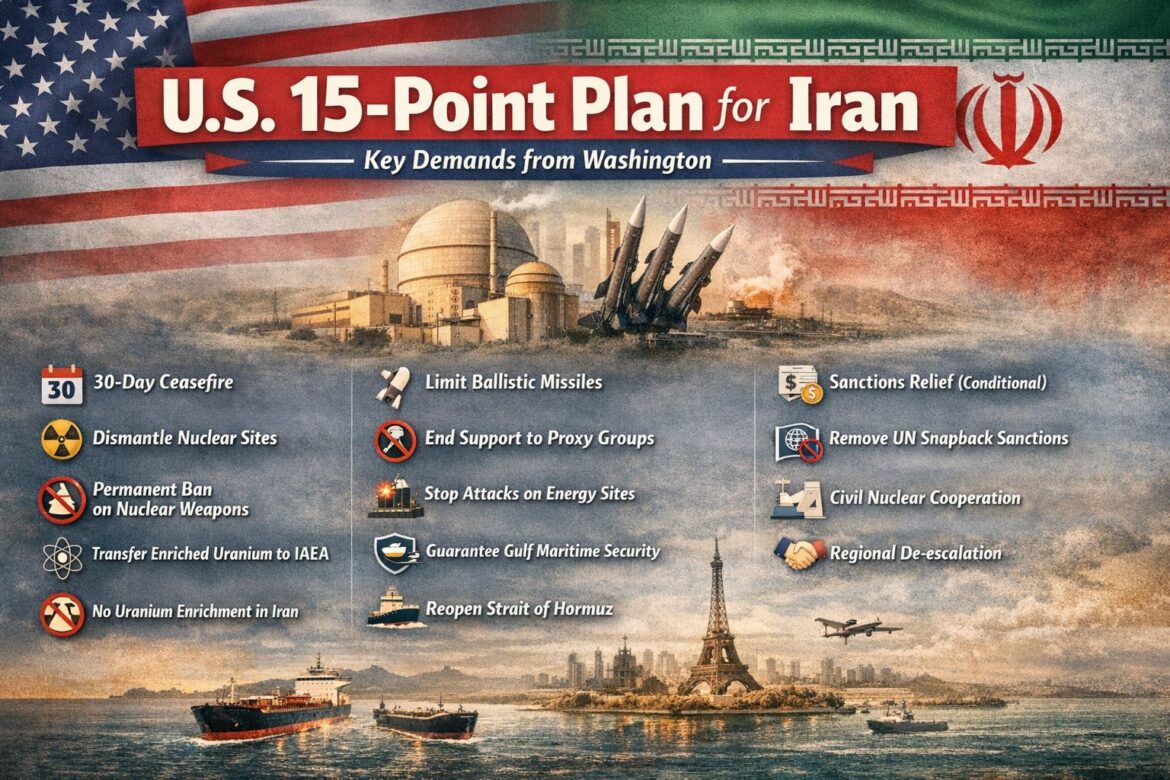
U.S. 15-Point Plan for Iran :
- 30-day ceasefire
- Dismantling of nuclear facilities (Natanz, Fordow, Isfahan)
- Permanent ban on nuclear weapons development
- Transfer of enriched uranium to international control (IAEA)
- Complete halt to uranium enrichment داخل Iran
- Full IAEA inspections and monitoring
- Restrictions on ballistic missile program
- End support to proxy groups (Hezbollah, Houthis, Hamas)
- Stop attacks on regional energy infrastructure
- Guarantee maritime security in the Gulf
- Reopen and secure the Strait of Hormuz
- Conditional sanctions relief
- Removal/prevention of UN snapback sanctions
- Civil nuclear cooperation for peaceful energy
- Broader regional de-escalation and normalization
In short: the US is asking Iran to give up its nuclear programme, its missiles, its regional influence, and control of the Strait of Hormuz — in exchange for sanctions relief and civilian nuclear cooperation.
Iran’s Reaction: Swift and Scornful
The Diplomatic Response
Iran’s Foreign Minister Abbas Araghchi confirmed receiving the plan but described it in blunt terms — calling it ‘extremely maximalist and unreasonable’ and ‘not beautiful, even on paper.’ He stressed that Iran is not in direct negotiations with the US, only exchanging messages through mediators.
The Military’s Response
Iran’s military spokesperson Ebrahim Zolfaghari was even harsher, mocking the US directly: ‘Do not call your defeat an agreement. You will see neither your investments in the region nor the former prices of energy and oil again.’
The Counter-Proposal: Iran’s 5 Conditions
| IRAN’S 5-POINT COUNTER-PROPOSAL
1. Halt all assassinations and attacks on Iranian officials immediately 2. Establish binding mechanisms guaranteeing the war will not resume 3. Pay war reparations and damages to Iran 4. End all US-Israeli attacks on Hezbollah in Lebanon and pro-Iranian militias in Iraq 5. International recognition of Iran’s sovereignty over the Strait of Hormuz |
Notice what Iran is asking for: it wants the Strait of Hormuz recognised as under its sovereignty — the exact opposite of the US demand that it be opened unconditionally. Iran is also demanding Lebanon be included in any deal, which dramatically expands the scope of negotiations.
The Gap Is Enormous — A Comparison
| Issue | 🇺🇸 US Position | 🇮🇷 Iran Position |
| Nuclear Program | Dismantle Natanz, Isfahan & Fordow entirely | Retain civilian rights; Bushehr plant acceptable |
| Uranium Enrichment | Stop all enrichment on Iranian soil | Non-negotiable sovereign right |
| Strait of Hormuz | Reopen immediately; free passage guaranteed | Iran demands sovereignty; controls access |
| Proxy Forces | End all support for Hezbollah, Houthis, Iraqi militias | Not on the table; regional alliances stay |
| Missile Program | Cap range and number of ballistic missiles | No restrictions on self-defence capability |
| War Reparations | Not mentioned | Mandatory — precondition for any deal |
| Ceasefire Format | 30-day truce while finalising terms | No direct negotiations; only mediated messages |
| Lebanon | Separate issue | Must be included as part of any deal |
The two sides are essentially negotiating from different planets. The US wants a surrender of Iran’s strategic assets. Iran wants acknowledgment that it won the first phase of the war and demands structural guarantees before any ceasefire.
Who Is Mediating — and Is It Working?
Pakistan delivered the US plan to Iran. Turkey and Egypt are also involved as back-channel facilitators. Trump has claimed negotiations are ‘underway,’ but Iran’s foreign ministry has flatly denied any formal talks are happening — only ‘message exchanges,’ which it says is not the same thing.
This gap in perception itself is a problem. If the US thinks it’s negotiating and Iran thinks it’s just receiving messages, there is no shared framework for a deal.
What Does This Mean for India?
WHY INDIANS SHOULD CARE
|
Oil Prices & the Import Bill
With Brent crude trading above $100 per barrel since the war began, India’s monthly oil import bill has surged. Every $10 increase in crude prices adds roughly $12–15 billion to India’s annual import bill, widening the current account deficit and putting downward pressure on the rupee.
The Rupee Under Pressure
The rupee has been under stress since the war began, with risk-off sentiment pushing foreign investors away from emerging markets. A prolonged conflict without a ceasefire in sight will keep this pressure alive throughout Q2 2026.
India’s Diplomatic Balancing Act
India has historically maintained ties with both Iran and the US. New Delhi has not publicly condemned the airstrikes, but has called for ‘restraint and dialogue.’ With Iran’s new leadership and the Strait of Hormuz still disrupted, India will need to rapidly diversify its oil sourcing — likely leaning more heavily on the UAE, Saudi Arabia, and Russia.
The Haj Season Risk
With the Hajj season approaching, thousands of Indian Muslims travel through the Gulf. Any escalation in the Arabian Sea corridor or Gulf of Oman remains a real concern for travel safety and logistics.
What Happens Next?
The odds of a quick deal are low. Iran has rejected the US plan, proposed maximalist counter-conditions, and shown no signs of backing down militarily. Meanwhile, Trump has predicted the war could last 4–5 weeks — suggesting the US itself does not expect a fast resolution.
Three scenarios are now in play:
- Phased ceasefire: Both sides quietly narrow the gap through Pakistan and Turkey mediation, agreeing to a 30-day humanitarian pause while talks continue.
- Escalation: Iran targets US bases more aggressively or blocks the Strait completely, forcing a wider regional war and a possible spike in oil to $130–140/barrel.
- Prolonged stalemate: Neither side wins decisively. The war grinds on for months, oil prices stay elevated, and the global economy absorbs the shock.
For now, scenario three looks the most likely.
| KEY TAKEAWAYS FOR WORTHVIEW READERS
• The US 15-point plan demands Iran surrender its nuclear programme, missiles, proxies, and Hormuz leverage — in exchange for sanctions relief. • Iran has rejected it as ‘unreasonable’ and countered with 5 conditions including war reparations and sovereignty over Hormuz. • No direct negotiations are happening. Pakistan, Turkey, and Egypt are acting as mediators. • For India, elevated oil prices, a weaker rupee, and supply chain disruptions are the immediate risks. • A deal looks unlikely in the short term. Watch for whether mediators can get both sides to agree even on a temporary humanitarian ceasefire. |
Enjoy Worthview?
Add Worthview as a Preferred Source on Google to see more of our stories in Search.

Worthview Editorial Team is the shared byline for content created collaboratively by Worthview’s editors and contributors. Since 2008, we’ve published thousands of articles across technology, AI, finance, health, home, travel, and lifestyle. Our editorial process emphasizes original research, reputable sources, regular content updates, and clear attribution. Articles covering higher-trust topics, including health and finance, may also undergo review by qualified subject-matter experts.







One thought on “America’s 15-Point Peace Plan for Iran: What It Demands, What Tehran Said, and What It Means for India”
Comments are closed.