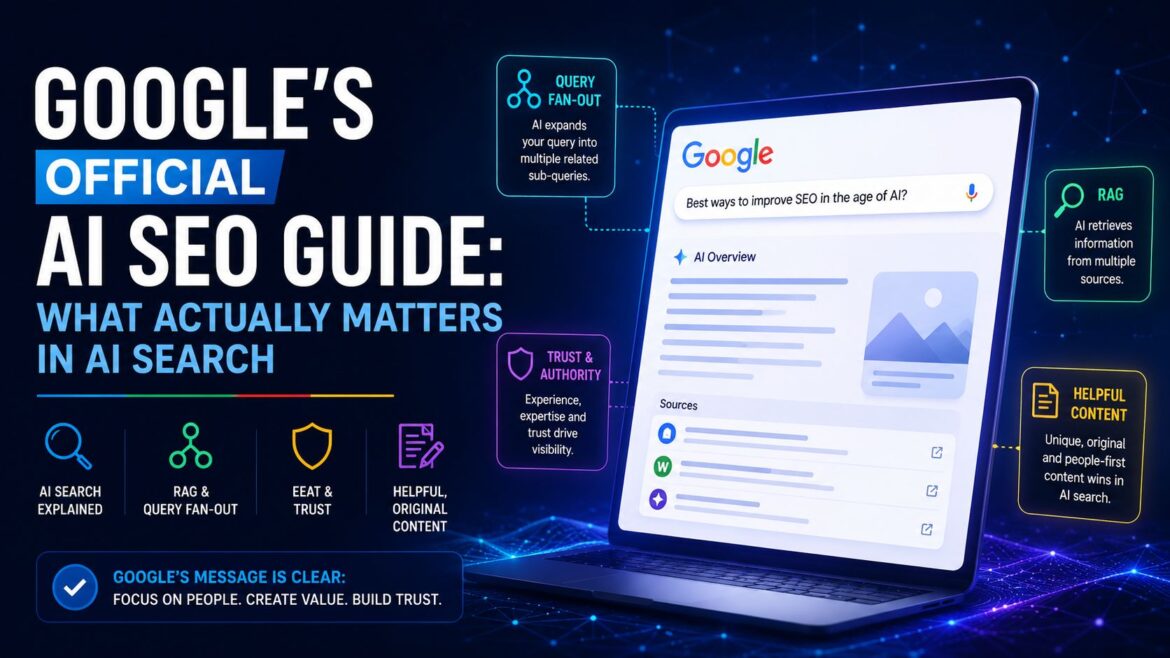
Google has officially published its AI Optimization Guide for Search, giving publishers, bloggers, SEOs, and businesses a clearer understanding of how content is discovered and surfaced in AI-powered search experiences. The guide comes at a time when the SEO industry is flooded with terms like GEO, AEO, AI SEO, and “ranking in ChatGPT.”
But after reading Google’s official documentation, one message becomes very clear:
AI search optimization is not about finding secret hacks. It is about creating genuinely useful, technically accessible, and trustworthy content.
For months, many marketers believed AI search would completely replace traditional SEO. Others started experimenting with questionable tactics like fake brand mentions, AI-generated authority signals, and “LLMS.txt optimization.” Google’s new guide pushes back against much of that hype.
Instead, Google explains that its AI-powered search systems still rely heavily on core SEO fundamentals, including:
- Crawlability
- Indexing
- Helpful content
- Structured site architecture
- Page experience
- Expertise and trust
One of the biggest hidden takeaways from Google’s guide is the growing importance of what it calls “non-commodity content.” In simple terms, content that anyone — or any AI tool — can generate easily may struggle to stand out in AI-driven search experiences.
That changes the game for publishers and affiliate marketers.
The goal of this article is simple: separate the real signals from the noise and understand what actually matters in AI search optimization today.
In short,
- Google confirms that traditional SEO still powers AI search experiences.
- AI systems use RAG and Query Fan-Out to understand topics, context, and related user intent.
- AI search is becoming more topic-driven rather than keyword-driven.
- Original, first-hand, and non-commodity content matters more than ever.
- Technical SEO, crawlability, and structured content remain critical for visibility.
- Google emphasizes trust, expertise, and genuinely helpful content over AI SEO “hacks” or shortcuts.
The Biggest Takeaways From Google’s AI SEO Guide
After analyzing Google’s official documentation, several major themes stand out. Some confirm long-standing SEO best practices, while others reveal how AI-powered search is changing the way content is discovered and evaluated.
Here are the most important takeaways publishers and marketers should understand.
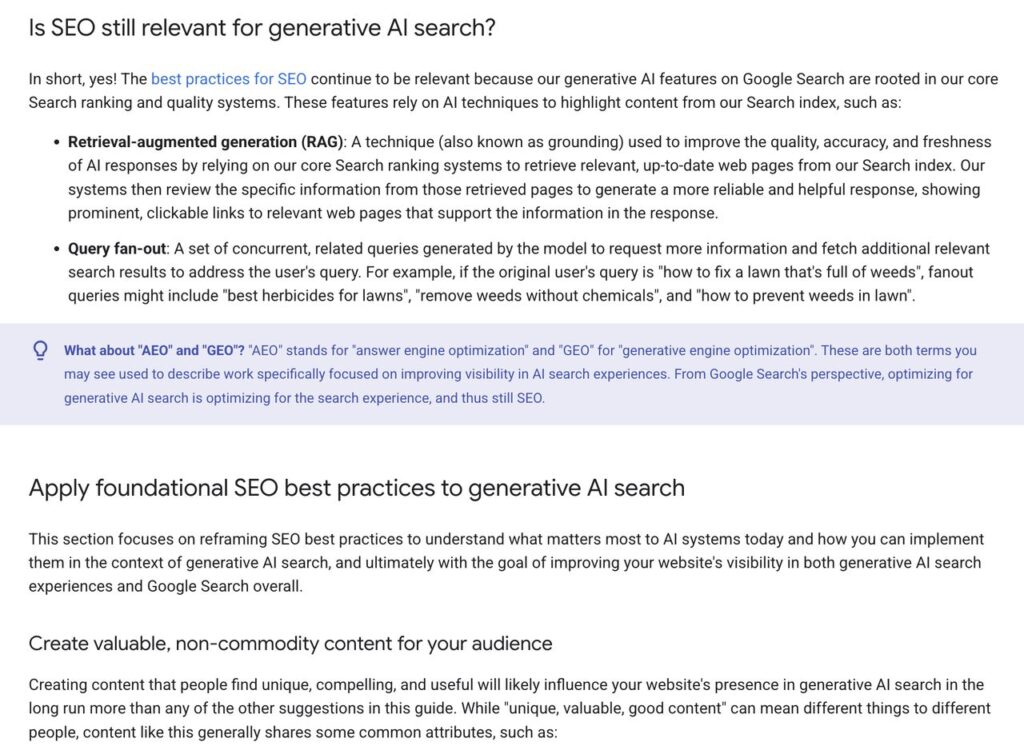
SEO Is Still the Foundation of AI Search
One of the clearest messages in the guide is that AI search is still built on top of traditional Google Search systems.
Google explains that AI-generated experiences rely on the same core infrastructure that powers regular search results. That means the fundamentals of SEO are still critical.
Websites still need:
- Proper crawlability
- Strong internal linking
- Clean site architecture
- Indexable content
- Fast page performance
- Helpful and trustworthy information
This directly challenges the growing narrative that “traditional SEO is dead.”
In reality, AI search appears to amplify the importance of strong SEO foundations rather than replace them.
If Google cannot properly crawl or understand your content, your chances of appearing in AI-generated responses become significantly lower.
Original Content Matters More Than Ever
This may be the most important hidden signal in the entire guide.
Google repeatedly emphasizes the value of:
- unique information
- original insights
- first-hand expertise
- non-commodity content
This is a major shift for content publishers.
For years, many websites succeeded by:
- rewriting existing articles
- summarizing competitor content
- producing large volumes of similar pages
But AI systems can now generate generic information instantly.
That means “average” content becomes less valuable.
The new advantage comes from publishing content AI cannot easily replicate, such as:
- personal experience
- original research
- case studies
- expert analysis
- real-world testing
- unique opinions
- proprietary data
In simple terms:
If your content looks like everyone else’s content, AI search may have less reason to surface it.
AI Search Understands Topics, Not Just Keywords
Traditional SEO heavily focused on individual keywords.
For years, publishers optimized pages around:
- exact-match phrases
- keyword density
- isolated search terms
But AI-powered search is changing how information is retrieved and understood.
Google’s AI systems increasingly rely on broader contextual understanding rather than simply matching keywords on a page. The company’s guide indirectly references concepts like Retrieval-Augmented Generation (RAG) and Query Fan-Out, which help explain how modern AI search actually works.
In simple terms, RAG means the AI system:
- retrieves relevant information from the web
- analyzes multiple sources
- generates an answer using those sources
This is important because AI-generated answers are still heavily dependent on web content.
Google’s AI systems are not simply “guessing” answers from memory. They actively retrieve and evaluate content from indexed pages across the web before generating responses.
That means websites still need:
- crawlable pages
- strong technical SEO
- trustworthy information
- structured content
- contextual relevance
to improve their chances of being surfaced in AI-generated experiences.
Another major shift in AI search is something called:
Query Fan-Out
Instead of processing a single query in isolation, AI systems can automatically expand a user’s search into multiple related subtopics and follow-up questions.
For example, a user searching:
“How do I start investing in crypto safely?”
may trigger additional internal searches like:
- best crypto wallets for beginners
- common crypto scams
- crypto tax basics
- how much beginners should invest
- cold wallets vs hot wallets
Technical SEO Still Powers Visibility
Many people assumed AI search would make technical SEO less important.
Google’s guide suggests the opposite.
AI systems still rely on:
- crawling
- rendering
- indexing
- structured understanding
If technical issues prevent Google from accessing your content properly, AI systems may struggle to use it effectively.
Important technical factors still include:
- mobile friendliness
- clean HTML structure
- proper heading hierarchy
- structured data
- canonicalization
- crawl efficiency
In other words:
AI search still depends heavily on machine-readable websites.
Multimedia Is Becoming More Important
Google also highlights the growing role of rich media in search experiences.
This includes:
- images
- videos
- charts
- visual explainers
- interactive content
AI-powered search is evolving beyond text-only answers. For publishers, this means content strategy can no longer rely entirely on plain text articles.
Trust and Brand Signals Are Growing in Importance
AI systems need confidence in the information they surface.
Because of this, signals related to trust, authority, and reputation appear increasingly important.
Google’s guide indirectly reinforces the value of:
- recognized brands
- expert authors
- consistent topical authority
- credible citations
- strong reputation signals
This aligns closely with Google’s long-standing EEAT principles:
- Experience
- Expertise
- Authoritativeness
- Trustworthiness
The future of SEO may become less about “ranking pages” and more about building trusted entities that AI systems confidently reference.
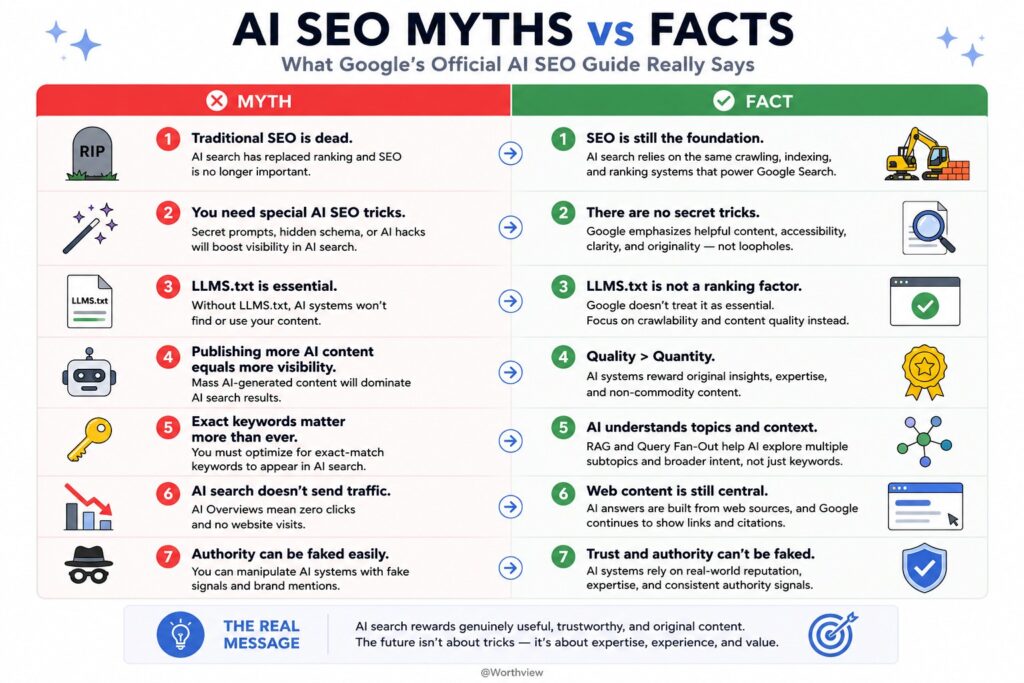
AI SEO Myths Google Quietly Debunked
One of the most interesting parts of Google’s AI Optimization Guide is what it indirectly rejects.
Over the past year, the SEO industry has been flooded with theories about how to “rank” in AI-generated answers. Entire services and frameworks have emerged around concepts like GEO, AEO, and LLM optimization.
But Google’s documentation quietly challenges many of those claims.
Here are some of the biggest AI SEO myths the guide appears to debunk.
Myth #1: “Traditional SEO Is Dead”
This is probably the biggest misconception in the industry right now.
Many people assumed AI-generated search experiences would completely replace traditional ranking systems.
Google’s guide suggests the opposite.
AI search still relies heavily on:
- crawling
- indexing
- ranking systems
- relevance signals
- quality evaluation systems
That means:
- technical SEO still matters
- content quality still matters
- authority still matters
- internal linking still matters
AI search is not operating separately from Google Search.
It is being layered on top of it.
The websites already following strong SEO practices are often in the best position to succeed in AI-powered search experiences.
Myth #2: “You Need Special AI SEO Tricks”
The rise of AI search created demand for shortcuts.
As a result, many marketers started promoting:
- hidden AI prompts
- AI-specific metadata
- secret schema techniques
- prompt injection methods
- “ChatGPT optimization formulas”
Google’s official guide does not support these ideas.
In fact, the documentation repeatedly focuses on:
- accessibility
- clarity
- helpfulness
- structure
- original value
Google does not mention any secret optimization layer designed specifically for AI-generated answers.
That is a major signal.
The companies chasing loopholes may be focusing on the wrong problem.
Myth #3: “LLMS.txt Is Essential”
One of the most heavily discussed topics in AI SEO recently has been LLMS.txt.
Some marketers positioned it as the future equivalent of robots.txt for AI systems.
But Google’s guide does not treat it as an important ranking or visibility factor.
Instead, Google continues emphasizing existing standards and crawlability practices.
This suggests that:
- traditional accessibility signals still matter more
- clear site architecture matters more
- content quality matters more
At least for now, LLMS.txt appears far less important than many people claimed.
Myth #4: “Publishing More AI Content Equals More Visibility”
Many publishers reacted to AI search by massively increasing content production using generative AI tools.
The assumption was simple:
More pages = more chances to appear in AI search.
Google’s guide indirectly pushes back against this mindset.
The repeated emphasis on:
- originality
- unique value
- first-hand expertise
- non-commodity information
suggests that mass-produced generic content may become less effective over time.
AI systems can already generate surface-level information instantly.
That reduces the value of repetitive content that adds little beyond what already exists online.
This does not mean AI-assisted writing is bad.
But content still needs:
- human insight
- unique perspective
- expertise
- practical usefulness
Myth #5: “Exact Keywords Matter More Than Ever”
Traditional SEO heavily focused on exact-match keyword optimization.
AI search is moving toward broader contextual understanding.
Google’s systems increasingly interpret:
- intent
- semantics
- relationships between topics
- follow-up questions
- conversational patterns
This means overly repetitive keyword usage becomes less important than:
- comprehensive coverage
- contextual relevance
- topical authority
- natural language clarity
Instead of optimizing for one isolated keyword, publishers should optimize for complete user journeys.
Myth #6: “AI Search Doesn’t Send Traffic”
A major fear after the rollout of AI Overviews was that websites would lose all visibility and clicks.
While concerns about click-through rates are still valid, Google’s guide repeatedly reinforces that web content remains central to AI-generated experiences.
AI systems still need:
- source material
- authoritative references
- trusted publishers
Google also continues surfacing links and citations within AI experiences.
This suggests the web ecosystem is still foundational to AI search — even if traffic patterns evolve over time.
The bigger challenge may not be “whether traffic exists,” but:
which types of content still earn engagement in AI-driven search environments.
Myth #7: “Authority Can Be Faked Easily”
Some SEO experiments attempted to manipulate AI systems using:
- fake brand mentions
- synthetic reviews
- automated authority signals
- AI-generated citations
Google’s guide strongly emphasizes trust and credibility instead.
This aligns with broader spam-fighting efforts across Search.
AI systems increasingly rely on:
- reputation signals
- trusted sources
- established expertise
- consistent topical authority
Short-term manipulation tactics may become riskier as AI systems improve at evaluating credibility.
The Real Message Behind Google’s Guide
The biggest hidden message throughout the documentation is surprisingly simple:
AI search rewards genuinely useful content more than clever manipulation.
That may sound basic, but it represents a major shift in modern SEO.
For years, many ranking strategies focused on exploiting weaknesses in search algorithms.
AI-powered search changes that dynamic because modern systems are getting better at evaluating:
- depth
- context
- usefulness
- trust
- originality
And that makes sustainable SEO strategies more important than ever.
Conclusion
Google’s official AI SEO guide sends a very clear message to publishers, marketers, and businesses:
The future of AI search is not about shortcuts, hacks, or secret optimization tricks.
It is about creating genuinely useful, trustworthy, and original content that helps users solve real problems.
While the SEO industry continues chasing terms like GEO, AEO, and “AI ranking tactics,” Google’s documentation repeatedly points back to the same core principles that have always mattered:
- helpful content
- technical accessibility
- topical expertise
- trustworthiness
- strong user experience
At the same time, the guide also reveals an important evolution in search itself.
AI-powered systems are becoming better at understanding:
- context
- intent
- entities
- relationships between topics
- conversational user journeys
This means the future of SEO will rely less on isolated keyword targeting and more on building complete topical authority.
For publishers and bloggers, this creates both a challenge and an opportunity.
The challenge is that generic, mass-produced content is becoming easier for AI systems to generate and summarize. Simple rewrites and low-value articles may struggle to stand out in AI-driven search experiences.
But the opportunity is even bigger.
Websites that invest in:
- first-hand expertise
- original research
- unique perspectives
- multimedia content
- strong branding
- real audience trust
can become more valuable than ever in the AI search era.
In many ways, Google’s guide confirms that AI search is not replacing SEO — it is forcing SEO to mature.
The websites that succeed moving forward will not necessarily be the ones producing the most content. They will be the ones creating the most useful, credible, and differentiated content.
And that may ultimately be the biggest shift of all.
Enjoy Worthview?
Add Worthview as a Preferred Source on Google to see more of our stories in Search.

Sethuram Kishore is the founder and editor of Worthview, an online publication established in 2008. With over 18 years of experience in SEO, digital marketing, and online publishing, he writes about AI, technology, business, and digital trends. He is also the founder of MoneyHulk, a personal finance and business publication.





One thought on “Google’s Official AI SEO Guide Takeaways & Myths Debunked”
Comments are closed.