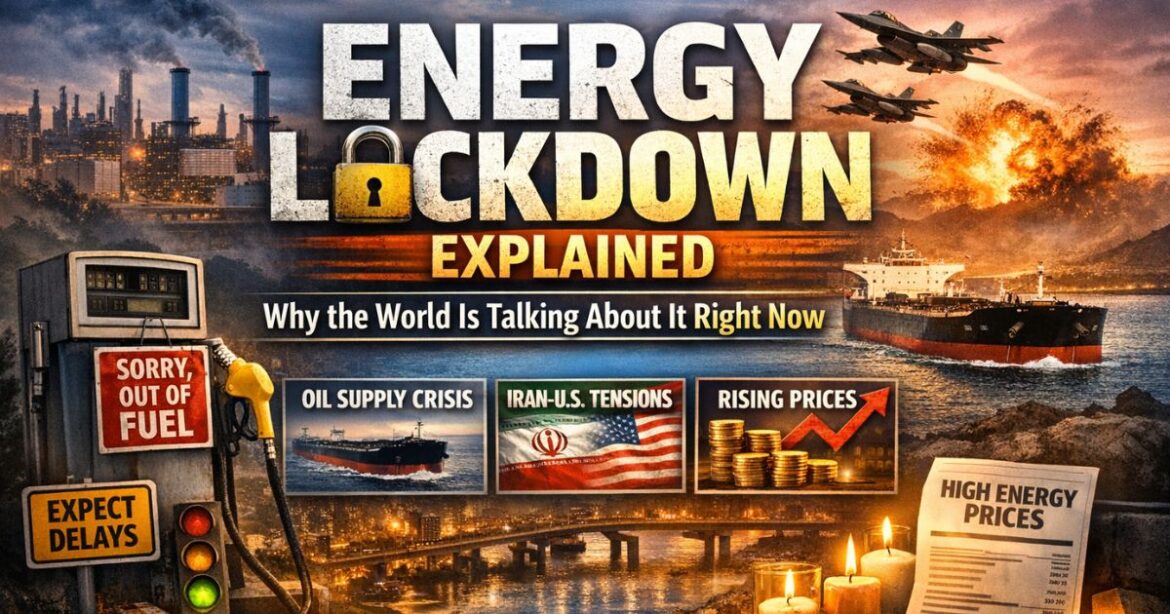
Energy lockdown is a situation where governments take emergency steps to reduce fuel and electricity usage during a supply crisis. This can include limiting travel, controlling fuel consumption, and encouraging people to use less power.
It is trending now because rising tensions involving Iran and the United States are threatening global oil supply—especially through the critical Strait of Hormuz—raising fears of shortages and higher energy prices worldwide.
If you have been on social media in the last few days, you have probably seen the phrase “Energy Lockdown” trending everywhere. WhatsApp groups are buzzing. Twitter is panicking. And people are rushing to petrol pumps and booking extra LPG cylinders — just in case.
But what exactly is an Energy Lockdown? Is it even real? And most importantly — will India actually impose one?
Let us break this down clearly, calmly, and completely.
TL;DR
- Energy lockdown means strict steps to reduce fuel and electricity use during a crisis
- It is not officially declared, but widely discussed due to rising tensions
- The main trigger is disruption in oil supply via the Strait of Hormuz
- Countries may enforce limits on travel, fuel usage, and power consumption
- India could face higher fuel prices, inflation, and supply pressure
What Is an Energy Lockdown?
First things first — the term “Energy Lockdown” is not an official government policy anywhere in the world. It was not announced by any prime minister, president, or international body.
The phrase was coined by social media users to describe a possible scenario where governments might impose strict restrictions on fuel, electricity, and gas usage — similar to how countries imposed COVID lockdowns in 2020.
In practical terms, an energy lockdown refers to a combination of government-enforced measures designed to reduce national energy consumption during a severe supply crisis. Think of it as a COVID lockdown — but instead of shutting down to fight a virus, you shut down to conserve fuel.
The types of measures that could be included are:
- Fuel rationing — limiting how much petrol or diesel a vehicle can buy per week
- Alternate-day driving — odd and even number plates allowed on alternate days
- Work from home mandates — to reduce office energy use and commuting fuel
- Speed limit reductions — lower speeds mean less fuel burned per kilometre
- Business flight cuts — reducing air travel to save aviation fuel
- Industrial energy rationing — factories getting limited electricity supply
None of these have been implemented in India. But the fear is real — and it is rooted in a genuine global energy crisis that started in late February 2026.
The Root Cause: Strait of Hormuz and the West Asia War
To understand the energy lockdown fear, you need to understand what triggered it — the ongoing conflict involving the United States, Israel, and Iran that escalated sharply in late February 2026.
At the heart of the crisis is a single geographical chokepoint: the Strait of Hormuz.
Why Does the Strait of Hormuz Matter So Much?
The Strait of Hormuz is a narrow waterway between Iran and Oman — only about 33 kilometres wide at its narrowest point. But it carries an extraordinary share of the world’s energy supply:
- About 20% of all global crude oil consumption passes through it every day
- Around 20 million barrels of crude oil and oil products transit daily
- One-fifth of the world’s Liquefied Natural Gas (LNG) is shipped through it
- One-third of global fertiliser exports pass through it
- Nearly half of the world’s sulphur supply transits through this route
When this strait gets disrupted, the entire world feels it — from petrol prices in Delhi to electricity bills in Europe.
What Happened to Qatar’s LNG Plant?
The conflict brought a devastating blow to global gas markets. Qatar’s Ras Laffan facility — the world’s largest LNG processing plant, which normally supplies about one-fifth of the world’s LNG — was damaged in a drone attack. Qatar Energy warned that full repairs could take three to five years, and that it may have to exit long-term supply contracts with Italy, Belgium, South Korea, and China.
That single incident sent shockwaves through global energy markets. Crude oil prices surged past $100 per barrel, and diesel, jet fuel, and LPG prices spiked even higher.
Why Is ‘Energy Lockdown’ Trending Right Now in India?
The panic hit India around March 24, 2026. Three separate events collided on the same day and created a perfect storm of misinformation.
Trigger 1: PM Modi’s Parliament Speech
Prime Minister Narendra Modi addressed the Rajya Sabha and urged the nation to remain prepared and united amid disruptions caused by the West Asia conflict. He drew a parallel with the COVID-19 pandemic — noting that the difficult global conditions are likely to persist for an extended period.
The COVID comparison was enough. Social media ran with it. Within hours, people were posting that India was heading into a fuel lockdown just like the 2020 pandemic lockdown.
Trigger 2: COVID Lockdown Anniversary
March 24 is the sixth anniversary of the day India announced its first COVID lockdown in 2020. The emotional memory of that sudden announcement — late at night, just four hours notice — was still fresh. PM Modi’s preparedness language on the exact same date set off alarm bells that even the most cautious users could not ignore.
Trigger 3: The IEA’s 10-Point Emergency Plan
On March 20, 2026, the International Energy Agency published what it called a 10-point emergency demand reduction plan to help member countries cope with the oil supply shock. The plan included measures like working from home three extra days a week, lowering highway speed limits, reducing business air travel by 40%, and switching from LPG cooking to electric alternatives.
These were voluntary, advisory measures meant for IEA member nations — which India is not a formal part of. But Indian social media picked up screenshots of the plan and circulated them as a “global energy lockdown announcement.” The rest, as they say, is viral history.
The IEA’s 10-Point Plan — What Does It Actually Say?
Let us look at what the International Energy Agency actually proposed, because this plan is the backbone of the whole global energy lockdown conversation.
The IEA said all 10 measures combined could reduce global oil demand by 2.7 million barrels per day — that is roughly 2.7% of daily global consumption. The measures are:
- Work from home 3 extra days per week — could cut national car fuel use by 2 to 6%
- Reduce highway speed limits by 10 km/h — cuts individual fuel use by 5 to 10%
- Alternate-day driving in cities based on number plates
- Make Sundays car-free in major cities
- Increase public transport use — could cut car fuel use by 1 to 3%
- Cut business flights by 40% — reduces global jet fuel demand by 7 to 15%
- Avoid air travel under 1,000 km where train is available
- Shift freight from road to rail where possible
- Use electric vehicles and bikes over petrol-powered alternatives
- Switch cooking fuel from LPG to electric alternatives where feasible
The IEA also announced on the supply side that member countries agreed to release 400 million barrels of oil from emergency reserves — the largest emergency stock release in the IEA’s history.
These are global-level advisory measures, not government orders. In India, none of these have been made mandatory.
How Vulnerable Is India to This Crisis?
Let us be honest — India is among the most exposed nations in the world to a Strait of Hormuz disruption. Here is why:
- India imports approximately 88% of its crude oil
- About half of India’s natural gas comes from imports
- Nearly 60% of India’s LPG is imported
- An estimated 85 to 90% of India’s LPG shipments historically pass through the Strait of Hormuz
- South Asia as a whole — India, Bangladesh, Pakistan — imported almost two-thirds of their total LNG supplies via the Strait in 2025
This dependency is why the crisis triggered real concern — not just social media panic. For Indian households, LPG is not a luxury. It is what 300 million families use to cook every single day. Any shortage in cooking gas hits the poorest households hardest.
What Actually Happened on the Ground?
In cities like Hyderabad, motorists lined up at petrol pumps and households started booking extra LPG cylinders. Petrol stations in areas like Secunderabad, Jubilee Hills, and Banjara Hills reported heavy rushes. Some stations displayed “No Stock” signs — not because of a genuine shortage, but because of panic buying overwhelming local delivery schedules.
The irony is that panic buying itself creates the very shortage people fear. When everyone books three cylinders at once, distributors cannot keep up with demand in the short term — even if total national supply is adequate.
What Is the Indian Government Actually Doing?
Here is what many people do not know: the government has been working quietly but urgently behind the scenes. The response has been far more robust than the official denials suggest.
Emergency LPG Production Orders
On March 8, 2026, the government issued the LPG Control Order, directing all Indian refineries to maximise LPG yields and channel 100% of their C3 and C4 hydrocarbon streams exclusively to the three Oil Marketing Companies (OMCs) for domestic cooking gas production. In the five days that followed, LPG production jumped by 28%.
By the time you are reading this, daily domestic LPG output has been pushed to 50,000 metric tonnes per day — a 40% increase over normal levels.
Import Diversification
India has not just been producing more — it has been importing from everywhere it can. Consignments totalling 800 metric tonnes of LPG are en route from multiple countries, including the United States, Russia, and Australia. These shipments are scheduled to arrive at India’s 22 import terminals spread across the coast.
Supply Operations
Oil marketing companies are currently supplying over 5 million LPG cylinders every single day. The government has also secured crude oil supplies for the next 60 days, giving refineries a firm runway to plan production.
Financial Support
LPG subsidy allocations for the financial year 2026-27 have been scaled up. The government has approved OMC compensation for under-recovery losses of Rs 30,000 crore, with a separate Rs 17,500 crore OMC support package also confirmed. In plain language — the government is absorbing the global price shock so that retail LPG prices do not spike uncontrollably for Indian consumers.
Will India Impose an Energy Lockdown?
The official government answer is clear: No.
The Ministry of Petroleum and Natural Gas has stated that there is no shortage of petrol, diesel, or LPG anywhere in the country, and that all fuel outlets are operating normally without any rationing. Key facts the government has highlighted:
- Refineries are currently operating at over 100% of their rated capacity
- India has secured crude oil supplies for the next 60 days
- Total national LPG storage capacity stands at 74 days worth of supply
- Current stock cover is approximately 60 days
- Supply diversification has been achieved across 41+ supplier nations
India has built supply buffers precisely for situations like this. And unlike COVID — where the problem spread silently before anyone reacted — the energy crisis is visible, predictable, and being managed in real time.
That said, if the Strait of Hormuz remains disrupted for months rather than weeks, and if global energy prices continue to surge, the government may need to introduce softer advisory measures — like encouraging work from home, reducing government vehicle usage, or promoting public transport. But even these would be voluntary and not a lockdown in any meaningful sense of the word.
What Other Countries Are Doing
Some countries, particularly those with even greater dependence on Gulf energy, have already moved to formal emergency measures:
- The Philippines has proclaimed a national energy emergency and introduced a four-day government work week to reduce energy consumption
- Pakistan and Bangladesh have enforced conservation measures including reduced office hours, lighting curfews in commercial areas, and reduced fuel allocations
- European nations are strategically releasing oil reserves and urging citizens to reduce gas heating usage
India’s position is comparatively stronger because of its larger reserve buffers and more diversified import base. But the situation bears watching.
Key Facts at a Glance
| Factor | Detail |
| Crisis trigger | US-Israel-Iran conflict, Strait of Hormuz disruption |
| Crude oil price | Surged past $100 per barrel |
| IEA emergency stock release | 400 million barrels — largest in IEA history |
| India crude import dependency | ~88% — among the world’s highest |
| India’s current fuel reserves | ~60 days of stock |
| India LPG production increase | 28% to 40% via emergency refinery orders |
| Daily LPG cylinders supplied | Over 5 million per day |
| LPG import sources | USA, Russia, Australia + 38 other nations |
| Government financial support | Rs 30,000 crore OMC compensation approved |
| Is India imposing an energy lockdown? | No — officially and practically |
What Should Indian Citizens Actually Do?
Instead of panic buying or stockpiling, here is practical advice for Indian households and businesses in this environment:
- Do not hoard LPG cylinders — panic buying creates the very shortage you fear and makes things harder for others
- Use fuel efficiently — combine errands, carpool, maintain tyre pressure for better mileage
- Track official government communications at mopng.gov.in rather than relying on WhatsApp forwards
- If you run a business, now is a good time to audit your energy costs and explore diversification
- Consider whether work-from-home arrangements are feasible — not as a mandate, but as a smart cost-saving move
The Bottom Line
The Energy Lockdown is real as a concept — but it is not imminent for India as a policy. What is real is a genuine global energy supply shock, triggered by the most serious disruption to the Strait of Hormuz in modern history. India is feeling the pressure, but its government has moved aggressively behind the scenes to buffer the impact.
The viral panic on social media is a case study in how three separate, real events — PM Modi’s preparedness speech, the COVID lockdown anniversary, and the IEA’s emergency plan — merged into a single, terrifying-sounding narrative that was not rooted in any actual government order.
Stay informed. Do not panic. And keep watching this space — because the situation in West Asia is still evolving, and the weeks ahead will tell us how deep and lasting this energy crisis truly is.
FAQs: Energy Lockdown Explained
What is energy lockdown in simple terms?
Energy lockdown means reducing the use of fuel and electricity during a crisis to avoid shortages and manage supply.
Is energy lockdown officially announced anywhere?
No. As of now, no country has declared a full energy lockdown, but many are preparing for possible restrictions if the situation worsens.
Why is energy lockdown trending now?
It is trending due to rising tensions involving Iran and the United States, which are affecting global oil supply—especially through the Strait of Hormuz.
What happens during an energy lockdown?
Governments may:
- Limit fuel usage
- Encourage work-from-home
- Reduce travel and flights
- Promote saving electricity
Will fuel prices increase because of this?
Yes, fuel prices can rise if supply is disrupted, which can also increase the cost of transport and daily goods.
Can India face an energy lockdown?
India is unlikely to have a full lockdown soon, but it may face higher fuel prices and supply pressure due to its dependence on oil imports.
Is energy lockdown similar to COVID lockdown?
Not exactly. COVID lockdowns were for health reasons, while energy lockdown focuses on saving fuel and electricity during a crisis.
How long can an energy crisis last?
It depends on global conditions. If tensions reduce, the situation may improve quickly. If not, it can last for months or longer.
What can individuals do during such a situation?
- Use less electricity
- Avoid unnecessary travel
- Save fuel wherever possible
- Follow government guidelines
Enjoy Worthview?
Add Worthview as a Preferred Source on Google to see more of our stories in Search.

Worthview Editorial Team is the shared byline for content created collaboratively by Worthview’s editors and contributors. Since 2008, we’ve published thousands of articles across technology, AI, finance, health, home, travel, and lifestyle. Our editorial process emphasizes original research, reputable sources, regular content updates, and clear attribution. Articles covering higher-trust topics, including health and finance, may also undergo review by qualified subject-matter experts.