Italy is one of those places that feels like you have stepped inside a history book. Every street corner, every hilltop, every old stone wall has a story to tell. But nothing captures Italy’s magic quite like its stunning castles and magnificent basilicas.
Whether you are a first-time traveler from India planning your Europe dream trip, or a seasoned globetrotter adding another stamp to your passport — this guide is made for you. We have done the research, filtered the fluff, and put together the 10 best castles and 10 best basilicas that are truly worth your time and money.
By the end of this article, you will know exactly which sites to visit, what makes each one special, how much it costs, and how to plan your trip like a pro. Let’s go!
| ⚡In Short:
The 10 best castles in Italy include Castel Sant’Angelo (Rome), Castello Sforzesco (Milan), Castel del Monte (Puglia), and more. The 10 best basilicas include St. Peter’s (Vatican), San Marco (Venice), and the Basilica of St. Francis (Assisi). Together, these 20 sites represent over 2,000 years of Italian art, architecture, and history. |
📊 Italy Travel — Quick Facts at a Glance
| 📌 Quick Fact | Details |
| 🌍 Country | Italy (Southern + Central Europe) |
| 🏛️ Best Castles Region | Campania, Sicily, Lazio, Lombardy |
| ⛪ Best Basilicas Region | Rome, Venice, Assisi, Florence |
| 📅 Best Time to Visit | April–June, September–October (pleasant weather, fewer crowds) |
| ⏱️ Ideal Duration | 10–14 days to cover all major sites comfortably |
| ✈️ Nearest Airports | Rome (FCO), Milan (MXP), Venice (VCE), Naples (NAP) |
| 🗣️ Local Language | Italian (English widely spoken at tourist sites) |
| 💳 Currency | Euro (€) — carry some cash for small villages |
| 🌡️ Avg. Temp (Apr–Oct) | 18°C–30°C — Light layers recommended |
| 🎟️ Entry Fees | Free to €18 per site; book online to skip queues |
| 🚆 Best Way to Travel | Trenitalia high-speed trains between cities |
🏰 PART 1: The 10 Best Castles in Italy
Italy is home to over 40,000 castles. Yes, you read that right — 40,000! But you do not have time to visit all of them. So we have picked the absolute best ones based on history, beauty, accessibility, and traveler reviews. Here they are, in all their glory.
🗺️ Castles Comparison Table
| Castle | Location | Entry Fee | Built | Famous For |
| Castel Sant’Angelo | Rome, Lazio | €15 | 4th century | Papal fortress + bridge |
| Castello Sforzesco | Milan, Lombardy | Free/€5 | 15th century | Renaissance art & museums |
| Castel del Monte | Apulia, Puglia | €7 | 13th century | UNESCO octagonal mystery |
| Castello Aragonese | Ischia, Naples | €12 | 1441 | Island castle, sea views |
| Castello di Amorosa | Tuscany region | €25+ | Modern replica | Wine tasting castle |
| Castello di Miramare | Trieste | €6 | 1860 | Habsburg royal palace by sea |
| Castello di Fénis | Aosta Valley | €6 | 14th century | Alpine fortress + frescoes |
| Castel Nuovo | Naples, Campania | €6 | 1282 | Angevin kings’ seat of power |
| Castello di Giulietta | Verona | Free outside | Medieval era | Romeo & Juliet legend |
| Castello di Lombardia | Enna, Sicily | €4 | 14th century | Largest castle in Sicily |
1. 🏰 Castel Sant’Angelo
| 📍 Location | Rome, Lazio |
| 🎟️ Entry Fee | €15 (online booking saves time) |
| ⭐ Best For | History lovers, photographers, Rome tourists |
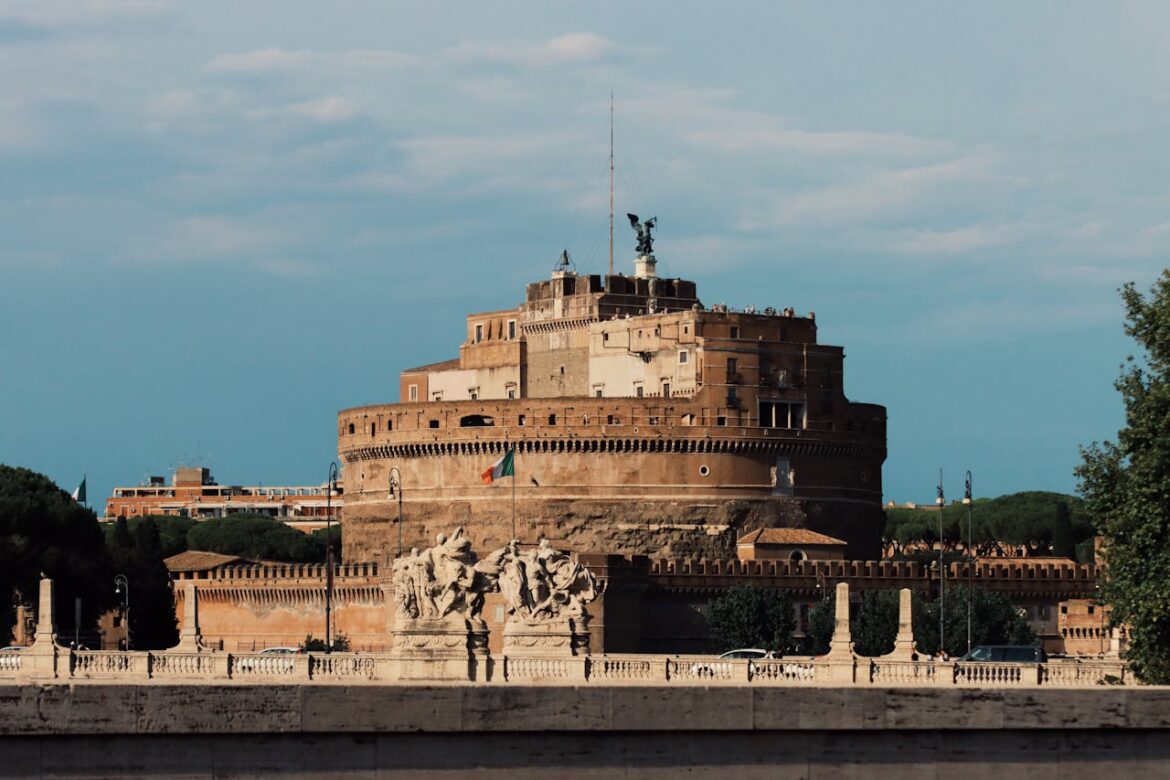
If you visit only one castle in all of Italy, make it Castel Sant’Angelo. Originally built by Emperor Hadrian in 123 AD as his mausoleum, this massive cylindrical fortress has survived wars, papal power plays, and centuries of history.
Later, it became a prison, a papal refuge, and today — a beautiful museum. The Popes even built a secret passageway called the ‘Passetto di Borgo’ that connected the Vatican directly to this castle. Imagine escaping through a secret tunnel!
Standing on its roof terrace, you get one of the best views of Rome — the Tiber River, St. Peter’s Dome, and the entire city spreading out below you. The bridge leading to the castle, Ponte Sant’Angelo, is lined with angel statues sculpted by Bernini’s students.
✨ Highlights
- Built in 123 AD — over 1,900 years old
- Secret escape tunnel connecting to the Vatican
- Rooftop panoramic view of Rome
- Featured in the novel ‘Angels & Demons’ by Dan Brown
- The bronze angel statue on top can be seen from miles away
2. 🎨 Castello Sforzesco
| 📍 Location | Milan, Lombardy |
| 🎟️ Entry Fee | Free entry / €5 for museums inside |
| ⭐ Best For | Art lovers, families, Milan day-trippers |
Castello Sforzesco is Milan’s crown jewel — a massive red-brick fortress right in the heart of the city. Built by the powerful Visconti family in the 14th century and later taken over by the Sforza dynasty, this castle has been at the center of Milanese power for centuries.
What makes it truly special today is what’s inside. The castle holds several world-class museums, including one that houses Michelangelo’s very last sculpture — the Rondanini Pietà, an unfinished masterpiece he was working on just days before he died in 1564.
The castle’s courtyard is open to the public for free and is a favorite spot for locals to relax. Beyond the castle lies the large Sempione Park — perfect for a picnic after your visit.
✨ Highlights
- Houses Michelangelo’s last unfinished sculpture
- Multiple museums inside covering art, archaeology, and ancient Egypt
- Free courtyard open every day
- Connected to Sempione Park — great for families
- Just 10 minutes walk from Milan’s famous Duomo cathedral
3. ⬛ Castel del Monte
| 📍 Location | Andria, Puglia (Southern Italy) |
| 🎟️ Entry Fee | €7 |
| ⭐ Best For | Architecture buffs, UNESCO enthusiasts, mystery lovers |
Castel del Monte is one of the most mysterious buildings in all of Italy. Built in 1240 by Holy Roman Emperor Frederick II, this castle is unlike anything you have ever seen. It is perfectly octagonal — eight-sided walls, eight towers, eight rooms on each floor.
Nobody knows exactly why Frederick II chose this strange shape. Some say it was connected to the number eight’s spiritual significance, others say it was designed using advanced astronomical knowledge. The castle has no stables, no kitchens, no moat — it was likely never used as a military fortress at all.
Today it is a UNESCO World Heritage Site and one of southern Italy’s most photographed landmarks. It even appears on Italy’s one-euro coin!
✨ Highlights
- Perfect octagonal shape — 8 towers, 8 rooms per floor, 8 sides
- UNESCO World Heritage Site since 1996
- Featured on Italy’s 1-euro coin
- Built in 1240 — over 780 years old
- One of the best-preserved medieval castles in Europe
4. 🏝️ Castello Aragonese
| 📍 Location | Ischia Island, near Naples |
| 🎟️ Entry Fee | €12 |
| ⭐ Best For | Couples, honeymooners, island explorers |
Imagine a castle rising dramatically from a volcanic rock in the middle of the sea, connected to the main island by a long stone bridge. That is exactly what Castello Aragonese looks like — and it is every bit as magical as it sounds.
Located on the stunning island of Ischia in the Bay of Naples, this fortress dates back to 474 BC when it was first built by the ancient Greeks. Later expanded by the Aragonese rulers of Naples in 1441, it became a thriving community with churches, convents, and even a convent of nuns.
Today you can explore multiple levels of the castle, visit ancient chapels, and enjoy some of the most breathtaking views of the Mediterranean you will ever see.
✨ Highlights
- Built on a volcanic rock island in the sea
- Originally constructed by ancient Greeks in 474 BC
- Connected to Ischia island by a stone bridge
- Stunning 360-degree views of the Mediterranean
- Home to fascinating stories of nuns, prisoners, and royals
5. 🍷 Castello di Miramare
| 📍 Location | Trieste, Friuli Venezia Giulia |
| 🎟️ Entry Fee | €6 |
| ⭐ Best For | History lovers, architecture fans, nature walkers |
Perched dramatically on a cliff overlooking the crystal-blue Adriatic Sea, Castello di Miramare is one of the most romantically beautiful castles in all of Europe. Built between 1856 and 1860 for Archduke Maximilian of Austria — the younger brother of Emperor Franz Joseph — it is a fairy-tale in stone and sea.
The castle is surrounded by a stunning 22-hectare park, and every room inside is preserved almost exactly as it was in the 1800s. Maximilian had grand dreams, but his story ended tragically — he later became Emperor of Mexico and was executed in 1867.
Today the castle is a museum and one of the most-visited sites in the northeastern Italy region.
✨ Highlights
- Built right on a cliff above the Adriatic Sea
- Every room preserved as it was in the 1860s
- Surrounded by a beautiful 22-hectare park
- Haunting royal history — Maximilian of Austria’s tragic fate
- Spectacular sunset views from the sea-facing windows
6. 🏔️ Castello di Fénis
| 📍 Location | Aosta Valley, Northwestern Italy |
| 🎟️ Entry Fee | €6 |
| ⭐ Best For | Alpine travelers, fresco lovers, history explorers |
Nestled in the foothills of the Alps, Castello di Fénis looks exactly like the castles you drew in your school notebooks — tall towers, thick stone walls, a courtyard, and a double ring of defensive walls. It is beautifully preserved and one of the finest examples of medieval military architecture in Italy.
Built in the 14th century by the powerful Challant family, the castle features remarkable frescoes painted directly onto the walls of the courtyard. These paintings show Saint George slaying the dragon and other medieval legends, making the castle feel like a living storybook.
The Aosta Valley itself is spectacular — snow-capped Alps, charming villages, and the kind of landscape that makes you want to slow down and breathe deeply.
✨ Highlights
- Classic medieval castle design — towers, walls, moat
- Well-preserved 14th-century frescoes inside the courtyard
- Set against the stunning backdrop of the Alps
- One of the best-preserved castles in the entire Aosta Valley
- Excellent guided tours in English available
7. 👑 Castel Nuovo (Maschio Angioino)
| 📍 Location | Naples, Campania |
| 🎟️ Entry Fee | €6 |
| ⭐ Best For | History lovers, Naples tourists, medieval architecture fans |
Castel Nuovo — also known as ‘Maschio Angioino’ meaning ‘New Angevin Male Castle’ — is one of the defining images of Naples. Its five round towers and the stunning white marble Triumphal Arch at the entrance make it impossible to miss when you arrive at Naples harbour.
Built in 1282 by Charles I of Anjou, the castle served as the royal seat of the Kingdom of Naples for centuries. Inside today, you’ll find an excellent Civic Museum with ancient frescoes, sculptures, and a fascinating history of the city.
The area around the castle, right by the harbour, offers beautiful views of the Bay of Naples and the distant outline of Mount Vesuvius.
✨ Highlights
- Five massive cylindrical towers visible from Naples harbour
- Beautiful white marble Triumphal Arch from 1443
- Excellent Civic Museum with medieval frescoes
- Views of Mount Vesuvius from the castle grounds
- Walking distance from Naples central train station
8. ❤️ Castello di Giulietta (Juliet’s Castle)
| 📍 Location | Verona, Veneto |
| 🎟️ Entry Fee | Free (exterior) / €6 museum |
| ⭐ Best For | Romantics, couples, literature lovers |
You may know Verona as the city of Romeo and Juliet — Shakespeare’s most famous love story. And while Juliet was fictional, Verona’s Casa di Giulietta (Juliet’s House) and the nearby castle have become powerful symbols of love and romance worldwide.
The house has a famous balcony where tourists from around the world come to recreate that iconic scene. The walls outside are covered with love notes written by visitors — a tradition that has been going on for decades. And the bronze statue of Juliet in the courtyard is said to bring luck in love if you touch her right shoulder.
Verona itself is a UNESCO-listed city, and beyond Juliet’s house, it has a magnificent Roman arena, stunning piazzas, and charming medieval streets.
✨ Highlights
- Famous balcony from Shakespeare’s Romeo and Juliet
- Thousands of love notes cover the courtyard walls
- Bronze Juliet statue said to bring romantic luck
- Set in UNESCO-listed Verona city
- Magnificent Roman Arena Verona — still used for opera today
9. 🌊 Castello di Lombardia
| 📍 Location | Enna, Sicily |
| 🎟️ Entry Fee | €4 |
| ⭐ Best For | Sicily travelers, panoramic view seekers, history buffs |
If you’re visiting Sicily — and you absolutely should — the Castello di Lombardia in Enna is one of the most impressive fortresses on the entire island. Built in the 14th century by the Sicilian Normans, it is the largest castle in Sicily and sits at the highest point of Enna, one of Italy’s highest-altitude cities.
From the castle towers, you get a breathtaking 360-degree view of Sicily’s green valleys, distant volcanoes, and ancient towns. On a clear day, you can see Mount Etna — Europe’s largest active volcano — smoking gently in the distance.
Sicily itself is underrated by most tourists, but it offers some of Italy’s most authentic experiences — incredible food, ancient Greek ruins, and a culture that feels entirely its own.
✨ Highlights
- Largest castle in Sicily
- Located at Enna — one of Italy’s highest-altitude cities
- Spectacular views of Mount Etna on clear days
- 14th-century Norman architecture remarkably well-preserved
- Nearby Persephone temple ruins add mythological depth
10. 🌹 Castello di Amorosa
| 📍 Location | Tuscany region |
| 🎟️ Entry Fee | €25+ (includes wine tasting) |
| ⭐ Best For | Wine lovers, Tuscany visitors, unique experience seekers |
Castello di Amorosa is Italy’s most romantic and quirky entry on our list — it is actually a modern winery built to look and feel like a 13th-century medieval Italian castle. Located in the beautiful Napa Valley of Italy — Tuscany — it was painstakingly constructed by winemaker Dario Sattui using authentic medieval techniques and original European materials.
Inside, you will find stone towers, a moat, a dungeon, chapels with hand-painted frescoes, and 107 rooms spread across multiple levels. Of course, the main attraction is the incredible wine tasting, with award-winning Sangiovese and other Tuscan varietals.
For Indian travelers who want the fairy-tale Italy experience with great wine, this is your spot.
✨ Highlights
- Looks 700 years old — actually completed in 2007
- Built using authentic medieval techniques and materials
- 107 rooms including towers, chapel, and dungeon
- Award-winning Sangiovese wine tasting included
- Set in Tuscany — surrounded by rolling vineyards
⛪ PART 2: The 10 Best Basilicas in Italy
Italy is not just the birthplace of the Roman Empire — it is also the spiritual heart of the Catholic world. With more than 900 basilicas officially recognized by the Vatican, Italy has more sacred architecture per square kilometer than anywhere else on Earth.
But you only have limited time. So here are the 10 basilicas that will genuinely leave you speechless — whether you are religious or not, whether you are a first-timer or a repeat visitor. These are sacred spaces that humans have been building, decorating, and praying in for over 1,500 years. No matter where you’re from, walking inside them feels like something special.
🗺️ Basilicas Comparison Table
| Basilica | Location | Entry Fee | Built | Famous For |
| St. Peter’s Basilica | Vatican City, Rome | Free/€8 dome | 1626 | World’s largest church |
| Basilica di San Marco | Venice | Free/€3 | 11th c. | Byzantine golden mosaics |
| Basilica of St. Francis | Assisi, Umbria | Free | 1253 | Giotto’s famous frescoes |
| Santa Maria Maggiore | Rome | Free | 5th c. | Oldest Marian basilica |
| Basilica di Sant’Ambrogio | Milan | Free | 379 AD | Oldest Milanese church |
| Orvieto Cathedral | Orvieto, Umbria | €3 | 1290 | Stunning Gothic facade |
| Basilica of San Vitale | Ravenna | €11.50 | 547 AD | UNESCO Byzantine mosaics |
| Certosa di Pavia | Pavia, Lombardy | Free | 1396 | Monastic Renaissance marvel |
| Basilica di Superga | Turin, Piedmont | €8 | 1731 | Baroque hillside panorama |
| Sacra di San Michele | Val di Susa, Turin | €6 | 983 AD | Mountain abbey, breathtaking |
1. ✝️ St. Peter’s Basilica
| 📍 Location | Vatican City, Rome |
| 🎟️ Entry Fee | Free entry | €8 for dome climb |
| ⭐ Best For | Everyone — this is unmissable |
St. Peter’s Basilica is the single most visited church in the entire world — and once you step inside, you will instantly understand why. Its sheer size is staggering. The central nave stretches 187 meters long. The dome, designed by Michelangelo himself, rises 136 meters into the sky.
Inside, every surface is covered in marble, gold, and centuries of artistic masterpieces. Bernini’s Baldachin — the massive bronze canopy above the main altar — stands 29 meters tall. Michelangelo’s Pietà (a sculpture of Mary holding Jesus) sits quietly behind bullet-proof glass and has moved visitors to tears for 500 years.
Climbing the dome is not easy — 551 stairs — but the view from the top is one of the greatest in the world. Below you, the colonnaded piazza spreads out like open arms welcoming the world.
✨ Highlights
- World’s largest church — can hold 60,000 people
- Dome designed by Michelangelo, completed 1590
- Michelangelo’s Pietà — one of the world’s most famous sculptures
- Bernini’s 29-meter bronze Baldachin above the altar
- Catacombs below hold the tombs of dozens of Popes
2. ✨ Basilica di San Marco
| 📍 Location | Venice |
| 🎟️ Entry Fee | Free / €3 for special access areas |
| ⭐ Best For | Art lovers, Venice tourists, anyone visiting Venice |
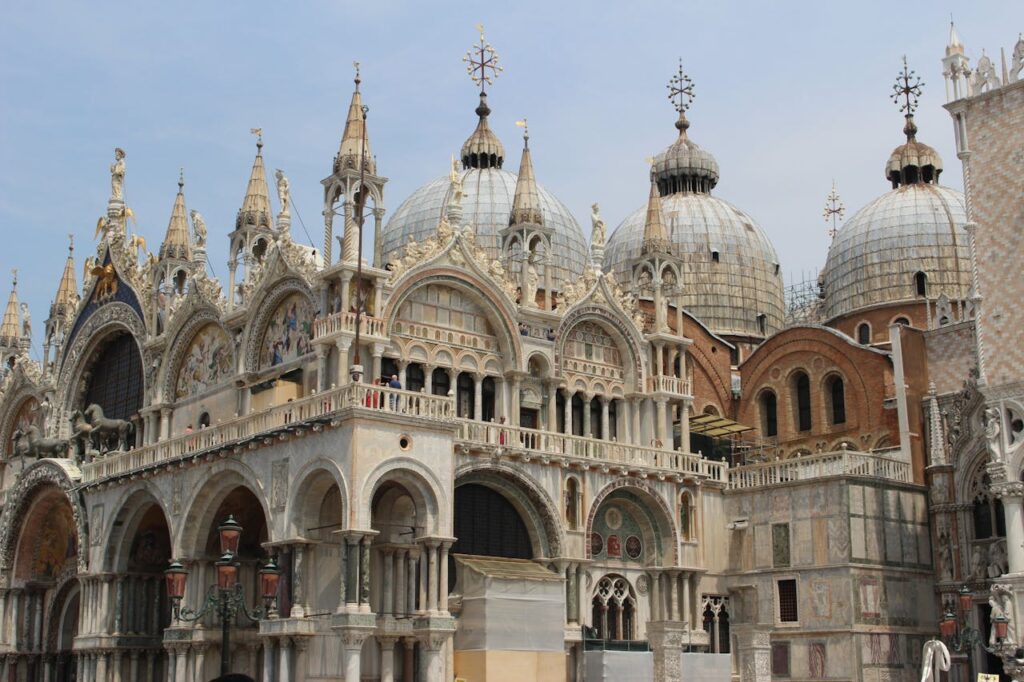
Venice’s Basilica di San Marco is unlike any other church in Italy. While most Italian basilicas are Gothic or Baroque, San Marco is deeply Byzantine — its stunning golden mosaics, multiple domes, and richly decorated facade look more like something you would find in Istanbul than in Europe.
The story of the basilica begins with a bit of medieval theft. In 828 AD, two Venetian merchants smuggled the remains of St. Mark the Evangelist out of Alexandria, Egypt, hiding the holy relics under layers of pork and cabbage (so the Muslim guards would not touch them). Venice built this magnificent basilica to house those relics.
Inside, over 8,000 square meters of golden Byzantine mosaics cover the walls and ceilings — each tiny piece of glass tile carefully placed by hand. When the candles are lit, the entire interior shimmers like liquid gold.
✨ Highlights
- Over 8,000 sq. meters of golden Byzantine mosaics inside
- Built in 829 AD to house the stolen remains of St. Mark
- Five massive bronze horses (replicas) on the facade
- Combines Byzantine, Gothic, and Islamic architectural elements
- Must-see: The Pala d’Oro — a golden jeweled altarpiece with 255 precious stones
3. 🌿 Basilica of St. Francis of Assisi
| 📍 Location | Assisi, Umbria |
| 🎟️ Entry Fee | Free (donations welcome) |
| ⭐ Best For | Art lovers, pilgrims, peaceful seekers |
If you are looking for the most moving, most spiritual, and most artistically important basilica outside of Rome — the Basilica of St. Francis in Assisi is your answer. It is a UNESCO World Heritage Site and one of the most important pilgrimage destinations in the entire Christian world.
The basilica is actually two churches built on top of each other — an Upper Church and a Lower Church, with the crypt of St. Francis at the very bottom. The Upper Church contains what many art historians consider the birth of Western art — Giotto’s 28 masterpiece frescoes painted in the late 13th century, depicting the life of St. Francis in vivid, lifelike detail. Before Giotto, religious painting was flat and symbolic. Giotto made it human.
The town of Assisi itself is one of Italy’s most beautiful medieval hilltop towns — cobblestone streets, honey-colored stone houses, and panoramic views of the Umbrian countryside.
✨ Highlights
- UNESCO World Heritage Site since 2000
- Giotto’s 28 famous frescoes — considered birth of Western art
- Two churches on top of each other — Upper and Lower Basilica
- Contains the actual tomb of St. Francis in the crypt below
- Set in Assisi — one of Italy’s most beautiful medieval towns
4. 🌹 Basilica di Santa Maria Maggiore
| 📍 Location | Rome, Lazio |
| 🎟️ Entry Fee | Free (small fee for museum) |
| ⭐ Best For | History lovers, Rome travelers, Marian devotees |
Santa Maria Maggiore is one of Rome’s four major basilicas and the oldest and largest church in the world dedicated to the Virgin Mary. It was built in the 5th century AD — that means it is over 1,600 years old — and it has been continuously used as a place of worship ever since.
The interior is breathtaking. The nave is lined with 36 ancient columns, and the ceiling was gilded with the first gold that Columbus brought back from the Americas — a gift from the Spanish monarchs to the Pope. The 5th-century mosaics in the apse are some of the oldest Christian mosaics still in existence today.
The basilica also houses what tradition claims are wooden planks from the manger where Jesus was born in Bethlehem — the Reliquary of the Holy Crib.
✨ Highlights
- World’s largest church dedicated to Virgin Mary
- Built in the 5th century — over 1,600 years old
- Gilded ceiling with first gold brought from the Americas
- Houses relics believed to be from Jesus’s manger in Bethlehem
- Ancient 5th-century mosaics — some of the oldest in existence
5. ⚓ Basilica di Sant’Ambrogio
| 📍 Location | Milan, Lombardy |
| 🎟️ Entry Fee | Free |
| ⭐ Best For | Early Christian history buffs, Milan visitors |
The Basilica di Sant’Ambrogio is one of the oldest and most historically significant churches in Italy — and yet most tourists visiting Milan rush past it to get to the Duomo. That is their loss, and your gain.
It was built in 379 AD by St. Ambrose himself — one of the four original Doctors of the Church and the bishop who baptized St. Augustine. The church has barely changed since the 4th century, giving it an atmosphere of genuine, ancient holiness that is rare even in Italy.
Inside, you will find a 4th-century sarcophagus, a golden altar from the 9th century, and the actual remains of St. Ambrose kept in a glass case below the altar — remarkably preserved in his full bishop’s robes.
✨ Highlights
- Built in 379 AD — one of Italy’s oldest standing churches
- Founded by St. Ambrose who is buried here
- 9th-century golden altar with intricate carvings
- 4th-century sarcophagus — among the oldest in northern Italy
- Far less crowded than Milan’s Duomo — a hidden gem
6. 🟨 Orvieto Cathedral (Duomo di Orvieto)
| 📍 Location | Orvieto, Umbria |
| 🎟️ Entry Fee | €3 |
| ⭐ Best For | Architecture lovers, art fans, Umbria travelers |
The Duomo di Orvieto has one of the most jaw-dropping exteriors of any building in the world. Built starting in 1290 on the orders of Pope Nicholas IV, the cathedral’s Gothic facade is covered with golden mosaics, intricate marble carvings, and colored sculptures that shimmer dramatically when the afternoon sun hits them.
Inside, the Chapel of San Brizio contains a series of frescoes by Luca Signorelli that art historians describe as a direct inspiration for Michelangelo’s Sistine Chapel ceiling. If you want to understand how Michelangelo came to paint the way he did, start here.
The city of Orvieto sits dramatically atop a volcanic cliff — arriving by funicular railway from the train station below is itself an experience.
✨ Highlights
- One of the most beautiful Gothic facades in the world
- Luca Signorelli frescoes that inspired Michelangelo’s Sistine Chapel
- City sits atop a volcanic cliff — arrive by funicular
- Construction took over 300 years — started 1290, completed 1600s
- Nearby underground Orvieto caves — a bonus must-visit
7. 🌟 Basilica of San Vitale
| 📍 Location | Ravenna, Emilia-Romagna |
| 🎟️ Entry Fee | €11.50 (joint ticket with other Ravenna sites) |
| ⭐ Best For | Byzantine art fans, UNESCO enthusiasts, history lovers |
Ravenna is one of Italy’s great underrated cities — most tourists drive straight past it on the way to Venice or Florence. That is a huge mistake. Ravenna was the capital of the Western Roman Empire, the Byzantine Exarchate, and later the Ostrogothic Kingdom. And it shows.
The Basilica of San Vitale, built in 547 AD during the reign of Byzantine Emperor Justinian I, contains the finest collection of early Byzantine mosaics outside of Istanbul. The colors are so vivid, so perfectly preserved after 1,500 years, that they look like they were completed last week.
The famous mosaic panels of Emperor Justinian and Empress Theodora — golden, commanding, and brilliantly detailed — are considered some of the greatest artworks of the ancient world.
✨ Highlights
- Built in 547 AD — nearly 1,500 years old
- UNESCO World Heritage Site since 1996
- Famous mosaic portraits of Emperor Justinian and Empress Theodora
- Colors perfectly preserved after 15 centuries
- One of the finest examples of Byzantine architecture in the world
8. 🌸 Certosa di Pavia
| 📍 Location | Pavia, Lombardy |
| 🎟️ Entry Fee | Free (donation expected) |
| ⭐ Best For | Architecture lovers, peaceful retreat seekers, Milan day-trippers |
The Certosa di Pavia is not technically a basilica — it is a Carthusian monastery. But its church is so spectacular that it belongs on every list of Italy’s greatest sacred architecture. Located 30 kilometers south of Milan, this monastery complex was founded in 1396 by Gian Galeazzo Visconti as a spiritual counterpart to his Milan castle.
The facade of the church is one of the most ornate and beautiful in all of Lombardy — entirely decorated with inlaid marble, medallions, statues, and carvings. Inside, every surface is a work of art: Renaissance frescoes, Gothic stone carvings, and an incredibly peaceful cloister garden where the monks still live.
The monks who live here today are part of a centuries-old tradition of silence and contemplation — and guided tours are led by the monks themselves.
✨ Highlights
- Founded in 1396 by the Visconti family of Milan
- Monks still live here and lead guided tours
- One of northern Italy’s most beautiful facades
- Peaceful cloister garden — genuinely serene
- 30 km from Milan — easy half-day trip by train
9. 🏔️ Basilica di Superga
| 📍 Location | Turin, Piedmont |
| 🎟️ Entry Fee | €8 (includes museum) |
| ⭐ Best For | Panoramic views, Turin visitors, royal history lovers |
The Basilica di Superga sits on a hilltop 672 meters above sea level, overlooking the city of Turin and the entire Po Valley beyond. Built between 1717 and 1731 by architect Filippo Juvara, it is one of the finest examples of Baroque architecture in northern Italy.
Victor Amadeus II of Savoy commissioned the basilica as a thanksgiving offering after Turin survived a French siege in 1706. Inside, the royal crypt holds the remains of most of the House of Savoy — the ruling dynasty of Italy until 1946.
The basilica is also the site of one of Italian football’s darkest tragedies — on May 4, 1949, a plane carrying the entire Torino FC football team crashed into the hillside here. A memorial inside commemorates the tragedy that shocked a nation.
✨ Highlights
- Sits 672 meters above Turin with stunning panoramic views
- Royal crypt with tombs of Italy’s Savoy dynasty
- Built 1717–1731 — masterpiece of Baroque architecture
- Memorial to the 1949 Torino FC air disaster
- Reached by the historic Superga rack railway — itself a fun ride
10. 🦅 Sacra di San Michele
| 📍 Location | Val di Susa, Turin |
| 🎟️ Entry Fee | €6 |
| ⭐ Best For | Adventure travelers, mountain lovers, medieval history fans |
The Sacra di San Michele is Italy’s most dramatically located sacred building — and possibly the most dramatically located church in all of Europe. Perched at 962 meters above sea level on a rocky Alpine summit overlooking the Val di Susa valley, it looks like something out of a fantasy novel.
Founded around 983 AD by a Benedictine hermit, the abbey was built on pure rock face, which meant the builders had to construct massive staircases literally inside the mountain just to reach the entrance. The ‘Staircase of the Dead’ — where deceased monks’ bones were placed in niches along the walls — is genuinely haunting.
Writer Umberto Eco was inspired by San Michele when writing his famous novel ‘The Name of the Rose.’ The abbey is very much still a living place of worship and community today.
✨ Highlights
- Perched at 962 meters on a rocky Alpine summit
- Founded 983 AD — over 1,000 years old
- The ‘Staircase of the Dead’ — bones set into the mountain walls
- Inspired Umberto Eco’s novel ‘The Name of the Rose’
- Panoramic views of the Alps and Po Valley on clear days
Best Time to Visit Italy
- April to June: Best weather, blooming landscapes, manageable crowds — highly recommended
- July to August: Hot (30–38°C), crowded, expensive — avoid if possible
- September to October: Excellent — cooler, harvest season, beautiful light
- November to March: Off-season — cold, some sites have reduced hours, but cheapest prices and fewest tourists
Getting Around Italy
- Trenitalia high-speed trains (Frecciarossa): Rome to Milan in 3 hours, Rome to Venice in 3.5 hours
- Italo trains: Alternative private rail network, often cheaper
- Renting a car: Great for Tuscany, Puglia, Sicily, and countryside castles
- Local buses and metro: Efficient in Rome, Milan, and Naples
- Walking: The best way to explore historic city centers
Frequently Asked Questions
What is the most famous castle in Italy?
Castel Sant’Angelo in Rome is Italy’s most iconic castle. Built in the 2nd century as a mausoleum, it later became a papal fortress and is now one of Rome’s top-visited landmarks. The bridge leading to it — Ponte Sant’Angelo — is equally stunning.
Which is the most beautiful basilica in Italy?
St. Peter’s Basilica in Vatican City tops most lists. With Michelangelo’s massive dome, Bernini’s grand colonnade, and centuries of masterpiece artwork inside, it’s considered one of the greatest architectural achievements in human history.
How many days do I need to visit Italy’s castles and basilicas?
Plan at least 10–14 days to cover the top sites across Rome, Venice, Milan, Naples, and Assisi. If you’re short on time, even 5–7 days in Rome alone gives you access to several world-class castles and basilicas.
Is it expensive to visit castles and basilicas in Italy?
Many basilicas — including St. Peter’s and Assisi’s Basilica — are free to enter. Castles typically cost between €4–€15. The bigger expense is travel between cities. Overall, budget around €60–€100 per day including food, transport, and entry fees.
What should I wear when visiting basilicas in Italy?
Dress modestly — shoulders and knees must be covered inside basilicas and churches. Carry a light scarf or shawl in your bag, especially in summer. Many basilicas will deny entry or lend paper wraps if you’re not dressed appropriately.
Can Indian tourists visit Italian castles without a visa?
Indian passport holders need a Schengen Visa to visit Italy. Apply at least 6–8 weeks before travel. Italy is part of the Schengen Area, so one visa covers most of Europe. Check vfsglobal.com for the nearest application center in India.
What is the best time of year to visit Italy for sightseeing?
April to June and September to October are the best months. The weather is pleasant (20–28°C), crowds are manageable, and prices are lower than peak summer. Avoid August if possible — it’s hot, expensive, and very crowded.
Enjoy Worthview?
Add Worthview as a Preferred Source on Google to see more of our stories in Search.

Worthview Editorial Team is the shared byline for content created collaboratively by Worthview’s editors and contributors. Since 2008, we’ve published thousands of articles across technology, AI, finance, health, home, travel, and lifestyle. Our editorial process emphasizes original research, reputable sources, regular content updates, and clear attribution. Articles covering higher-trust topics, including health and finance, may also undergo review by qualified subject-matter experts.




One thought on “🏰 10 Best Castles and Basilicas to Visit in Italy”
Comments are closed.