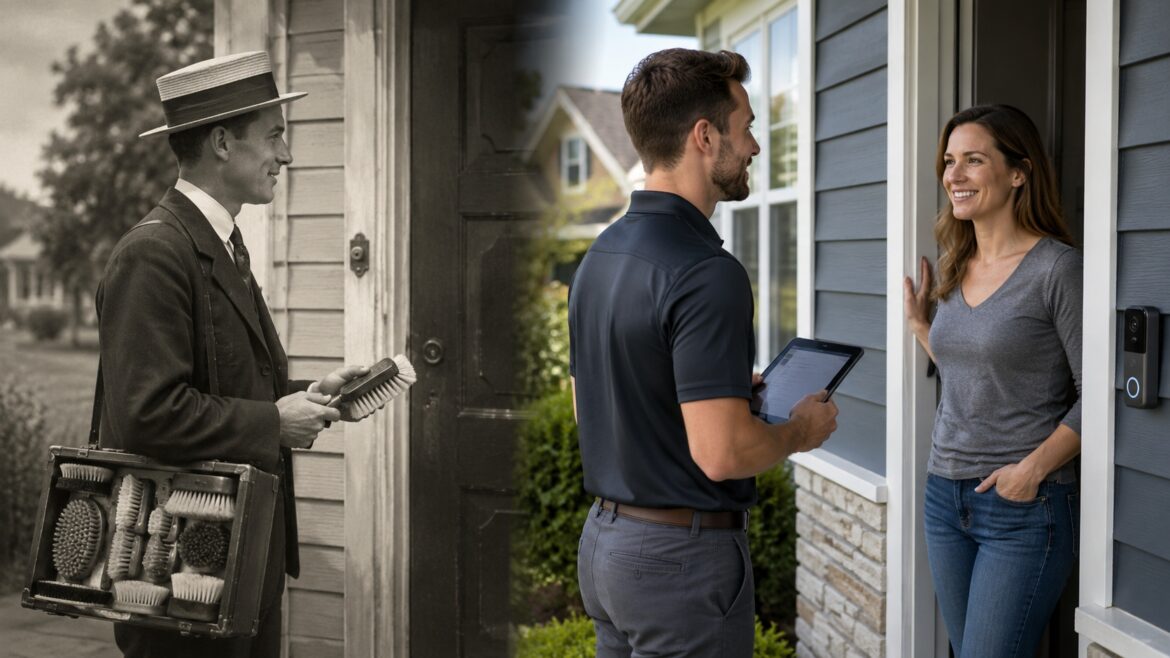
A stranger knocking on a stranger’s door to sell something is one of the oldest sales mechanics in American commerce, and it has survived roughly a century of predictions that it was finished. To understand why it is still around, and why a modern company built entirely on it can still compete for attention against a phone in every homeowner’s pocket, it helps to start with how the industry actually got here.
Key Takeaways
- Door-to-door sales began with the Fuller Brush Company in 1906.
- The industry evolved from selling household goods to high-value home services.
- Personal conversations remain more effective than digital ads for complex purchasing decisions.
- Modern companies use podcasts, social media, and structured onboarding to recruit and train sales teams.
- Video doorbells have changed how sales representatives build trust with homeowners.
- Grit Marketing demonstrates how traditional sales techniques can succeed with modern technology.
What Is Door-to-Door Sales?
Door-to-door sales is a direct selling method where sales representatives visit homes or businesses in person to promote products or services. Unlike online or phone sales, it allows customers to ask questions, receive demonstrations, and make purchasing decisions through face-to-face interactions.
Where the Knock on the Door Actually Came From
| Year | Milestone |
|---|---|
| 1906 | Fuller Brush founded |
| 1930s | Hundreds of thousands of sales representatives |
| 1931 | Green River ordinance introduced |
| 1960–1980 | Vacuum cleaners and encyclopedias dominate |
| 1990s | Pest control sales boom |
| Today | Solar, security, pest control remain major industries |
Organized door-to-door selling in the United States traces back to the Fuller Brush Company, founded in 1906, which sent traveling salesmen door to door with cases of brushes and cleaning demonstrations. The model spread fast enough that by the 1930s Fuller Brush alone had built a sales force in the hundreds of thousands, and other categories followed the same playbook through the middle of the century: vacuum cleaners, encyclopedias, home cleaning products, all sold through an in-person demonstration that a mail-order catalog could not replicate.
The backlash arrived almost as quickly as the industry did. Cities began passing ordinances restricting door-to-door solicitation as early as the 1920s, and in 1931 the town of Green River, Wyoming passed the first law of its kind requiring a homeowner’s invitation before a salesman could approach a door.
The legal fight over that ordinance went all the way to the Supreme Court. It set the tone for a tension that has followed the industry ever since, caught between genuine demand for the product and a public that has always been at least a little suspicious of a stranger on the porch.
Why the Golden Age Ended and the Industry Did Not
By the second half of the twentieth century, telemarketing offered companies a cheaper way to reach the same households, and later e-commerce offered an even cheaper one. Door-to-door selling should have died somewhere in that transition, and for the low-cost consumer goods that built its reputation, mostly it did. Nobody sells encyclopedias door to door anymore.
What survived was a narrower but more durable category: high-consideration home services that genuinely benefit from an in-person conversation, pest control, home security, solar, and similar categories where a homeowner has real questions that a phone call or a banner ad cannot fully answer.
Pest control’s door-to-door segment specifically traces to the 1990s, when companies began recruiting sales teams built around a talent pool that continues to fuel the industry today, college students and returned missionaries out of Utah County and the surrounding region, comfortable approaching strangers and unusually tolerant of rejection.
Some of the earliest people who went through that system later started pest control companies of their own, a pattern that shows up repeatedly across the industry’s more recent history.
Traditional vs Modern Door-to-Door Sales
| Traditional | Modern |
|---|---|
| Paper brochures | Digital presentations |
| Word-of-mouth recruiting | Social media recruiting |
| Printed training manuals | Podcasts and online resources |
| Cold introductions | Video doorbell first impressions |
| Local reputation | Online reviews and social proof |
A Case Study in What Adaptation Actually Looks Like
Grit Marketing, a door-to-door pest control sales organization based in Lindon, Utah, is a useful present-day example of how a century-old sales mechanic keeps adapting without actually changing at its core. The company still recruits and trains reps to do the fundamentally old thing, walk up, introduce themselves, hold a conversation, and close a deal in person. What has changed is nearly everything surrounding that moment.
Training That Starts Before the First Door
Grit Marketing’s onboarding still runs on in-person role-play and shadow days, the same basic method any sales organization has used for decades. What is different is what happens before a new rep ever reaches that stage. The company’s path from entry-level rep to leadership is now documented in writing and made publicly available before a recruit’s first day, something a Fuller Brush salesman’s manager never had an easy way to produce or distribute. The in-person training still does the heavy lifting. The written material around it exists to set expectations earlier and more consistently than a verbal orientation ever could.
A Podcast Built Around the People Doing the Job
Grit Marketing also produces an internal podcast, The Landing Pad, featuring conversations with the company’s own sales leaders about how they built their careers inside the organization. Content like this did not exist in any form for most of the industry’s history, since there was no cheap way to record, produce, and distribute it. Its function is closer to institutional memory than marketing: a way of passing down how a career in door-to-door sales actually unfolds, told by the people who lived it, to new reps who have not yet found out for themselves.
A Digital Presence Built for Recruiting, Not Selling
Grit Marketing has also built a visible social media presence, an Instagram account under the handle the___grit that has grown to roughly 18,000 followers across more than 2,100 posts, and a YouTube channel under the same handle. Neither platform sells pest control directly, and neither is meant to. What they do is give a prospective recruit or a curious homeowner a way to see the company before ever meeting a rep in person, something no version of the Fuller Brush Company ever had available to it.
The Evidence That the Core Mechanic Still Works
None of the recruiting content, the podcast, or the social presence matters if the actual conversation at the door has stopped producing results. It has not. Grit Marketing reported that 37 of its sales representatives earned Golden Door Award recognition in a single summer season, an award tied to a specific, verified account-closing threshold rather than a subjective performance review. The same season produced a new company rookie record, with a first-year representative closing 750 accounts over a single twelve-week selling block. Numbers like that are a more concrete argument than any general claim about human nature. They are evidence that the specific company adapting around the edges is still winning the part that was never up for negotiation.
The Homeowner’s Side of the Equation Changed Too
Digital tools did not just change how companies recruit and train. They changed what happens the moment a rep reaches the door. A homeowner with a video doorbell can see and hear a rep before deciding whether to answer at all, something that would have been unthinkable to a Fuller Brush salesman working a neighborhood in 1950. That shift raises the bar for the interaction itself. A rep today is often being evaluated before the door even opens, based on how they present themselves in the first few seconds, which is its own version of the same trust problem the industry has always had, solved with a tool the industry never had to account for before.
The Part That Never Actually Left
It is tempting to describe an industry like this as either stuck in the past or fully reinvented, and neither description holds up. Grit Marketing’s broader footprint today includes far more infrastructure than a comparable company would have needed a generation ago, recruiting content, a podcast, a visible online presence, all of it wrapped around a transaction that still depends entirely on one person convincing another person face to face. Utah County’s door-to-door sales industry, Grit Marketing included, did not survive by abandoning what a Fuller Brush salesman understood in 1906. It survived by keeping that part intact and building everything else around it.
Frequently Asked Questions
Why is door-to-door sales still effective in the digital age?
Despite the growth of online shopping and digital marketing, door-to-door sales remain effective for high-consideration services like pest control, home security, and solar installation. Face-to-face conversations allow sales representatives to answer questions, demonstrate value, build trust, and address customer concerns immediately—advantages that online ads and emails often cannot provide.
What types of businesses benefit most from door-to-door sales?
Door-to-door sales work best for businesses offering services that require education or personalized consultations. Common examples include:
- Pest control
- Home security systems
- Solar energy solutions
- Roofing and home improvement
- Internet and cable services
- Window and insulation installation
These industries benefit from in-person discussions that help homeowners make informed purchasing decisions.
How has technology changed door-to-door sales?
Technology has transformed nearly every part of the sales process except the face-to-face conversation itself. Modern companies now use social media for recruiting, digital onboarding programs, podcasts for training, CRM software for lead management, electronic contracts, and video doorbells that influence first impressions before a homeowner even opens the door.
For companies like Grit Marketing, social media is primarily a recruiting and employer-branding tool rather than a direct sales channel. Platforms such as Instagram and YouTube help prospective sales representatives learn about the company culture, training opportunities, and career growth before joining the organization.
What skills make someone successful in door-to-door sales?
Successful door-to-door sales representatives typically possess strong communication skills, resilience, confidence, active listening abilities, and the willingness to handle rejection. Building trust quickly, understanding customer needs, and explaining complex services in simple terms are also essential for long-term success.
Is door-to-door sales making a comeback?
While traditional door-to-door sales for low-cost consumer products has largely disappeared, the model continues to thrive in specialized industries that rely on personal interaction. Rather than making a comeback, the industry has evolved by combining traditional relationship-building with modern technology, digital branding, and structured sales training.
How do homeowners verify a door-to-door salesperson today?
Many homeowners now use video doorbells, online reviews, company websites, and social media profiles to verify a salesperson’s legitimacy before engaging in a conversation. Companies that maintain a professional online presence often establish credibility even before the first face-to-face interaction.
Why do some companies still prefer face-to-face sales over online marketing?
Face-to-face sales offer immediate, personalized interactions that digital channels often cannot match. Representatives can answer questions in real time, tailor their presentation to the homeowner’s needs, overcome objections, and build trust through personal communication. For complex or high-value services, this often leads to higher conversion rates than digital advertising alone.

Sethuram Kishore is the founder and editor of Worthview, an online publication established in 2008. With over 18 years of experience in SEO, digital marketing, and online publishing, he writes about AI, technology, business, and digital trends. He is also the founder of MoneyHulk, a personal finance and business publication.