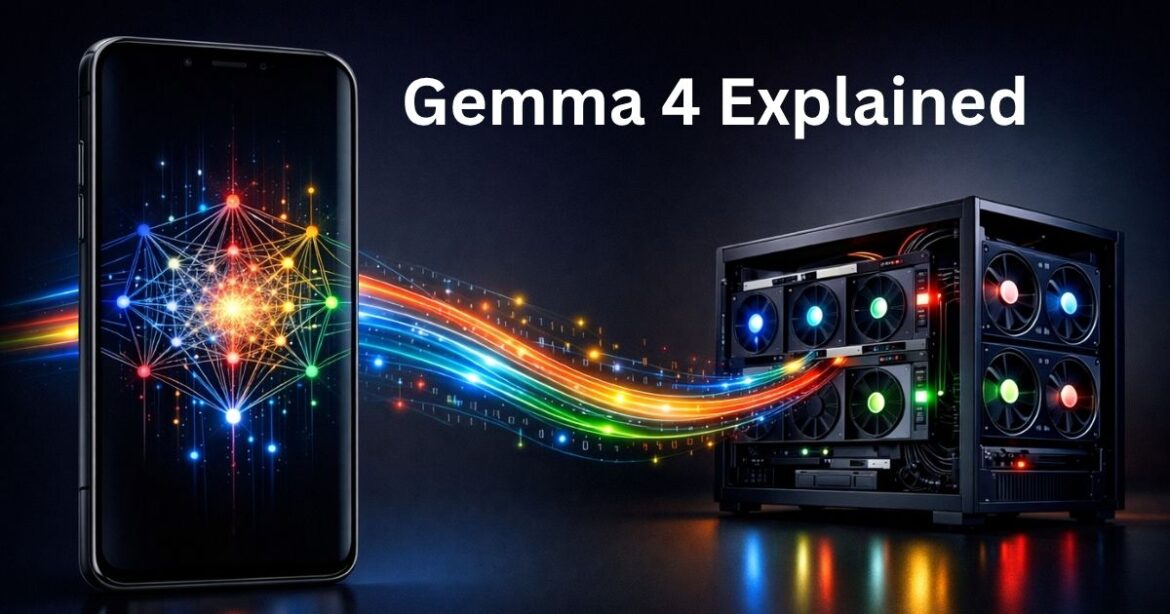
Google has released Gemma 4, a family of four open-weight AI models that deliver frontier-level performance — and for the first time, ships with a fully permissive Apache 2.0 license. It may be the most consequential open-model release of 2026.
Google didn’t just drop a new AI model this week. It dropped a statement. Gemma 4, introduced as Google’s most intelligent open models to date, is purpose-built for advanced reasoning and agentic workflows — and the company claims it delivers “an unprecedented level of intelligence-per-parameter.” More importantly, it arrives at a moment when the open-source AI ecosystem is hungry for a serious, commercially usable alternative to closed proprietary systems.
Here’s everything you need to know.
What Is Gemma 4?
Gemma 4 is Google’s latest family of open-weight large language models, meaning the model weights — the trained parameters that define how the AI thinks — are freely available for anyone to download, modify, and deploy. Built from the same technology and research that powered Gemini 3 Pro, Google is now making those advances accessible to the open-source community.
Since the launch of the first-generation Gemma, developers have downloaded the models over 400 million times, spawning a community of more than 100,000 model variants — what Google calls the “Gemmaverse.” Gemma 4 is designed to carry that momentum further.
Four Models, Two Deployment Tiers
📌 Quick Reference: Gemma 4 Model Specs
| Model | Params | Context Window | Modalities | Best For |
|---|---|---|---|---|
| 31B Dense | 31B | 256K | Text + Image | Workstations, Cloud |
| 26B MoE | 26B (A4B active) | 256K | Text + Image | Cost-efficient Cloud |
| E4B | ~5.1B total / 4B effective | 128K | Text + Image + Audio | On-device, Complex tasks |
| E2B | ~5.1B total / 2B effective | 128K | Text + Image + Audio | On-device, Speed-first |
Gemma 4 arrives as four distinct models organized into two deployment tiers. The “workstation” tier includes a 31B-parameter dense model and a 26B A4B Mixture-of-Experts (MoE) model — both supporting text and image input with 256K-token context windows. The “edge” tier consists of the E2B and E4B, compact models designed for phones, embedded devices, and laptops, supporting text, image, and audio with 128K-token context windows.
The naming is worth unpacking. The “E” prefix denotes “effective parameters” — the E2B has 2.3 billion effective parameters but 5.1 billion total, because each decoder layer carries additional weight. This architectural efficiency is central to Google’s pitch: smaller active footprint, lower RAM consumption, longer battery life.
Workstation Models (31B Dense + 26B MoE)
These are designed for developers and enterprises running on GPUs or cloud infrastructure. The 31B and 26B variants claimed the third and sixth spots respectively on Arena AI’s text leaderboard, beating out models 20 times their size. That’s a remarkable benchmark result for models of this weight class.
Edge Models (E2B + E4B)
These are built for on-device inference — phones, Raspberry Pi, NVIDIA Jetson Orin Nano. The E4B is designed for higher reasoning power and complex tasks, while the E2B is optimized for maximum speed — approximately 3x faster than the E4B — at lower latency. The new models are up to 4x faster than previous versions and use up to 60% less battery.
What Can Gemma 4 Actually Do?
Multimodal by Default
All models can process video and images, making them ideal for tasks like optical character recognition. The two smaller edge models are additionally capable of processing audio inputs and understanding speech. This makes the edge tier genuinely compelling for real-world applications like voice assistants, live translation, and document scanning — all without a cloud connection.
Reasoning & Code Generation
The 31B dense model hits 88.7% on AIME 2026 math benchmarks and 79.2% on LiveCodeBench. The MoE model tracks closely: 88.3% on AIME 2026 and 77.1% on LiveCodeBench. Even the compact edge models punch above their weight — the E4B hits 42.5% on AIME 2026, significantly outperforming Gemma 3 27B on most benchmarks despite being a fraction of the size, thanks to built-in reasoning capability.
Native Function Calling & Agentic Workflows
Function calling is native across all four models, with the capability trained into the model from the ground up — rather than relying on instruction-following to coax models into structured tool use. It’s optimized for multi-turn agentic flows involving multiple tools. This matters enormously for developers building AI agents that need to interact with APIs, databases, or real-world systems.
140+ Language Support
With context windows up to 256K, native vision and audio processing, and fluency in over 140 languages, these models excel at complex logic, offline code generation, and agentic workflows. For multilingual apps — especially relevant in markets like India — this is a significant capability upgrade.
Offline-First Design
Engineered for maximum compute and memory efficiency, these models activate an effective 2B and 4B parameter footprint during inference to preserve RAM and battery life, and can run completely offline with near-zero latency across edge devices. Vibe coding on a plane just became a reality.
The Licensing Story: Why Apache 2.0 Changes Everything
This may be the most underreported aspect of the Gemma 4 launch.
For the past two years, enterprises evaluating open-weight models faced an awkward trade-off. Google’s Gemma line consistently delivered strong performance, but its custom license — with usage restrictions and terms Google could update at will — pushed many teams toward Mistral or Alibaba’s Qwen instead. Legal review added friction, and compliance teams flagged edge cases.
Gemma 4 eliminates that friction entirely. Google DeepMind’s newest open model family ships under a standard Apache 2.0 license — the same permissive terms used by Qwen, Mistral, and most of the open-weight ecosystem. No custom clauses, no restrictions on redistribution or commercial deployment.
The timing is notable: as some Chinese AI labs have begun pulling back from fully open releases for their latest models, Google is moving in the opposite direction — opening up its most capable Gemma release yet while explicitly stating the architecture draws from its commercial Gemini 3 research.
Where Can You Run It?
Google has made Gemma 4 available across a wide range of platforms from day one:
- Download the weights: Available on Hugging Face, Kaggle, and Ollama.
- Cloud deployment: Available on Vertex AI, Cloud Run (with NVIDIA RTX PRO 6000 Blackwell GPUs), and Google Kubernetes Engine.
- On-device (Android): Accessible via the AICore Developer Preview today, with forward-compatibility for Gemini Nano 4-enabled devices arriving later this year.
- Developer tools: Day-one support for Hugging Face Transformers, vLLM, llama.cpp, MLX, Ollama, NVIDIA NIM, LM Studio, and more.
What This Means for the AI Ecosystem
Gemma 4 is a calculated move on several fronts simultaneously.
For developers, this is the most capable open model family that can run on consumer hardware — including a single NVIDIA GPU or even a smartphone. The combination of reasoning, multimodality, and native function calling puts it in serious contention with much larger proprietary models for agentic use cases.
For enterprises, the Apache 2.0 license removes the legal ambiguity that had previously made Gemma a second-choice option. Businesses can now build production applications on Gemma 4 without worrying about Google changing the terms underneath them.
For the open-source ecosystem, this is a significant power shift. Google is effectively donating Gemini 3-grade research to the developer community — and betting that ecosystem goodwill, developer lock-in through Google Cloud, and Android adoption will more than compensate for giving the weights away.
For Google’s competitors, the pressure is real. With Gemma 4 hitting top-3 on Arena AI’s leaderboard at 31B parameters, it makes a strong case that you don’t need a 200B model to achieve frontier performance — you just need better architecture.
The Bottom Line
Gemma 4 is not just an incremental update to Google’s open-model line. It’s a deliberate repositioning: a commercially free, frontier-capable, multimodal, on-device AI family — built on the same research as Google’s best proprietary model — released at a moment when the open-source ecosystem is hungry for exactly this.
Whether you’re a developer building a voice assistant for rural India, a startup fine-tuning a specialized enterprise model, or a researcher running experiments on a gaming GPU, Gemma 4 just became the most serious open-weight option in the market.
The real question now is whether the rest of the open-source field — including Meta’s Llama and Mistral — can respond.
Enjoy Worthview?
Add Worthview as a Preferred Source on Google to see more of our stories in Search.

Worthview Editorial Team is the shared byline for content created collaboratively by Worthview’s editors and contributors. Since 2008, we’ve published thousands of articles across technology, AI, finance, health, home, travel, and lifestyle. Our editorial process emphasizes original research, reputable sources, regular content updates, and clear attribution. Articles covering higher-trust topics, including health and finance, may also undergo review by qualified subject-matter experts.