What Just Happened at Google I/O 2026?
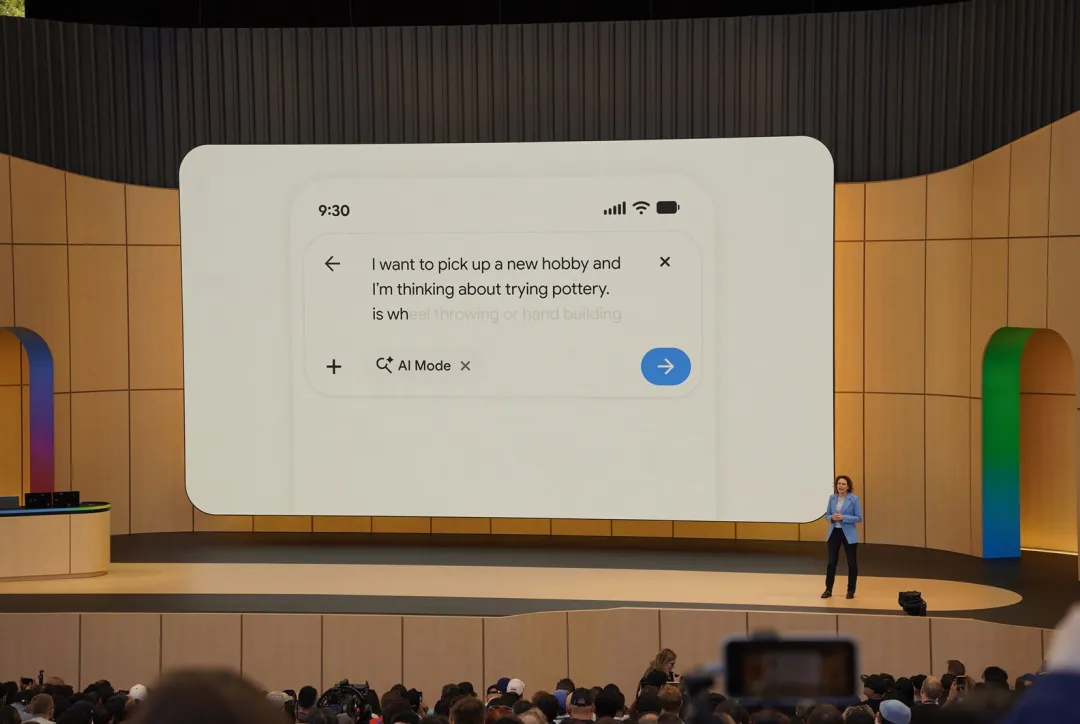
If you typed something into Google today and noticed it looked… different — you are not imagining it. At Google I/O 2026, held on May 20 at the Shoreline Amphitheatre in Mountain View, Google announced the single biggest upgrade to its search box in 25 years.
This is not a minor design refresh. Google has fundamentally changed how its search product works — from what you can put into the box, to how it processes your question, to what it does after you hit search. The era of typing two-word keywords is officially over.
🔑 Key Takeaway
Google Search is no longer a keyword box. It is now an AI-powered conversation interface backed by the full web — and the new AI Search box is starting to roll out today, in all countries and languages where AI Mode is available, Google said.
The Intelligent Search Box: What Is It?
Google’s Head of Search, Liz Reid, took the stage at I/O 2026 and described the new product as “the biggest upgrade to our iconic search box since its debut over 25 years ago.” The new box has a new name to match its new identity: the Intelligent Search Box.
“Now, we’re entering the next chapter of Google Search, where incredible AI features aren’t just in Search; Google Search is AI Search through and through,” Elizabeth Reid, who leads Search at Google, said at the company’s annual I/O conference. “We’re entering the era of search agents now.”
Here is what has changed in plain terms:
1. The Box Now Expands as You Type
The old search box was narrow — it subtly pushed you toward short queries. The new design actively expands as you type, accommodating full sentences, paragraphs, or complex multi-part questions. It is designed to look and feel more like a chat interface than a traditional search bar.
2. You Can Now Search With More Than Just Text
The new search box accepts multiple input types in a single query:
- Images — point your camera or upload a photo and ask a question about it
- Files — attach a document and search across its contents
- Videos — upload or reference a video clip
- Chrome tabs — search in the context of what you are currently browsing
For example: You can open a product page, attach a Chrome tab, and ask Google to “compare this laptop to the ones I was looking at last week” — and it will understand the full context.
3. AI-Powered Suggestions That Go Beyond Autocomplete
The old autocomplete tried to predict what you were going to type next based on popular search strings. The new AI-powered suggestion system understands your intent and suggests full query completions, follow-up directions, and related angles — more like a research assistant than a spell-checker.
4. Conversation Memory
The new search box holds on to your past conversations. If you searched for “best budget 5G phones under 15000 rupees” earlier today, your next query — “which one has the best camera” — will automatically carry forward the context. No need to repeat yourself.
| 📌 India Relevance
Google noted that AI Overviews is driving over a 10% increase in search usage in its biggest markets — explicitly naming the US and India. India is a priority market for these AI search features. |
AI Mode: Now Live for All US Users
AI Mode is Google’s most powerful search experience — and as of today, it is available to all users in the United States without requiring a Labs sign-up. A tab for AI Mode will appear in Search and in the Google app over the coming weeks.
Think of AI Mode as the premium lane of Google Search. It gives you:
- More advanced reasoning across complex, multi-step questions
- Full multimodal understanding — text, images, and files in one query
- Follow-up question threads that go deeper into any topic
- Links back to the web, so you can verify and explore further
How AI Mode Works Under the Hood: Query Fan-Out
This is the part that makes AI Mode technically interesting. Instead of running a single search query, AI Mode uses a technique Google calls “query fan-out.” Here is how it works:
- Your question is broken down into multiple subtopics
- Google runs dozens of queries simultaneously across those subtopics
- Results are synthesised into a single, coherent, cited answer
The result is an answer that would normally require you to read 10 different web pages — delivered in seconds, with citations to each source.
| ⚙️ Under the Hood
AI Mode in Search now runs on a custom version of Gemini 2.5 — Google’s most capable model — for both AI Mode and AI Overviews in the US. This is the same model family that powers Google’s paid AI products. |
Deep Search: Research-Grade Answers in Minutes
For questions where you need real depth — think policy research, market analysis, or technical comparisons — Google is introducing Deep Search inside AI Mode (launching first in Labs).
Deep Search takes the query fan-out technique to a completely different level:
- It can issue hundreds of parallel searches on your behalf
- It reasons across unconnected pieces of information from different sources
- The output is an expert-level, fully-cited report
- What might take a researcher hours can be completed in minutes
This is Google’s direct answer to tools like Perplexity and ChatGPT’s research mode — but with the advantage of Google’s full index and first-party data.
Agentic Search: Your Personal Research Assistant That Never Sleeps
The most forward-looking announcement in the search stack is agentic search — and it signals where Google is headed over the next 2-3 years.
Starting this summer for Google AI Pro and AI Ultra subscribers, users will be able to create and manage multiple AI agents directly inside Google Search. These are not chatbots. They are task-specific autonomous agents that work in the background.
Real-World Examples of What These Agents Can Do
- Monitor property listings in Whitefield, Bengaluru under a certain budget and alert you when something new appears
- Track a specific stock and notify you when there is a notable move
- Watch flight prices for a route and tell you when the best time to book is
- Follow a developing news story and surface new developments daily
The agents work 24/7 and surface updates through the Google app. Users can review and manage their active agents through AI Mode history.
| 🇮🇳 What This Means for Indian Users
Use cases like property monitoring (Bengaluru, Mumbai, Hyderabad corridors), stock tracking (NSE/BSE alerts), and price monitoring for e-commerce are directly applicable to how Indian digital users engage with search. |
Old Google Search vs. New Intelligent Search: Side-by-Side
| Feature | Old Google Search | New Intelligent Search |
| Query type | Short keywords (2-3 words) | Long, conversational sentences |
| Input formats | Text only | Text, images, files, videos, Chrome tabs |
| Autocomplete | Keyword-based suggestions | AI-powered intent suggestions |
| Memory | No session memory | Holds past conversations, context-aware |
| Results | Blue links + snippets | AI-generated answers + cited web links |
| Background tasks | Not available | AI agents monitor tasks 24/7 |
| Powered by | Traditional ranking algorithms | Gemini 3.5 Flash + query fan-out |
The Scale: Just How Big Is This?
Google shared some remarkable numbers at I/O 2026 that put the AI search transition in perspective:
- AI Mode has surpassed 1 billion monthly users in its first year
- AI Mode queries are doubling every quarter since launch
- AI Overviews now reaches more than 2.5 billion monthly users globally
- Overall Google search query volume hit an all-time high last quarter
- In the US and India, AI Overviews is driving 10%+ increase in search usage
Google CEO Sundar Pichai framed these as evidence that AI features are additive to search — not replacing it. He said: “When people use our AI-powered features in search, they use search more.”
Liz Reid added: “It’s not just that people are searching more, it’s that they’re searching differently.”
What This Means for SEO, Content Creators, and Publishers
This is the section that every digital marketer, blogger, and content creator in India needs to read carefully.
The Traffic Reality: CTR Is Under Pressure
The data is clear and it is not comfortable reading for publishers who depend on organic search traffic:
- CTR from Search results fell from 1.76% in 2024 to 0.61% in 2025 for AI Overview-affected queries
- Pew Research found clicks dropped to 8% when AI Overviews appeared, vs 15% when they did not
- Some publishers have reported CTR declines of up to 89% for specific query types
But There Is a Silver Lining: Become the Source Google Cites
The flip side of this equation is significant:
- Pages cited inside AI Overviews see CTR increases of up to 35%
- Brands mentioned in AI responses experience 91% higher paid CTR — the halo effect
- Being the cited source inside an AI answer is the new Page 1
What Content Types Are Safe vs. Vulnerable?
Analysis of 2026 SERPs shows the following pattern:
- High risk: Informational ‘what is’ and ‘how to’ content, health/wellness, B2B tech, education (80%+ AI coverage)
- Lower risk: Local intent, e-commerce, transactional queries (AI coverage under 15%)
- Opportunity: Deep-dive explainers, original research, and expert commentary that AI cannot fully replicate
| ✍️ WorthView Editorial Note
For technology publishers covering AI and India-first audiences, the path forward is clear: produce citation-worthy content that AI wants to reference, not just rank. Structured data, FAQ schema, authoritative sourcing, and AEO-optimised formatting are now table stakes. |
Frequently Asked Questions
Is AI Mode available in India?
As of Google I/O 2026, AI Mode has rolled out to all users in the United States without a Labs sign-up. India availability has not been officially confirmed for the full AI Mode experience, though AI Overviews is already live in India. Expect a phased rollout.
Will the Intelligent Search Box replace traditional Google Search?
No — it replaces the search bar interface, not the underlying search product. Traditional blue-link results remain, but they are now framed within an AI-first experience. The shift is in how users interact with Search, not whether Search exists.
What is the difference between AI Mode and AI Overviews?
AI Overviews are the summarised answers that appear above traditional search results. AI Mode is a fully separate, more powerful search experience — with deeper reasoning, follow-up threads, multimodal input, and eventually agentic capabilities. AI Mode is the end-state; AI Overviews is the entry point.
What is agentic search and when is it coming?
Agentic search allows users to create persistent AI agents inside Google Search that monitor tasks — property prices, stock movements, news stories — in the background and alert you when conditions change. It is launching for Google AI Pro and Ultra subscribers in the US starting summer 2026.
How should Indian content creators and SEOs adapt?
Focus on becoming a cited source, not just a ranked page. Implement FAQ schema and structured data. Produce authoritative, well-sourced content on specific topics. Optimise for AEO (Answer Engine Optimisation) — write content that directly answers specific questions in a way AI systems can extract and cite.
The Bottom Line
Google I/O 2026 was not a product launch. It was a declaration of intent.
Google is transforming Search from a tool you use to find links, into an AI system you have a conversation with — one that understands context, remembers your history, accepts any input format, runs research on your behalf, and eventually manages ongoing tasks for you autonomously.
The Intelligent Search Box is the new front door of the internet. The question for every publisher, content creator, and digital marketer is: will your content be inside the answer, or left behind the door?
Enjoy Worthview?
Add Worthview as a Preferred Source on Google to see more of our stories in Search.

Sethuram Kishore is the founder and editor of Worthview, an online publication established in 2008. With over 18 years of experience in SEO, digital marketing, and online publishing, he writes about AI, technology, business, and digital trends. He is also the founder of MoneyHulk, a personal finance and business publication.





One thought on “Google Just Rebuilt Its Search Box for the AI Age — Here’s Everything That Changed”
Comments are closed.