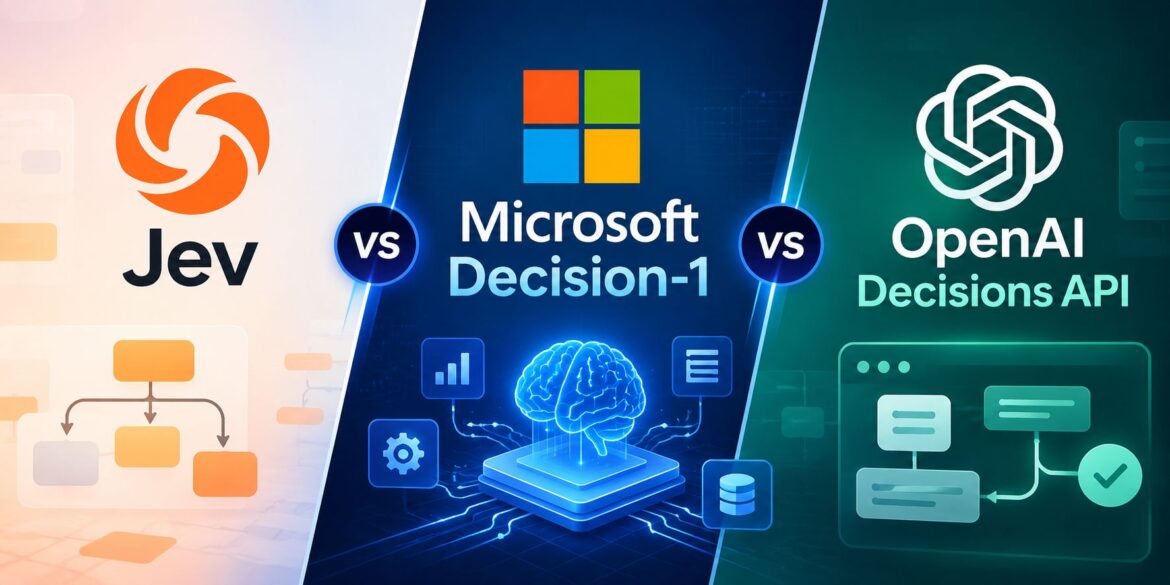
Three decision models launched within four weeks: TypeSafe AI’s Jev on 15 September, OpenAI’s Decisions API in public beta on 6 October, and Microsoft-Decision-1 on 9 October. None of them writes text. Each takes an input plus a set of options and returns a probability for every option.
Input costs between $0.042 and $0.10 per million tokens, and output is free on all three. The pitch is that software agents burn expensive LLM calls on small jobs, such as routing a request or approving a command, and a purpose-built model can do those jobs faster and for less.
The catch is that almost every speed and accuracy figure so far comes from the company that published it. This article compares the three, separates claims from evidence, and says which one fits which job.
What a decision model does
A decision model answers a question about an input and returns probabilities, not prose. You supply the input, which can be text or an image, plus a set of allowed answers. The model returns how likely each answer is.
All three vendors offer the same three answer shapes:
- Yes/no: the probability that a condition is true, such as whether a product photo shows visible damage.
- Choice: the best option from a fixed list, with a probability for each option and an overall confidence.
- Score: a rating against ordered levels, such as how severe a bug report is.
Two properties make this useful for software. First, the possible answers are fixed before the call, so the model cannot invent an option. TypeSafe calls this a structural property rather than a measured result. Second, each answer carries a calibrated confidence, so code can act automatically above a threshold and send everything else to a person.
The trade-off is that these models cannot chat, explain or draft. They suit the small decisions inside agents and pipelines: routing a request, classifying content, scoring an issue, judging whether a command is safe to run. Vercel swapped a safety classifier running on a general OpenAI model for Jev and saw that step run 5 to 18 times faster.
The idea is not new. The Register notes that researchers have built probability-based classifiers for years. What is new is that large labs now sell them as a product category with an API and a price list.
The three contenders
Jev (TypeSafe AI)
Jev went into early access on 15 September alongside a $40M seed round led by DCVC. It was built by Diogo Almeida, who worked on the instruction-following research behind ChatGPT at OpenAI.
It takes a block of program state and typed questions, and answers with a choice (up to 255 options), an ordered score, or a yes/no probability. Every answer carries a calibrated confidence. It is text only.
TypeSafe charges $0.042 per million input tokens and does not meter output. It puts end-to-end response time at 70 to 500 milliseconds. It says it trained Jev entirely on synthetic data, using a method it calls reinforcement learning for calibrated decisions. The architecture and base model are undisclosed, and outside observers suspect an open-weight language model underneath.
The adoption numbers are the strongest in the category. Within 24 hours of arriving on Vercel’s AI Gateway, Jev reached nearly 13% of paid teams, twice the share of the GPT-5.6 family and the fastest uptake in that gateway’s history. Access was free on Vercel until 25 September, so early usage is not a clean demand signal.
Microsoft-Decision-1
Microsoft-Decision-1 was announced on 9 October by Achint Srivastava, a VP of software engineering in Microsoft’s Office of the CTO. It is Alibaba’s open-weight Qwen3.5-9B, post-trained by Microsoft. It is text only, has a 32,000-token context window, and is available through Microsoft Foundry and OpenRouter.
It costs $0.042 per million input tokens, the same as Jev, and output tokens are free. Microsoft says it will later rebase the model onto its own MAI models and OpenAI’s, without saying why. The model card advises against using it as the sole basis for consequential decisions about people, such as credit or employment.
Microsoft’s headline claims, all from its own tests:
- Highest accuracy (83.5%) in a 36-benchmark comparison covering nearly 150,000 questions held out from training.
- 2.8x faster than Jev, 2.5x faster than the runner-up H2O-Lightning-4B, and 35x faster than OpenAI’s GPT-6 Sol.
- Changes its answer only 1.3% of the time, on average, when a request is reworded or reordered.
- Second place on confidence score (92.2%), behind Quyet-1.0-Large.
Inside Microsoft, Xbox Research used it to sort more than 10,000 pieces of player feedback into themes. Microsoft says quality was competitive with GPT-6 Sol, at over 14x the speed and 200x lower cost.
OpenAI Decisions API
OpenAI’s Decisions API was previewed at DevDay in late September and opened to all developers in public beta on 6 October. General availability is expected within weeks. It runs on a dedicated POST /v1/decisions endpoint, and gpt-6-luna is the only supported model.
It accepts text and images, with images passed as inline base64 data. It offers three question types: a predicate (a 0-to-1 probability), a choice from fixed options, and a score against ordered levels.
Input costs $0.10 per million tokens, with no charge for output, cache reads or cache writes. Regional processing premiums and long-context multipliers apply. OpenAI lists support for zero data retention, HIPAA use for eligible customers, and data residency in the US and Europe.
OpenAI says the endpoint is about 10x faster than the Responses API. That compares it with OpenAI’s own product, and coverage of the launch notes that no methodology or accuracy comparison has been published. It is also hosted only, while Perplexity, Cloudflare and AWS have released downloadable weights.
Side by side
Jev and Microsoft-Decision-1 cost the same, OpenAI costs about 2.4x more, and only OpenAI documents image input and enterprise data controls. Every speed and accuracy figure below is the vendor’s own.
| Jev | Microsoft-Decision-1 | OpenAI Decisions API | |
|---|---|---|---|
| Maker | TypeSafe AI | Microsoft | OpenAI |
| Launch | 15 Sep (early access) | 9 Oct | 6 Oct (public beta, GA expected within weeks) |
| Base model | Undisclosed | Qwen3.5-9B, post-trained | gpt-6-luna |
| Inputs | Text | Text, 32K-token context | Text and images |
| Answer types | Choice (up to 255 options), score, yes/no | Probabilities over options, ratings, rubric grading | Predicate, choice, score |
| Input price ($ per 1M tokens) | 0.042 | 0.042 | 0.10 |
| Output price | Free | Free | Free |
| Speed claim | 70–500 ms end to end | 2.8x faster than Jev (Microsoft’s test) | About 10x faster than the Responses API (OpenAI’s test) |
| Accuracy evidence | No public-benchmark results, by design | 83.5% across 36 benchmarks (Microsoft’s test) | None published |
| Access | TypeSafe, Vercel AI Gateway, OpenRouter | Microsoft Foundry, OpenRouter | Hosted /v1/decisions endpoint only |
| Enterprise controls | Not stated in launch coverage | Not stated in launch coverage | Zero data retention, HIPAA eligibility, US and EU data residency |
Claims versus evidence
None of the three has independent, head-to-head evidence yet. What each vendor has published:
- Jev: TypeSafe’s own team built the workflow evaluations. Its comparison against language models uses an average of GPT-6 Astra and Fable 5.1 answers as the reference, which TypeSafe concedes biases results towards OpenAI and Anthropic. Its figures for rival models come from OpenRouter traffic, and it publishes no public-benchmark results.
- Microsoft-Decision-1: every number comes from Microsoft’s own tests. Microsoft added Jev’s benchmarks to its post after launch, but the only direct Jev comparison reported is latency (2.8x faster). Whether Jev was part of the 83.5% accuracy comparison is not clear from coverage.
- OpenAI Decisions API: the 10x speed claim is measured against OpenAI’s own Responses API. Coverage notes no benchmark methodology and no accuracy comparison.
- Perplexity (a rival, for context): reports that its open-weight model beats Jev overall, 85.71% to 84.51% across 11 benchmarks, but The New Stack notes Jev wins six of those 11.
The closest thing to a neutral scorecard is JevBench, a community-maintained, MIT-licensed benchmark. Its v1.5.4 leaderboard tracked 112 decision systems and ranked Jev third (72.13), behind blockbrain’s Cygnet and the open-weight Winnow-12B, according to a 7 October snapshot. That predates Decision-1’s launch, and I found no independent score for it.
Confidence is not correctness
TypeSafe’s documentation says its confidence value measures how concentrated the probability distribution is, not the chance that an answer is right. A 95% confidence is actionable, but a 50% one is a coin toss, and the developer decides what to do with it. Armin Ronacher, CTO of Earendil, put the catch plainly: the approach hands part of the hallucination problem to the user.
Robustness is a second concern. A University of Southern California researcher found that an optimizer could redirect 61.4% of 508 initially correct Jev decisions by adding short, natural-looking context, with a median length of 31 words. That is an adversarial rate, not an everyday failure rate. But an open Qwen-based model in the same study flipped at 72.6%, which suggests the weakness belongs to the category rather than to one vendor. Where inputs include user-written text, a confidence threshold should be one control among several.
Vercel was also careful to say that Jev’s first-day adoption was unmatched but that the real test is whether it lasts.
Which one to pick
Decide on input type and data-handling needs first, then on price. On text-only work, Jev and Microsoft-Decision-1 cost exactly the same.
- Cheapest text-only routing and classification: Jev or Decision-1, both at $0.042 per million input tokens. Decision-1 has more published benchmark numbers and a stated base model. Jev has the longer adoption record and handles up to 255 options per choice.
- Images: OpenAI’s Decisions API is the only one of the three that accepts them. Cloudflare’s Clef models also have a vision encoder.
- Regulated or enterprise data: OpenAI is the only one of the three whose launch materials list zero data retention, HIPAA eligibility and US and EU data residency.
- Teams already on Azure: Decision-1 is sold through Microsoft Foundry, so it fits existing procurement and billing.
- Self-hosting: none of the three ships downloadable weights, as far as launch coverage shows. Open-weight alternatives exist, covered below.
- Decisions about people: Microsoft’s model card warns against using Decision-1 as the sole basis for credit or employment decisions. The same rule is sensible for any of these models.
Whichever you choose, test on your own data. Build a labelled set from real traffic, include messy and adversarial inputs, and set confidence thresholds from the cost of false positives against false negatives, as OpenAI’s own guide advises. Keep a fallback, such as an LLM or a human reviewer, for low-confidence answers.
The wider field and what to watch
Three is the tip of a long list. The Register counts more than 100 decision models, and a JevBench snapshot from 7 October tracked 112. Liquid AI, Snowflake and Surogate have also launched entries. The open-weight options are the ones most relevant to anyone who wants to self-host:
| Model | Maker | Weights and access | Notes |
|---|---|---|---|
| Strands Decider 2B | AWS | Apache 2.0 open weights | Built on Qwen3.5-2B; released 1 October; AWS reports a median of 115 ms per question on an RTX 3090 |
| pplx-decider v1.1 | Perplexity | Apache 2.0 weights and a hosted API | Fine-tuned from Qwen3.8-27B; hosted input priced at $0.02 per million tokens |
| Clef and Clef-flash | Cloudflare | Apache 2.0 weights, also hosted on Workers AI | Accept images as well as text |
| Solar Decide | Upstage | Hosted, closed | Built on Solar Mini 4, a 35B mixture-of-experts model with 3B active parameters |
| H2O-Lightning-4B | H2O.ai | Published on Hugging Face | Built on Qwen3.5-4B; the runner-up in Microsoft’s own benchmark |
Qwen is the common base. Microsoft, AWS, H2O and Perplexity all built on Alibaba’s models, and The Register put the Chinese lab in its headline on Microsoft’s launch.
TypeSafe’s request and response schema, called System One, is spreading faster than any single model. AWS’s Strands Decider, Upstage’s Solar Decide and Ollama (from version 0.35) all serve it, and applications written against it can move between providers by changing a base URL. The New Stack compares this with how OpenAI’s Chat Completions API became a default interface for language models. OpenAI, Perplexity and OpenRouter each run their own decision endpoints instead, and I found no statement on whether Microsoft-Decision-1 follows System One. Servers still differ in option limits, confidence calculation and answer quality, so a switch still needs testing.
What to watch
- OpenAI’s general availability: the date, and whether pricing holds at $0.10.
- Microsoft’s rebase: whether Decision-1 keeps its speed and accuracy when moved off Qwen onto MAI or OpenAI models.
- Independent scores: whether Decision-1 and OpenAI’s API appear on JevBench, and where.
- Jev after the free period: whether its Vercel adoption holds.
- The contract: whether OpenAI and Microsoft adopt System One, or the category splits into two schemas.
Enjoy Worthview?
Add Worthview as a Preferred Source on Google to see more of our stories in Search.

Sethuram Kishore is the founder and editor of Worthview, an online publication established in 2008. With over 18 years of experience in SEO, digital marketing, and online publishing, he writes about AI, technology, business, and digital trends. He is also the founder of MoneyHulk, a personal finance and business publication.