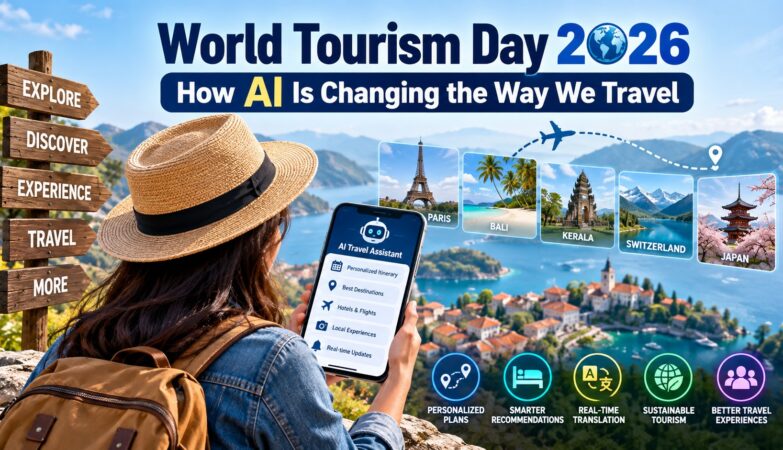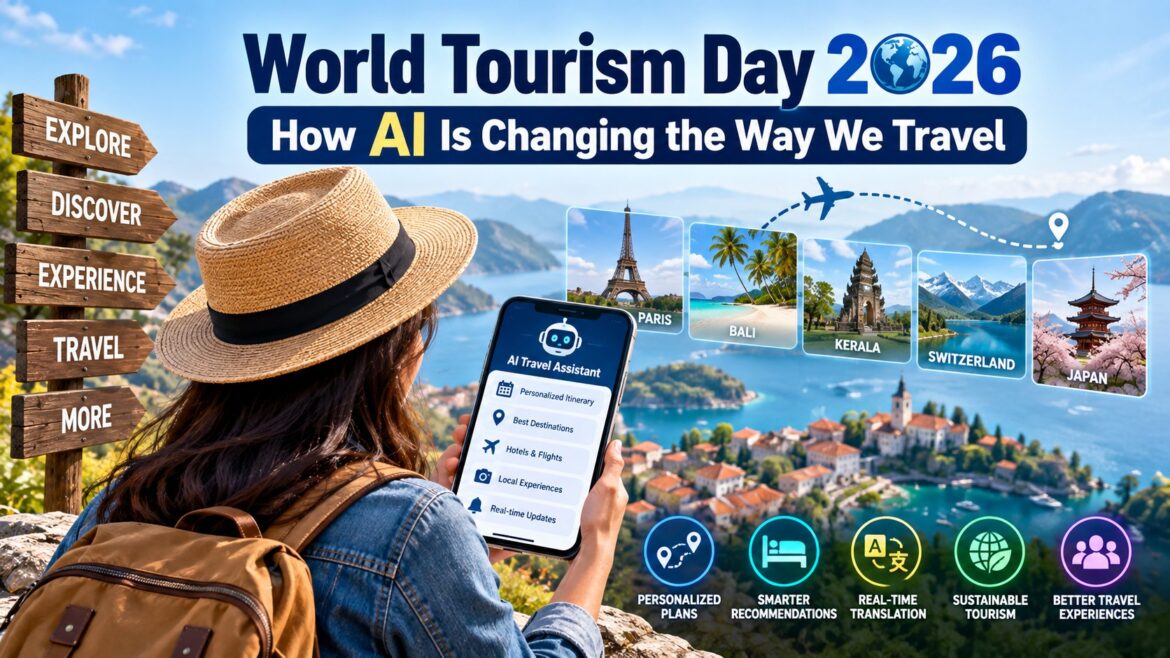
World Tourism Day 2026 is being observed on September 27 with a theme that reflects one of the biggest changes taking place in the travel industry: “Digital Agenda and Artificial Intelligence to Redesign Tourism.”
As artificial intelligence moves from chatbots and search engines into everyday travel services, the way people discover destinations, plan holidays, book accommodation and experience new places is beginning to change.
Instead of spending hours searching through dozens of websites, travelers can increasingly describe what they want and use AI-powered tools to organize the information into a personalized travel plan.
But AI could do more than make travel convenient. It could also change how destinations are promoted, how tourism businesses reach customers and how visitor numbers are managed.
What Is World Tourism Day 2026?
World Tourism Day is observed every year on September 27 to highlight the social, cultural and economic importance of tourism.
In 2026, the global observance is being hosted by El Salvador, with the theme focusing on digital technology and artificial intelligence. The United Nations says AI is already changing how travelers choose destinations, how tourism businesses operate and how travel experiences are designed.
The theme is particularly relevant because travelers are increasingly using digital platforms before, during and after their journeys.
The travel experience is becoming digital long before someone reaches an airport or checks into a hotel.
From Search Engines to AI Travel Assistants
Travel planning traditionally involved searching Google, reading travel blogs, comparing hotels, checking maps and building an itinerary manually.
AI can bring many of these activities together.
A traveler could potentially ask:
“Plan a five-day family trip to Kerala under ₹60,000, including hotels, sightseeing, food and transportation.”
An AI system can then help organize destinations, travel times, activities and other information around those requirements.
This represents a shift from searching for individual pieces of information to describing an objective and receiving a structured plan.
The technology is also moving beyond simple itinerary generation. AI can help with translation, destination discovery, recommendations, customer service and personalized travel experiences.
5 Ways AI Is Changing Tourism
1. Personalized Travel Planning
One of the most obvious applications of AI is personalized itinerary planning.
Instead of following a standard three-day or seven-day itinerary, travelers can specify their budget, interests, available time and travel preferences.
An AI assistant can use those requirements to suggest a customized plan.
For example, a traveler interested in history could receive a different itinerary from someone primarily interested in beaches, food or adventure activities.
The important change is that the itinerary can be built around the traveler rather than the destination alone.
2. Smarter Destination Discovery
AI could also change how people discover destinations.
Today, popular destinations dominate search results, social media and travel platforms. AI-powered recommendation systems could potentially introduce travelers to lesser-known attractions based on their interests.
This could create opportunities for smaller destinations and local tourism businesses.
However, there is another side to this.
The United Nations has warned that if AI systems rely heavily on existing popularity signals, algorithms could potentially send even more travelers toward the same destinations and platforms.
How AI is designed and what information it uses will therefore matter.
3. AI-Powered Travel Services
AI can also make the actual travel experience more seamless.
Travel platforms can use AI to provide personalized recommendations, answer questions, provide information about destinations and help travelers navigate services.
India’s revamped Incredible India Digital Platform, for example, includes an AI-powered tool designed to personalize visitor experiences with features such as real-time weather information, city exploration and travel services.
This is an example of how AI is moving from an experimental technology into practical tourism infrastructure.
4. Breaking Language Barriers
Language can be one of the biggest challenges when traveling internationally.
AI-powered translation tools can make it easier for travelers to communicate, understand signs and access information in unfamiliar languages.
Real-time translation could become particularly useful for interactions involving hotels, restaurants, transportation and local experiences.
For travelers, this could make international tourism more accessible.
For local businesses, it could make it easier to serve visitors from different countries.
5. Helping Tourism Businesses Understand Travelers
AI isn’t only changing the consumer side of tourism.
Hotels, airlines, travel agencies, destinations and other businesses can use data and AI to understand traveler behavior and improve marketing and services.
India’s Ministry of Tourism signed an MoU with Google India in June 2026 focused on digital tourism promotion, artificial intelligence, data-driven insights and capacity building.
This reflects a broader shift toward using data and AI to understand travel trends and visitor behavior.
India Is Building a Digital Tourism Ecosystem
India is also using digital technology to reshape its tourism sector.
According to the Ministry of Tourism, India recorded 428.55 crore domestic tourist visits in 2025, while foreign tourist visits reached 2.53 crore. Tourism contributed 5.22% of India’s GDP and supported 8.46 crore jobs during 2023-24, according to government figures.
The country’s digital tourism ecosystem includes platforms such as Incredible India Digital Platform and NIDHI+.
The government has also announced the National Digital Tourism Stack, intended to make tourism offerings more discoverable, accessible and trustworthy.
Another initiative, Dekho Apna Desh 2.0, is intended to promote lesser-known destinations and encourage a more balanced distribution of tourist traffic.
The direction is clear: tourism is increasingly becoming a combination of physical experiences and digital infrastructure.
Will AI Make Travel Better?
AI can make travel planning faster and more personalized, but that does not mean every AI recommendation will be correct.
AI systems can sometimes produce outdated or inaccurate information. Travelers still need to verify important details such as visa requirements, opening hours, transportation schedules, hotel policies and local travel advisories.
There is also a bigger question about how much of travel should be automated.
Part of the attraction of tourism is discovering something unexpected — a small restaurant found while walking through a new city, a conversation with a local resident or a destination that was never part of the original itinerary.
If every traveler follows an algorithmically optimized itinerary, some of that spontaneity could disappear.
The Risk of Everyone Going to the Same Places
AI could also have an unexpected effect on tourism.
If millions of people ask AI systems for the “best places to visit,” recommendation systems may repeatedly surface destinations that already have strong online visibility.
That could increase pressure on popular tourist destinations while leaving smaller communities behind.
The UN has highlighted this issue, noting that AI needs to be developed in a way that benefits local communities, tourism workers and emerging destinations rather than concentrating attention on a small number of places.
This makes responsible AI design an important part of the future of tourism.
The Future Traveler May Simply Tell AI What They Want
The biggest change may be the transition from search-based travel planning to goal-based travel planning.
Instead of asking:
- “Best places to visit in Japan”
- “Hotels in Tokyo”
- “Things to do in Kyoto”
- “Train from Tokyo to Kyoto”
a traveler may eventually say:
“I have eight days in Japan, a ₹2 lakh budget, I love food and history, and I don’t want to change hotels more than twice. Plan the trip for me.”
AI could then become the interface connecting the traveler with information, bookings, maps, transportation and local experiences.
That is where tourism begins to move toward the agentic AI era — where AI systems don’t simply answer questions but can potentially coordinate multiple steps to accomplish a travel goal.
Technology Shouldn’t Replace the Human Side of Travel
The future of tourism will not be determined by AI alone.
Technology can make travel more convenient, but tourism ultimately depends on people, communities, cultures, landscapes and experiences.
The challenge will be finding the right balance.
AI can help travelers discover places. Digital platforms can make services easier to access. Data can help destinations manage visitor flows. And automation can reduce friction.
But the purpose of travel remains remarkably simple: to experience somewhere different, meet people, discover cultures and create memories.
On World Tourism Day 2026, the conversation is therefore not simply about whether AI will change tourism.
It already is.
The bigger question is how we choose to use it.
World Tourism Day 2026 at a Glance
- Date: September 27, 2026
- Theme: Digital Agenda and Artificial Intelligence to Redesign Tourism
- Host country: El Salvador
- Major focus: Digital transformation, artificial intelligence and the future of tourism
- India’s focus: Digital tourism platforms, AI-enabled services, destination development and more inclusive tourism
As tourism enters its next digital chapter, the traveler of the future may need fewer searches, fewer tabs and fewer spreadsheets.
They may simply need to tell an AI where they want to go — and what kind of experience they want to have.
Enjoy Worthview?
Add Worthview as a Preferred Source on Google to see more of our stories in Search.

Worthview Editorial Team is the shared byline for content created collaboratively by Worthview’s editors and contributors. Since 2008, we’ve published thousands of articles across technology, AI, finance, health, home, travel, and lifestyle. Our editorial process emphasizes original research, reputable sources, regular content updates, and clear attribution. Articles covering higher-trust topics, including health and finance, may also undergo review by qualified subject-matter experts.