QUICK ANSWER
- Customers visit or call you (restaurant, clinic, salon, shop): put Google Business Profile first. It drives Maps, directions, calls and reviews, and ChatGPT’s local claiming is limited to existing US listings for now.
- You sell online (e-commerce, SaaS, online services with a website): claim your business in ChatGPT as well. Google Business Profile is built for businesses that meet customers in person, so it usually will not apply.
- Either way: neither platform lifts your rankings on the other. Do the Google work first, the ChatGPT claim second, and keep both consistent with your website.
OpenAI launched Businesses in ChatGPT in beta on 10 November 2026, and the first question from business owners has been simple: do I now need this on top of Google Business Profile, or instead of it?
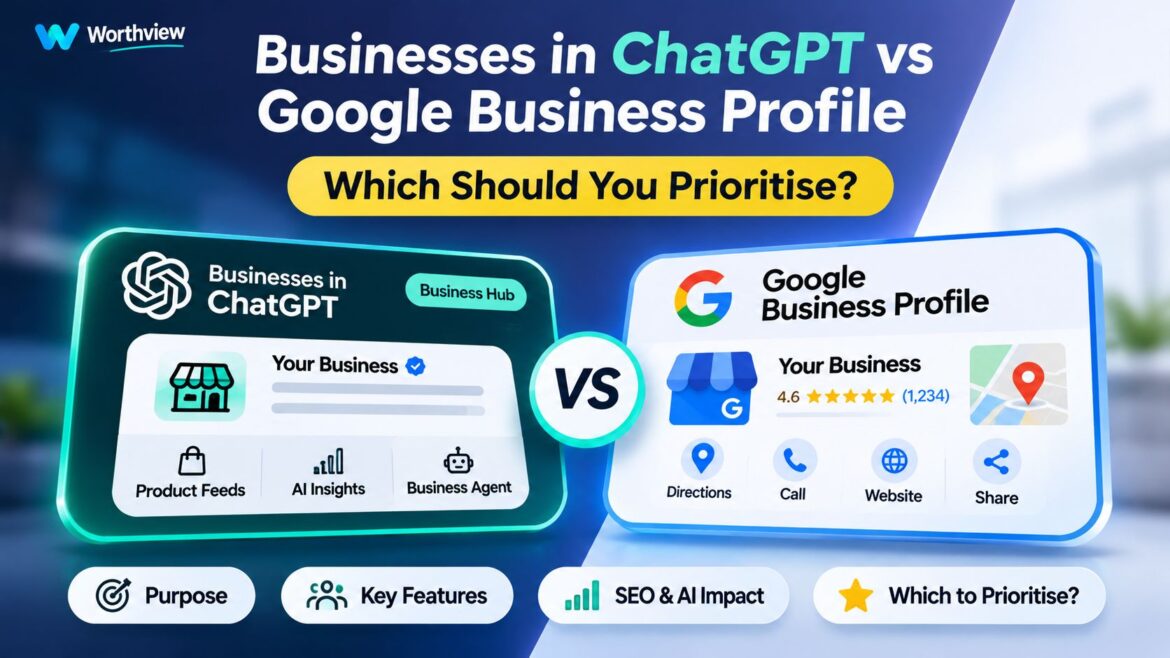
The honest answer is that they do different jobs for different customers. Google Business Profile (GBP) controls how you appear in Google Search and Maps. Business Hub controls the information ChatGPT can use about you and shows how often ChatGPT mentions you and sends people to your site. This guide compares them feature by feature, flags the eligibility gaps that matter in India, and ends with a 30-day plan. If you want the full background first, start with our complete guide to Businesses in ChatGPT.
Which should you prioritise?
It depends on how your customers reach you. Find your row, then read the details below.
Google Business Profile first
Restaurants, clinics, salons, shops, plumbers. Your customers search “near me” and want directions, hours, reviews and a phone number. ChatGPT local claiming does not cover you yet outside existing US listings.
Both, Google first
Run GBP for the physical location and claim the online store in ChatGPT, using Shopify or a DNS record to verify. Keep product, price and policy details identical in both.
ChatGPT claim plus website SEO
E-commerce brands, SaaS and online services with a website. GBP generally needs in-person contact with customers, so Business Hub and your own site carry the weight.
What each platform actually does
Google Business Profile
A free profile that shows your business in Google Search and Maps: location, hours, photos, reviews, products and services, plus calls, directions and website clicks from the listing. It is built for local discovery.
Businesses in ChatGPT
A beta from OpenAI. In Business Hub you claim your business, verify ownership, update details, add product feeds and see aggregated mentions, website clicks and discovery topics. Eligible US businesses can also publish a Business Agent.
OpenAI says ChatGPT reaches 1.2 billion people a week, so the audience is large. But the two products sit at different points in a customer’s journey. Google is where people look for a place to go or a provider to call. ChatGPT is increasingly where they research and compare before they decide.
Feature comparison
| Feature | Google Business Profile | Businesses in ChatGPT |
|---|---|---|
| Main surface | Google Search and Maps | ChatGPT answers and Business Hub |
| Built for | Businesses that meet customers in person or travel to them | Eligible online and offline businesses with a website |
| Cost | Free | No price published. Reported free in beta |
| Verification | Google chooses the method, for example a video recording | Phone, email, DNS TXT record or Shopify, then a Persona ID check |
| Verified badge | Verified profile | Blue check after Persona approval |
| Customer reviews | Yes, central to ranking | No Google-style review system |
| Maps and directions | Yes | Not a maps listing |
| Product data | Products and services on the profile | Product feeds: Shopify or CSV |
| Analytics | Views, calls, directions, website clicks, bookings, messages | Mentions, website clicks, discovery topics (28 days) |
| Conversational agent | No equivalent | Eligible US e-commerce and online services |
| Paid options | Google Ads | ChatGPT Ads, including sponsored Business Agents |
| Multiple locations | Manage many locations | Each brand managed separately, no central view across locations |
Business Hub details come from OpenAI’s announcement and its setup guide as reported on launch day. Beta features can change.
Local businesses in India: what you can claim today
OpenAI says any eligible business located where ChatGPT is available can claim its business through Business Hub, and India is one of those markets. The catch is in the detail. Initial claiming is limited to businesses with a website, and local stores and restaurants can currently claim only an existing US listing.
Online business in India
E-commerce stores, SaaS, agencies and online service providers with a website can try the claim, subject to OpenAI’s approval and verification.
Local shop or restaurant in India
A restaurant in Bengaluru has no ChatGPT listing to claim today. Google Business Profile is the only one of the two that works for you.
Do not wait for ChatGPT. Put your effort into Google Business Profile and a clear, crawlable website now. Those same assets are what ChatGPT can draw on, with or without a claim.
Business Agents add a second limit. They are open only to eligible e-commerce and online service businesses in the United States, so Indian businesses should not plan around one yet.
How each platform decides who to show
Google: relevance, distance, prominence
Google says local results rest mainly on three things: how well your profile matches the search, how far you are from the searcher, and how prominent you are. More reviews and positive ratings can improve local ranking, and your web results also count, so SEO still applies.
ChatGPT: independent recommendations
ChatGPT keeps making its own recommendations and comparisons based on relevance and the information available to it. It can show business information even if you have not claimed anything or built an agent. Claiming gives you control and insight, not placement.
Claiming in ChatGPT does not raise your Google rankings, and a strong Google profile does not guarantee ChatGPT will recommend you. Each has its own system. Treat the two as separate channels that share one source of truth: your website.
What the analytics tell you
Both give you first-party numbers, but they measure different moments. GBP reports what happened on your listing. Business Hub reports how ChatGPT referenced and linked to your site.
| Question | Google Business Profile | Business Hub |
|---|---|---|
| How often was I shown? | Profile views and search appearances | Business mentions (website referenced or local listing shown) |
| Did people visit my site? | Website clicks from the profile | Website clicks from ChatGPT |
| Did they act locally? | Calls, directions, bookings, messages | Not measured |
| What topics am I linked to? | Search terms used to find the profile | Discovery topics (aggregated themes) |
| Time window | Date ranges you choose | Previous 28 days, once activity thresholds are met |
- A Business Hub mention is not a Google impression. Do not compare the two numbers directly.
- Calls and directions are strong local-intent signals. ChatGPT clicks are more likely to be research-stage visits.
- Add UTM parameters to the website link on your Google profile so GA4 can separate it from organic search.
- In GA4, look for chatgpt.com / referral under Traffic acquisition. Not every ChatGPT visit carries a referrer, so treat that number as a floor.
Where to start, by business type
| Business type | Start with | Add next |
|---|---|---|
| Restaurant, café, salon, clinic | Google Business Profile | Website SEO. ChatGPT when local claiming widens beyond US listings |
| Retail store with an online shop | Google Business Profile | Claim the online store in ChatGPT and connect a product feed |
| Online-only e-commerce brand | ChatGPT claim + website SEO | GBP only if you have a qualifying physical presence |
| SaaS or online service | Website SEO + ChatGPT claim | Entity and schema work. Business Agents are US only |
| Agency or consultancy with an office | GBP + website SEO | ChatGPT claim if you have a website |
| Multi-location brand | GBP for every location | ChatGPT claim per brand, managed separately |
| Blog or publisher | Website SEO | Check ChatGPT eligibility. Owning a site is not enough |
How to set up both in a month
- 1
Week 1: Fix Google Business Profile
Confirm categories, hours, services, photos and the website link. Reply to recent reviews. If you are unverified, complete Google’s verification first.
- 2
Week 2: Claim your business in ChatGPT
Open Business Hub, find your business and verify with a DNS TXT record, Shopify, phone or email. Then complete Persona, because the badge and insights unlock only after it. Our claim and verify walkthrough covers each step.
- 3
Week 3: Make every source agree
Match your business name, description, hours, prices and delivery and return policies across your website, GBP and Business Hub. Add Organization or LocalBusiness schema to your site.
- 4
Week 4: Set up measurement
Tag the GBP website link with UTM parameters, filter chatgpt.com referrals in GA4, and record a baseline from GBP Performance and Business Hub Insights as data appears.
Five mistakes to avoid
- Treating a ChatGPT claim as a ranking shortcut. It is a control and measurement layer.
- Pausing Google Business Profile work to chase ChatGPT. For local customers, Google still carries the intent.
- Letting hours, prices and policies drift apart between your site, GBP and Business Hub.
- Reading ChatGPT mentions as search impressions. They use a different method.
- Waiting for Business Agents. They are US only for now, and you can act on everything else today.
Frequently asked questions
Do I need both Google Business Profile and Businesses in ChatGPT?
Is Businesses in ChatGPT replacing Google Business Profile?
Does claiming my business in ChatGPT improve my Google rankings?
Will a strong Google Business Profile make ChatGPT recommend me?
Can a local shop or restaurant in India claim a profile in ChatGPT?
Can an online-only business get a Google Business Profile?
Which platform has better analytics?
Is Business Hub free?
The bottom line
Local customers: Google Business Profile first. Online customers: claim in ChatGPT and keep investing in your website. If you have both, do Google first, ChatGPT second, and keep every source consistent.
Businesses in ChatGPT is a beta, and its effect on traffic is unproven. Treat it as an extra channel and a source of first-party insight, not a replacement for local SEO. For the wider playbook, read our 8-step GEO playbook, and if you run a local service business, our local SEO guide for pest control businesses shows the Google side in practice.
- OpenAI, Introducing Businesses in ChatGPT (10 November 2026)
- The Next Web, OpenAI lets businesses claim ChatGPT profiles and launch their own agents
- The Keyword, ChatGPT Opens Business Profiles and Agents to Brands (setup guide details on local listings and multi-brand management)
- Relevant Audience, OpenAI Launches Businesses in ChatGPT (beta pricing report)
- Google Business Profile Help, How to improve your local ranking on Google
- Google Business Profile Help, Verify your business with a video recording
Independent guide to a beta product, last updated 11 November 2026. Eligibility, features and markets can change, so confirm current details with OpenAI and Google before you act.
Enjoy Worthview?
Add Worthview as a Preferred Source on Google to see more of our stories in Search.

Sethuram Kishore is the founder and editor of Worthview, an online publication established in 2008. With over 18 years of experience in SEO, digital marketing, and online publishing, he writes about AI, technology, business, and digital trends. He is also the founder of MoneyHulk, a personal finance and business publication.