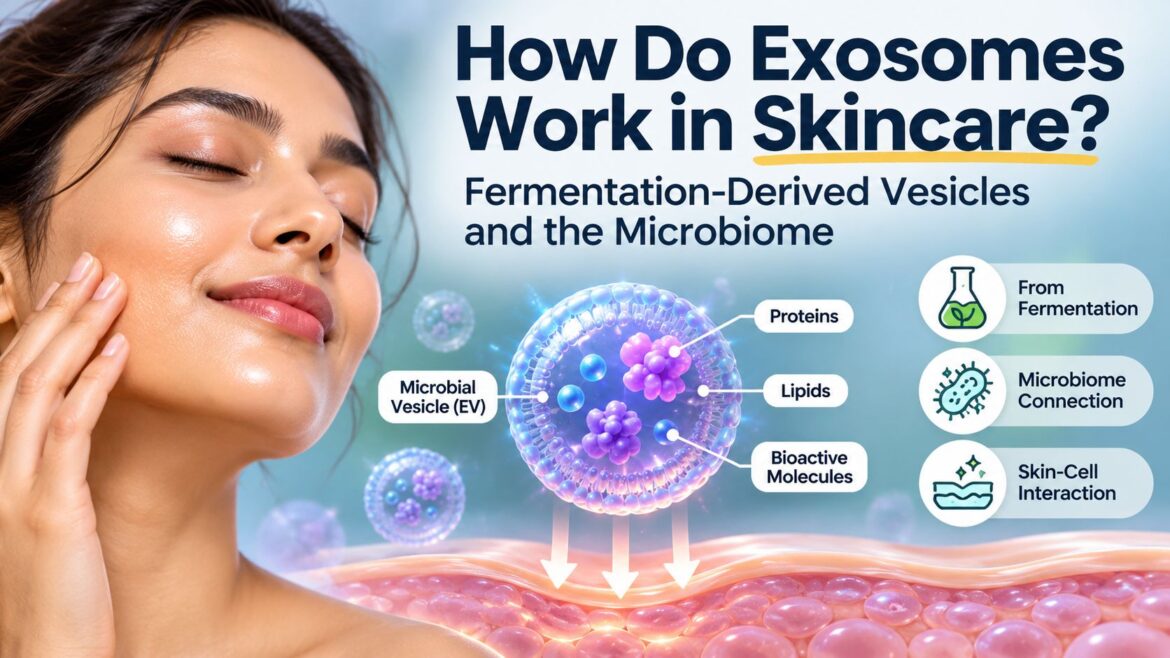
Exosomes in skincare are discussed as microscopic messengers that carry biological molecules, including lipids and proteins, which may influence communication between cells. In fermentation-derived skincare ingredients, similar structures called microbial extracellular vesicles (EVs) are released by microorganisms during growth and are being studied for their potential interactions with skin cells.
Their potential cosmetic effects depend on the source microorganism, how the vesicles are collected and characterized, their stability in the finished formula, and whether they can reach relevant skin cells. However, research is still developing, and laboratory findings do not yet establish visible skincare benefits in humans.
A skincare ingredient described as probiotic-derived may sound familiar to consumers interested in the skin microbiome. Yet the material inside a formula can be very different from a live probiotic culture. For brands asking “How do exosomes work in skincare?” a useful answer begins with what microorganisms release during growth, how that material is collected, and what evidence connects it to a proposed cosmetic outcome. Those details determine whether a compelling ingredient story is also a technically useful one.
How Do Exosomes Work in Skincare? What Microbial EVs Can Tell Us
Microorganisms can release membrane-bound extracellular vesicles, or EVs, into their surroundings. Such particles may contain lipids, proteins, and other molecules associated with the source organism and its growth conditions. Researchers are interested in how microbial EVs participate in communication within microbial communities and with host cells. Their composition and possible effects differ by species and preparation; a result for one microbe cannot establish the behavior of another.
Exosome terminology has a specific scientific meaning
In strict usage, exosomes are EVs generated through a particular internal pathway in eukaryotic cells. Microbial vesicles, especially bacterial preparations, may arise through different biological mechanisms. The MISEV2023 recommendations advise using broader EV terminology when the relevant origin has not been demonstrated. Beauty marketing may use the word exosome across several kinds of material, so product teams should request a description of the actual particles and methods used to identify them.
The source strain changes the starting material
Microbio describes its NEXOSOME™ ingredient as a fermentation-derived material associated with Parabacteroides goldsteinii. That is a source-specific product description, and its reported biological activities should be evaluated against the company’s technical data and the finished formula’s performance. When asking “How do exosomes work in skincare?” the identity of the source organism matters as much as the ingredient category. Even closely related strains can behave differently during growth and processing.
From Controlled Fermentation to a Cosmetic Ingredient
Controlled fermentation can specify nutrient supply, temperature, oxygen availability, and harvesting time. These conditions may influence the quantity and composition of extracellular material released by the microorganisms. A claim of consistent fermentation-derived quality needs supporting batch records, meaningful specifications, and a process for tracking variation over time.
Collection conditions influence the final mixture
Fermentation harvests can contain vesicles, soluble metabolites, proteins, and other particles. Separation and concentration steps determine which components remain. Suppliers should clarify whether the commercial product is an isolated EV fraction, a particle-containing mixture, or a broader extract. Evidence from one fraction may not describe the whole material sold to formulators.
Characterization and contaminant controls
Useful specifications may report particle size, concentration, composition, and appropriate identity measurements. Particle counts alone cannot confirm vesicle identity. Depending on the source, manufacturers also need suitable checks for contaminants, unwanted microbial constituents, and residual processing materials. Clear acceptance criteria make batch comparisons more meaningful.
How Do Exosomes Work in Skincare Formulas? Stability and Delivery
An ingredient’s behavior can change when it moves from a laboratory preparation into a moisturizer or serum. Processing temperature, pH, mixing, preservatives, and surfactants can affect a complex dispersion. A brand evaluating a vesicle-containing ingredient therefore needs stability information for the material as supplied and for the completed product. A laboratory signal measured immediately after particle collection does not establish that the same characteristic persists throughout retail storage.
Stability must be checked in the intended product
Formulators can identify key physical or functional attributes, then monitor them after production and during storage. Packaging, temperature exposure, and preservatives also require attention. A concentrated supplier preparation may behave differently after dilution or mixing. Shelf-life claims need appropriate testing in the finished product.
Topical use introduces a delivery question
Intact skin acts as a protective barrier. Nanoscale size alone does not establish how much of a particle-containing preparation can pass through it or reach a particular cell type. Experiments involving microneedling or injured tissue may use substantially different delivery conditions from everyday cosmetic application. Answering “How do exosomes work in skincare?” in the context of topical delivery requires identifying the preparation, application route, and measured exposure before predicting a cellular response.
The Skin Microbiome Connection Needs Specific Evidence
The skin microbiome is a community of microorganisms that interact with their environment and the host. Microbial products, including EVs, are being studied as one possible form of communication at that interface. A 2025 mini review of skin-microbiota-derived EVs discusses early cosmeceutical research while emphasizing that the field remains developing. A fermentation-derived ingredient can draw inspiration from microbiome science without being derived from a microorganism that normally lives on the skin.
Biological responses depend on the tested model
Laboratory research may measure inflammatory signaling, stress markers, or changes in cultured skin cells. These are clues to possible cosmetic applications. Claims about visible redness, hydration, or texture call for measurements suited to those outcomes. The organism, preparation, concentration, and study model determine how narrowly the findings apply.
Postbiotic is a term with its own definition
Postbiotic and microbial EV are related areas of ingredient research, but the terms describe different criteria. The ISAPP consensus defines a postbiotic through a preparation of inanimate microorganisms or their components that confers a health benefit. A purified microbial particle preparation should not automatically inherit claims from a different postbiotic formulation. Developers need to specify the material tested and substantiate any postbiotic positioning for the intended use.
What Brands Should Request Before Using a Microbial EV Ingredient
Supplier review should connect identity, manufacturing consistency, safety, and evidence. Ask which organism produced the material, how the ingredient was collected, and which tests define acceptable lots. Check stability information and compatibility with the intended formula. Raw-material experiments should be clearly distinguished from finished-product studies.
Different claims require different testing
A cell-based assay can support a mechanism-focused research description. A product advertised for hydration requires suitable human-use measurements; redness claims may need standardized visual assessments and tolerability data. Comparison groups, duration, participant characteristics, and application instructions determine the strength of the conclusions.
Keep microbiome language precise
A product can identify its microbial source and processing method without implying that it contains live bacteria or restores the skin microbiome. An effect seen in cultured skin cells does not establish changes in the skin’s resident microbial community. Such claims require microbiome-specific measurements in an appropriately designed study.
A defensible answer to “How do exosomes work in skincare?” connects the source organism, the recovered material, its behavior in a finished formula, and the outcomes actually measured. This chain of evidence gives brands a practical basis for evaluating an emerging technology while preserving the scientific distinctions that make the claims credible.
Frequently Asked Questions
1. How do exosomes work in skincare?
Exosomes are extracellular vesicles that carry biological molecules such as lipids and proteins. They are studied for their role in cellular communication and potential interactions with skin cells. In skincare, their proposed benefits depend on their source, composition, formulation, and delivery method.
2. What are microbial extracellular vesicles in skincare?
Microbial extracellular vesicles (EVs) are membrane-bound particles released by microorganisms during growth. They may contain lipids, proteins, and other molecules associated with their source organism. Researchers are investigating their potential role in communication between microorganisms and host cells.
3. Are exosomes and extracellular vesicles the same thing?
Not exactly. Exosomes are a specific type of extracellular vesicle generated through an internal cellular pathway in eukaryotic cells. Microbial vesicles, particularly those from bacteria, can form through different biological mechanisms. Therefore, the broader term extracellular vesicles is more scientifically appropriate when their precise origin has not been established.
4. What are fermentation-derived exosomes in skincare?
Fermentation-derived skincare ingredients may contain extracellular vesicles released by microorganisms during controlled fermentation. Their composition depends on the source organism, growth conditions, harvesting process, and subsequent separation and concentration methods. Not every fermentation-derived ingredient is an isolated vesicle preparation.
5. What is the role of Parabacteroides goldsteinii in exosome-based skincare?
Microbio describes its NEXOSOME™ ingredient as a fermentation-derived material associated with Parabacteroides goldsteinii. The source microorganism is relevant because different microbial species and strains can produce vesicles with different compositions and biological properties. Its reported activities should be evaluated using supplier data and finished-product testing.
6. Do microbial extracellular vesicles improve the skin microbiome?
Microbial EVs are being studied for their potential role in communication between microorganisms and host cells. However, an ingredient derived from a microorganism does not automatically restore or improve the skin microbiome. Such claims require microbiome-specific measurements in appropriately designed studies.
7. Can exosomes penetrate the skin when applied topically?
Not necessarily. The skin’s outer barrier limits the movement of many substances. A particle’s nanoscale size alone does not establish whether it can penetrate intact skin or reach specific cell types. Delivery findings from microneedling or injured-skin experiments may not apply to ordinary topical skincare products.
Enjoy Worthview?
Add Worthview as a Preferred Source on Google to see more of our stories in Search.

Worthview Editorial Team is the shared byline for content created collaboratively by Worthview’s editors and contributors. Since 2008, we’ve published thousands of articles across technology, AI, finance, health, home, travel, and lifestyle. Our editorial process emphasizes original research, reputable sources, regular content updates, and clear attribution. Articles covering higher-trust topics, including health and finance, may also undergo review by qualified subject-matter experts.