Universal Cart sounds like a convenience feature. It’s actually a fundamental shift in who controls online shopping — and it could quietly disrupt industries you’d never expect.
Picture this. You’re watching a YouTube review of a new pair of running shoes. You like them. Instead of opening a new tab, searching for the shoes, comparing prices across three sites, and finally checking out — you just tap ‘Add to Cart.’
That’s it. The shoes sit in your Google cart. Google monitors the price in the background. If it drops ₹500, you get a notification. When you’re ready, you checkout with one tap through Google Pay. No new accounts. No re-entering your address. No comparing coupon codes.
This is Google Universal Cart. And while it sounds like a neat shopping shortcut, what’s actually happening underneath is a much bigger story.
| Google isn’t just making shopping easier. It’s quietly repositioning itself as the most powerful layer between you and every online store in the world. |
So what exactly is Universal Cart?
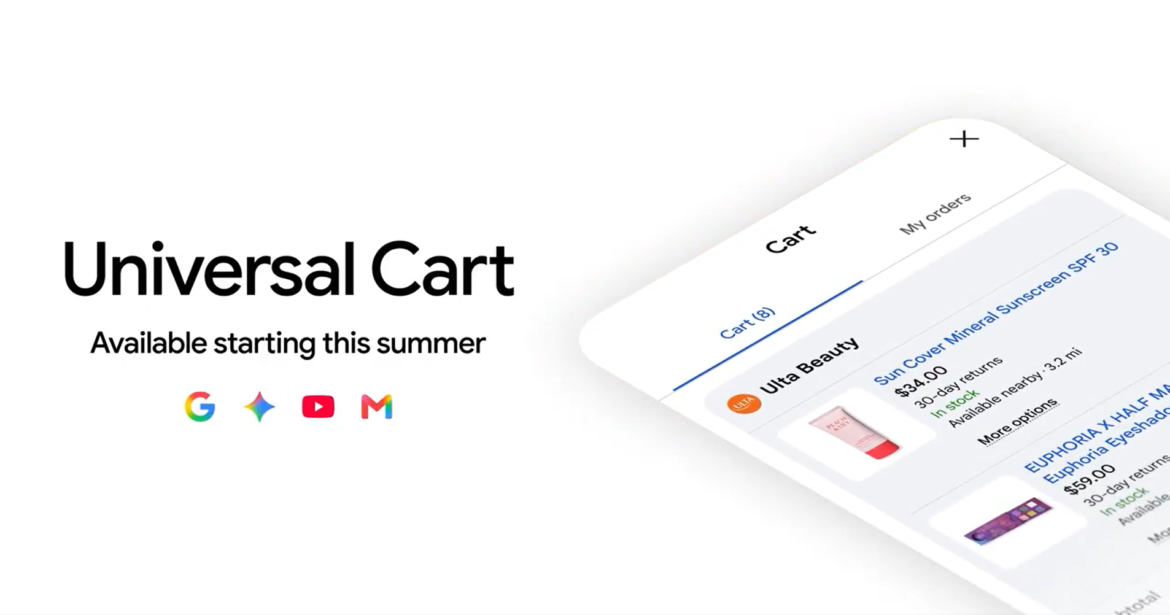
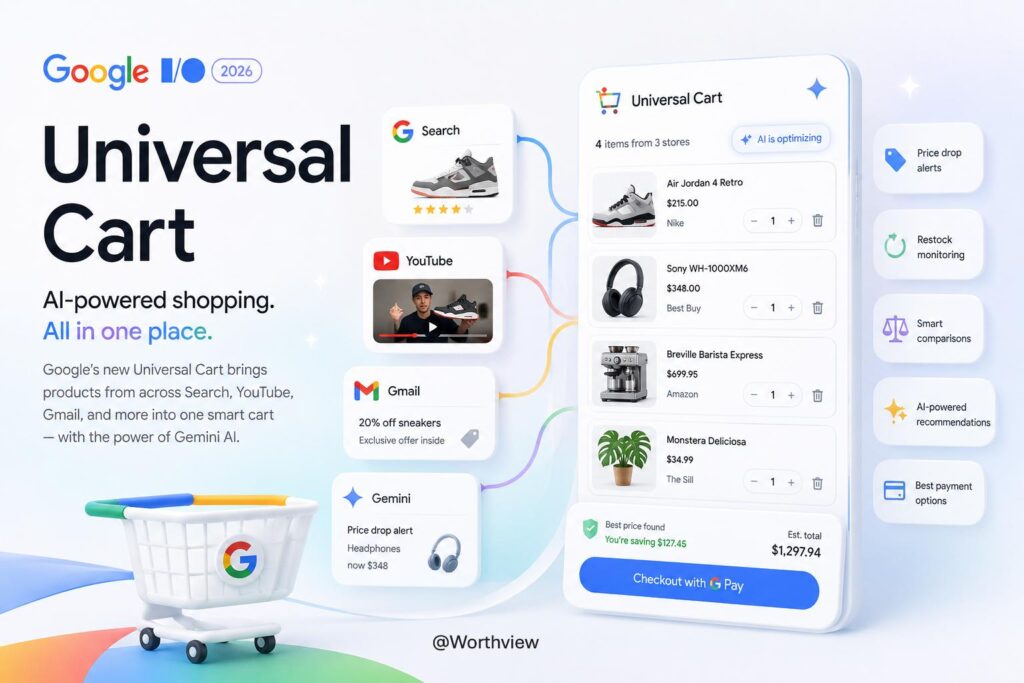
Universal Cart is a single, persistent shopping cart that works across everything Google — Search, Gemini, YouTube, and Gmail. You can add products from any of these surfaces, and they all land in the same place.
Think of it as a shopping list that follows you around Google’s universe, gets smarter over time, and eventually, can shop for you automatically.
| 🛒 The simple version
One cart. Across all of Google. Monitors prices. Notifies you on deals. Checks out with one tap. Powered by Gemini AI. |
Here’s what happens the moment you add something:
- Google tracks the price history of that item
- It alerts you when the price drops
- It tells you when a sold-out item is back in stock
- It checks if the item works with other things in your cart (useful for tech products)
- It surfaces deals and loyalty rewards you might have missed
And because it’s built on Google Wallet, it already knows your payment details, your reward points, and your loyalty memberships — without you setting anything up from scratch.
Before and after: how shopping actually changes
| Old Shopping on Google | With Universal Cart | |
| How you shop | Search → click 5 tabs → compare → buy | Add items while browsing, Gemini handles the rest |
| Price tracking | Manual — you check yourself | Automatic alerts for drops and deals |
| Payment | Enter card details on each site | One-tap checkout via Google Pay |
| Who buys? | You, every time | You — or your AI agent, within limits you set |
| Works across | Search only | Search, Gemini, YouTube, Gmail |
| Memory | None — start over each visit | Remembers your loyalty cards, preferences, past items |
The shift sounds incremental on paper. In practice, it collapses the 20-minute tab-juggling session most online shoppers know into a single, managed experience.
Why this matters: the scale of online shopping right now
| $214B
India e-commerce by FY30 (ICICI Securities) |
22.6B
UPI transactions in March 2026 alone |
300M
Users on Alibaba’s AI shopping agent in China |
60+
Partners backing Google’s AP2 payment protocol |
India’s e-commerce market is on track to nearly triple by 2030. UPI has made digital payments frictionless for hundreds of millions of people. And in China — where AI shopping agents are already mainstream — Alibaba’s Qwen assistant has 300 million monthly active users on Taobao alone.
Google is watching that Chinese playbook closely. Universal Cart is their opening move.
| 🇮🇳 India angle
Flipkart is already a named partner in Google’s Universal Commerce Protocol — the standard that makes Universal Cart work. That means Flipkart products could appear inside Google’s cart experience. |
The part nobody is talking about: AI that shops for you
Universal Cart is the front door. The real story is what sits behind it — a protocol called AP2 (Agent Payments Protocol).
Here’s the simple version: AP2 lets an AI agent buy things on your behalf, within rules you set yourself.
How it works
You tell Google: ‘Buy me flight tickets to Hyderabad if the price drops below ₹3,500. Only book IndiGo or Air India. Don’t spend more than ₹7,000.’
Then you forget about it. The AI monitors fares 24/7. The moment those conditions are met — without you being online, without you clicking anything — the ticket is booked. You get a notification after.
| This is called a ‘Human Not Present’ payment. The agent buys something when you’re not even looking. And Google shipped this in April 2026. |
AP2 uses cryptographic contracts (called ‘Mandates’) that create a tamper-proof record of every transaction. So if something goes wrong, there’s a clear audit trail of what the agent was authorised to do.
Google has also donated AP2 to the FIDO Alliance — the same body that manages password security standards globally — making it an open, industry-wide protocol rather than a Google-only system.
| 🔐 Is it safe?
Every AP2 transaction has a verifiable record linking you, the merchant, and the payment processor. The agent can only act within limits you define — specific brands, specific products, a spending cap. Think of it like setting rules for a very reliable personal assistant. |
Who quietly loses when Universal Cart wins
This is the part of the story that isn’t in Google’s press release.
Coupon and deal sites
Sites like Honey, RetailMeNot, and India’s CashKaro built their entire business on one thing: being the place where people discover deals before buying.
Universal Cart does that automatically, inside Google, before you ever visit those sites. If Google surfaces the discount first, the deal site loses the click — and the commission — even if the deal code originally came from their affiliate network.
Google hasn’t addressed this in any public documentation. For deal sites, it’s a slow-moving threat that’s easy to ignore — until it isn’t.
Affiliate marketers and content creators
A large chunk of how tech bloggers, YouTube reviewers, and comparison sites earn money is affiliate commissions. Someone reads a review, clicks a link, buys the product — the creator earns a cut.
When Universal Cart lets users add products to a Google-managed cart directly from YouTube, that purchase happens inside Google’s ecosystem. Attribution becomes murky. Did the creator drive that sale? Google’s system doesn’t clearly answer that yet.
Retailers’ direct relationship with customers
This is the deepest tension. Nike, Target, Walmart, and Sephora have all signed up as Universal Cart launch partners. They get Google’s reach. But Google now owns the discovery moment, the price comparison, and the checkout — the three most valuable touchpoints in e-commerce.
| It’s the same dilemma sellers faced when they first joined Amazon. More customers, but less control. Many of those sellers now wish they’d thought twice. |
China already did this — here’s what happened
Before we speculate about where Universal Cart is headed, we have a real-world data point: China.
Alibaba’s Taobao integrated AI shopping agents years ago. Today, its Qwen assistant has 300 million monthly active users. Consumers can describe what they want in natural language, and the agent surfaces, compares, and completes purchases across the platform.
What happened to the ecosystem around it? Small sellers who kept their product data clean and structured got more visibility. Those who didn’t got buried. Discovery sites and price comparison portals saw traffic decline as the AI absorbed their function. And Alibaba captured a larger share of the value chain with every transaction.
Google’s trajectory with Universal Cart points in the same direction — just playing out across a Western and Indian market context, with UPI and ONDC as variables that China never had to deal with.
| ⚡ ONDC factor
India has its own open commerce protocol — ONDC — backed by the government, with 10+ million monthly transactions and growing. It could become a parallel lane to Google’s Universal Commerce Protocol, especially for smaller sellers and regional platforms that Flipkart and Amazon don’t fully serve. |
Would you actually let an AI buy things without asking you?
This is the question Universal Cart’s future hinges on.
AP2’s ‘Human Not Present’ payments are technically impressive. But consumer trust in autonomous AI purchases is still untested at scale. Most people are comfortable with a streaming service auto-renewing a subscription. Fewer are comfortable with an AI booking a ₹15,000 flight on their behalf while they sleep.
The comfort level will likely follow a pattern we’ve seen before: routine, low-stakes purchases move first (reorder household supplies, catch a price drop on a book), then higher-consideration purchases follow as trust builds over years.
Google is betting that by the time people are ready for fully autonomous buying, Universal Cart will already be the default habit. And habits in consumer technology are extraordinarily hard to break.
What should you actually do with this information?
If you’re a regular shopper
Universal Cart rolls out in the US first. India timing is not confirmed. But Google Pay is already embedded in India through GPay, and Flipkart’s partnership with UCP suggests the infrastructure is being built. Watch this space — and keep an eye on whether Google Pay adds UPI-native checkout to the experience.
If you run a blog, YouTube channel, or affiliate site
Start thinking about your attribution model now. If a growing share of purchases happens inside Google’s ecosystem, affiliate link tracking breaks down. Diversify how you monetise — newsletters, memberships, brand partnerships — so you’re not entirely dependent on commission from product clicks.
If you’re a seller or brand
The question isn’t whether to join Universal Cart. It’s how you show up inside it. Product data quality — clean titles, accurate pricing, good reviews, fast fulfilment — will determine your visibility in an AI-mediated shopping layer. This is the new SEO for e-commerce.
FREQUENTLY ASKED QUESTIONS
Is Universal Cart available in India?
Not yet. It’s launching in the US first, across Search and the Gemini app. Expansion to other markets hasn’t been officially announced, but Flipkart’s involvement in Google’s Universal Commerce Protocol suggests India is on the roadmap.
Is it safe to let Google manage my shopping?
Google’s AP2 protocol uses cryptographic contracts that record every transaction and limit what the AI can do to the rules you set — specific brands, products, and a spending cap. That said, trust in autonomous AI purchases is still new territory for most consumers.
Does this hurt Amazon?
It’s designed to compete with Amazon’s checkout dominance. Amazon owns the cart for a huge share of online purchases — Universal Cart is Google’s attempt to own that moment across a wider set of retailers. It’s a direct challenge, though Amazon’s Prime ecosystem and logistics remain strong moats.
What happens to coupon sites and deal apps like Honey or CashKaro?
Universal Cart automatically surfaces price drops and deals — which is what those apps do today. If Google does this better or earlier in the shopping journey, traffic to dedicated coupon sites will likely decline. The attribution question for affiliate commissions is also unresolved.
What is UCP — the Universal Commerce Protocol?
UCP is an open standard that Google co-developed with Shopify, Flipkart, Walmart, Target, Mastercard, Visa, Stripe and others. Think of it as a common language that lets Google’s AI talk to retailer inventory, pricing, and checkout systems. It’s what makes Universal Cart work across different stores without a custom integration for each one.
The bottom line
Universal Cart is a genuinely useful product. For everyday shoppers, the convenience is real — one place to save items, automatic price tracking, fast checkout.
But underneath the convenience is something more significant: Google is building the infrastructure to become the permanent middleman of online commerce. Not a retailer. Not a marketplace. Something more powerful — the layer that sits between buyers and sellers and controls what gets discovered, compared, and purchased.
Whether that’s good or bad depends on which side of the transaction you’re on. For consumers, in the short term, it mostly looks good. For independent retailers, affiliate marketers, and deal sites, the long-term picture is harder.
What’s clear is that this is not a feature. It’s a strategy — and one that’s been years in the making.
| The real product isn’t the cart. It’s the data about what you want, what you’ll pay, and when you’ll buy. That data is worth more than any transaction fee. |
Enjoy Worthview?
Add Worthview as a Preferred Source on Google to see more of our stories in Search.

Sethuram Kishore is the founder and editor of Worthview, an online publication established in 2008. With over 18 years of experience in SEO, digital marketing, and online publishing, he writes about AI, technology, business, and digital trends. He is also the founder of MoneyHulk, a personal finance and business publication.