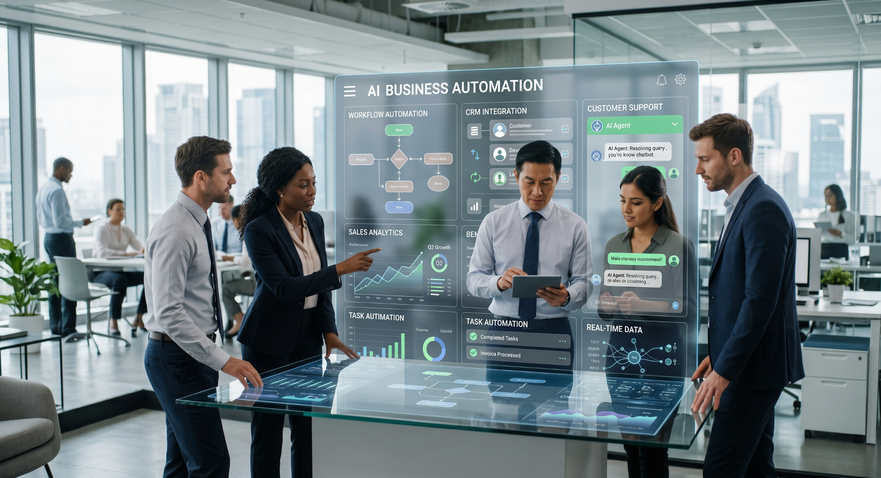
One of the most effective ways to optimize workflows is by integrating AI agents for business automations; these tools are ideal for streamlining sales operations and conversational processes.
This allows your customers to receive high-quality assistance while your company improves sales performance with minimal effort.
Today, we are no longer referring to traditional automation systems that simply send repetitive predefined messages and come with multiple limitations. Instead, businesses can now rely on intelligent solutions powered by AI agents.
Many companies have already faced the frustration of manual processes, delayed responses, reduced productivity, and high operational costs. Fortunately, intelligent automation strategies now offer a way to overcome those obstacles. Let’s explore how.
Key Takeaways
- AI agents are advanced, intelligent systems that plan and execute workflows to achieve specific business goals, moving beyond traditional rule-based automation.
- They enhance customer experience by providing personalized, real-time support and can function autonomously 24/7, significantly minimizing manual work.
- Key technologies enabling them include Reasoning Engines (CoT, SLMs) and Memory/Context systems (RAG, vector databases).
- Adopting AI agents drives business growth by accelerating revenue, reducing operational costs (up to 40% projected), and improving decision-making with real-time data.
- Successful integration requires maintaining data quality and system communication while carefully avoiding the risk of excessive automation.
What Are AI Agents for Business Automations?
You have probably interacted with virtual assistants before, but those experiences were likely limited to simple replies and basic customer support.
AI agents are different because they are advanced systems capable of planning, managing, and executing workflows focused on achieving business goals.
Definition and core capabilities of AI agents
An AI agent is an advanced technology capable of understanding its environment, which allows it to recognize customer needs more accurately.
Its main capabilities involve seamless customer interaction and the ability to accomplish business objectives through autonomous or semi-autonomous actions.
How AI agents for business automations differ from rule-based automation
There is a major distinction between traditional automated systems and AI agents. While conventional automation repeatedly sends predefined responses, AI agents can maintain coherent and natural conversations with customers.
In other words, one simply answers messages, while the other actively contributes to reaching company goals.
Key technologies behind AI agents
One of the first questions businesses ask is how AI agents automate processes so efficiently. The answer lies in the technologies behind them, including:
Reasoning Engines:
AI agents are equipped with advanced reasoning systems that allow them to process information and make intelligent decisions.
These capabilities are supported by technologies such as Chain-of-Thought (CoT), Small Language Models (SLMs), and autonomous planning.
Memory and Context:
AI agents also possess memory capabilities, allowing them to remember customer history and maintain contextual conversations.
Technologies such as Retrieval-Augmented Generation (RAG), Vector Databases, and long-term memory systems make this possible.
Governance and Security:
Although AI agents can operate autonomously, supervision remains necessary. Like any efficient employee, they require monitoring and governance.
Systems such as NeMo Guardrails and IAM (Identity and Access Management) help maintain secure and controlled operations.
How AI agents key benefits drive business growth
Because of their intelligent functionality and autonomous problem-solving capabilities, AI agents provide businesses with numerous advantages.
For this reason, companies continue investing in these systems with growing confidence.
Elevate your customer experience
When customers receive personalized, dynamic, and real-time support, their overall experience improves dramatically.
As a result, businesses create more satisfied customers who leave interactions with a stronger impression of the company’s service quality.
Accelerated revenue and sales velocity
AI agents help businesses reduce costs while simultaneously increasing revenue opportunities.
By using AI automation tools for small businesses, companies can automate management processes and accelerate sales workflows in a personalized and efficient way.
Optimize performance with autonomous actions
Perhaps the greatest advantage of AI agents is their ability to minimize manual work. Traditional automation tools still require someone working behind the scenes, but AI agents can function independently around the clock.
These systems continuously improve business performance through autonomous actions available 24/7.
Why Companies Are Increasing Investment in AI Agents
In 2026, more businesses are investing in AI agents because these technologies contribute directly to operational execution rather than simply analyzing market trends.
Demand for scalability and efficiency
As demand continues to increase, companies face greater operational challenges.
In these situations, businesses have discovered that AI agents are one of the best ways to improve efficiency, reduce repetitive tasks, and streamline processes.
Reducing operational costs
Companies already reported a 37% reduction in marketing expenses thanks to AI agents in 2025, and estimates suggest that number could exceed 40% in 2026.
This positions AI agents among the leading automation tools for small businesses.
Improving decision-making with real-time data
To improve business decisions, companies need products and services aligned with customer preferences.
AI agents collect and process real-time information to help organizations build more efficient business workflows.
Integrating AI Agents into Existing Systems
Working collaboratively creates more efficient and dynamic workflows, reducing operational burdens and improving overall productivity.
AI agents follow the same principle, which is why they are designed to integrate with existing systems.
CRM and marketing platform integration
CRM systems are relationship management platforms focused on customer engagement and personalized actions.
The benefits of AI agents within CRM systems come from their ability to exchange and process information strategically. CRM software identifies customer data while AI agents transform that information into intelligent actions.
Today, modern CRM systems have become ideal partners for AI automation tools for small businesses because they combine advanced data management with improved visibility across workflows.
Businesses can experience these benefits through Kommo AI, a solution that demonstrates the advantages of AI agents in CRM environments.
Building scalable automation ecosystems
AI agents can create scalable automation ecosystems by integrating software tools, AI technologies, and operational processes to improve efficiency.
For example, HubSpot provides AI-powered sales tools that help businesses optimize content management and build engaging campaigns using blog post generators.
Challenges and Considerations
According to Harvard Business Review, AI agents do not completely eliminate manual labor; in some cases, they can even intensify workloads. A study involving 200 employees revealed that operational pressure remains evident.
This demonstrates that AI agents are not perfect systems and still present challenges that companies must manage carefully.
For this reason, understanding how AI agents automate business processes is important, but knowing how to use them correctly is equally essential.
Data quality and system integration
For any automated system to operate efficiently, businesses must maintain balanced data quality and system integration.
If systems fail to communicate properly, information becomes fragmented. Likewise, poor-quality data can compromise operational accuracy.
Companies should ensure that chosen solutions provide consistency, integrity, precision, and reliable long-term data storage.
Avoiding over-automation
One of the greatest risks of AI adoption is excessive automation. Allowing AI systems to manage everything independently can create depersonalized experiences and reduce customer trust.
Instead, businesses should maintain balance by letting AI agents handle repetitive operational tasks while human teams focus on empathy-driven interactions.
My own point of view
As a researcher, writer, and member of a globally recognized CRM company, I have observed that AI agents have become one of the most successful business technologies available today.
This is not only a personal opinion; it is supported by the countless companies already implementing these systems successfully. Organizations such as Amazon, Tesla, and Netflix already rely on AI agents within their customer service operations.
Although implementation can be challenging, the benefits make the effort worthwhile. By the end of 2025, among the 23% of people actively using AI technologies, 10% reported significant productivity improvements.
From my perspective, adopting AI agents is worth considering, especially for businesses seeking measurable growth within a short period of time.
Final thoughts: Why you need this integration
After reviewing all this information, one conclusion becomes clear: AI-powered agents for business automation are becoming essential for modern companies.
There are many reasons for this, but the main one is their ability to help businesses overcome operational challenges while creating smoother and more efficient workflows.
This is the ideal moment to adopt advanced solutions such as Kommo and HubSpot, two of the leading AI automation tools for small businesses in 2026.
To summarize
To summarize briefly, three essential points stand out:
- AI agents are advanced systems capable of identifying improvement opportunities and delivering optimized business results.
- These tools help businesses accelerate workflows, improve operations, and increase performance.
- Companies can integrate AI agents with additional marketing technologies, especially CRM systems, to maximize success.
In addition, studies and real-world business examples continue demonstrating how organizations are already using AI agents within CRM systems to achieve scalable growth and stronger performance.
The best moment to act is now—start integrating AI agents for business automation today.
Frequently Asked Questions (FAQs)
Q: What are AI agents for business automations?
- AI agents are advanced systems designed to plan, manage, and execute workflows to achieve specific business goals. Unlike basic virtual assistants, these tools are capable of understanding their environment and recognizing customer needs accurately.
Q: How do AI agents differ from traditional rule-based automation systems?
- Traditional automated systems repeatedly send predefined messages, offering limited functionality and having multiple limitations. In contrast, AI agents can maintain natural and coherent conversations with customers and actively contribute to reaching company objectives.
Q: What are the key technologies that support AI agents?
- The core technologies include Reasoning Engines, which allow for intelligent decision-making using systems like Chain-of-Thought (CoT) and Small Language Models (SLMs). They also possess Memory and Context capabilities, enabled by Retrieval-Augmented Generation (RAG) and long-term memory systems, to remember customer history.
Q: What primary benefits do AI agents offer businesses?
- AI agents elevate the customer experience by providing personalized, real-time support and simultaneously reduce costs while increasing revenue opportunities. Their ability to function independently around the clock minimizes manual work and continuously improves overall business performance
Enjoy Worthview?
Add Worthview as a Preferred Source on Google to see more of our stories in Search.

Worthview Editorial Team is the shared byline for content created collaboratively by Worthview’s editors and contributors. Since 2008, we’ve published thousands of articles across technology, AI, finance, health, home, travel, and lifestyle. Our editorial process emphasizes original research, reputable sources, regular content updates, and clear attribution. Articles covering higher-trust topics, including health and finance, may also undergo review by qualified subject-matter experts.