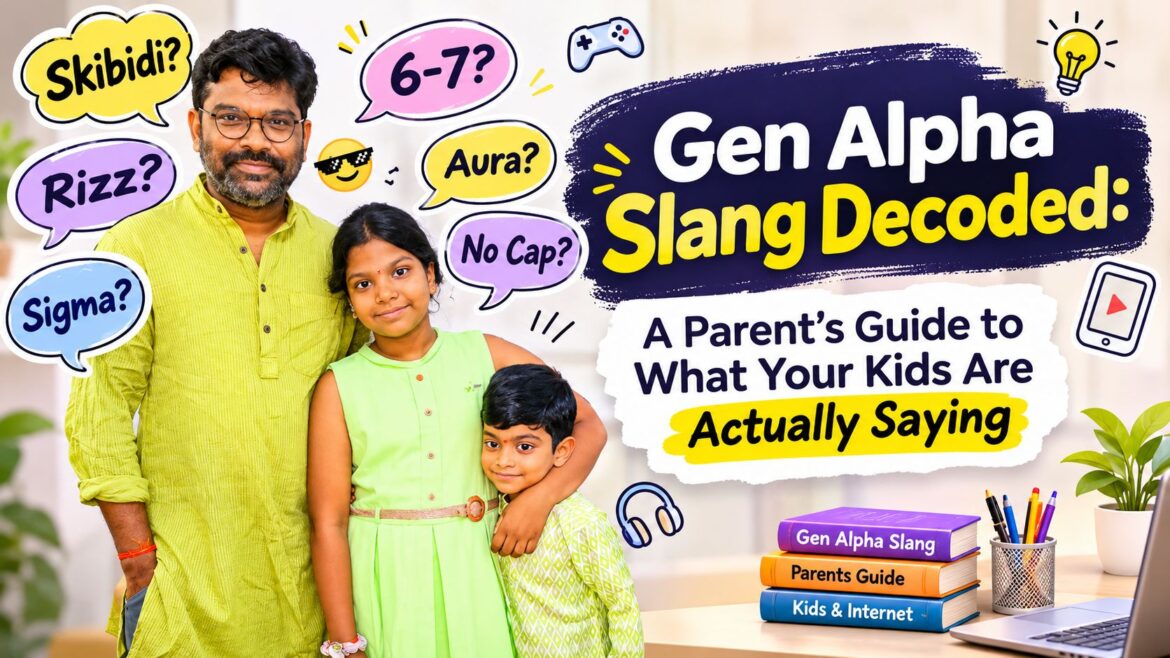
Happy Children’s Day! To celebrate, I’m going to admit something: I’m a dad of two, and some days I have no idea what my own kids are saying. From Skibidi and Sigma to Rizz and 6-7, here’s a dad’s attempt to understand the strange, funny and sometimes confusing language today’s kids use.
“What’s so funny?”
“Nothing, Dad. It’s just brainrot.”
“Brain… what?”
If you’re a parent, there’s a good chance you’ve had a conversation like this recently. You ask your child a simple question, and the answer sounds like something from another planet.
One minute they’re talking about school, and the next they’re throwing around words like Skibidi, Sigma, Rizz, Aura and 6-7. Sometimes they laugh uncontrollably at a number. Other times, they call something “Ohio” or tell you that you’ve lost your aura.
And if you ask what any of it means, you might get a smile, an eye roll or the classic “You wouldn’t understand, Dad!”
I have two kids, Veekshitha, who’s 12, and Karthikeya, who’s 7. Between them, I’ve realised that keeping up with children’s vocabulary is becoming a parenting skill of its own.
It’s Children’s Day, and instead of asking kids to understand our world for a change, let’s try understanding a little of theirs.
Welcome to the Gen Alpha slang dictionary for parents. No need to memorise everything. Let’s just try not to look completely confused at the dinner table!
First, Who Exactly Is Gen Alpha?
Generation Alpha generally refers to people born from around 2010 to the mid-2020s, although the exact dates vary depending on the source. They’re growing up in a world where smartphones, YouTube, online games, social media and AI are part of everyday life.
Unlike many of us who discovered new expressions through school friends, television or movies, today’s children pick up words from YouTube Shorts, Instagram Reels, gaming streams, memes and online communities.
A word can become popular overnight, travel across countries and suddenly pop up in school conversations before most parents even know what it means. And just when you start getting used to it, the trend disappears and a new one takes over! Keeping up with kids’ slang is almost like following AI updates – there’s always something new to learn, and you never know what’s coming next. 😄
Three things helped me stop panicking:
- A lot of it is deliberately absurd. A word like “skibidi” is funny because it means almost nothing. The joke is that adults don’t get it.
- Much of it is borrowed from older teens. “Rizz”, “sus”, “cap” and “slay” were Gen Z words first. Younger kids adopted them and gave them a twist.
- It’s a club password. Slang tells friends “you’re one of us” and tells parents “you’re not”. Our parents winced at our slang too.
One warning before the dictionary: meanings shift fast, and the same word can mean different things in different friend groups. Treat the list below as a snapshot of November 2026, and when in doubt, just ask your kid. (Trust me, they love explaining it. More on that later.)
The Gen Alpha Slang Dictionary: What Are Kids Actually Saying?
Let’s decode some of the expressions parents are most likely to hear.
1. The Internet’s Favourite Words
These are probably among the most recognisable Gen Alpha expressions.
| Slang | What it actually means | Example |
|---|---|---|
| Skibidi | A nonsense internet expression, often used to describe something weird, silly or ridiculous | “That video is so Skibidi!” |
| 6-7 (Six Seven) | A viral expression with no fixed meaning, often shouted randomly as an inside joke | “Six Seven!” |
| Sigma | Someone portrayed as independent, confident or a lone wolf; often used ironically | “He’s acting like a Sigma.” |
| Rizz | Short for charisma; the ability to charm or impress someone | “He’s got Rizz.” |
| Ohio | Something strange, weird or ridiculous | “That was so Ohio!” |
| Brainrot | Nonsensical or repetitive internet content, or jokingly, the feeling of having watched too much of it | “I’ve been watching Brainrot videos all day.” |
| Fanum Tax | Taking a bite or share of someone else’s food, usually as a joke | “You owe me Fanum Tax!” |
| What the Sigma? | A humorous replacement for “What the heck?” | “What the Sigma is happening?” |
A quick parent note: If your child randomly shouts “6-7” when you mention those numbers, don’t immediately assume there’s some hidden meaning. The joke is often that there isn’t one!
If you’ve already read our parent’s survival guide to the viral 6-7 trend, you’ll know exactly what we’re talking about.
2. Words About Being Cool, Popular or Impressive
A lot of Gen Alpha expressions revolve around popularity, appearance and how someone is perceived by others.
| Slang | What it means | Example |
|---|---|---|
| Aura | Someone’s coolness, confidence or overall vibe | “That guy has so much Aura.” |
| Aura Points | Imaginary points gained or lost based on how cool or embarrassing someone acts | “You lost 1000 Aura Points!” |
| Aura Farming | Doing something deliberately to look cool or impressive | “He’s just Aura Farming.” |
| Drip | Stylish clothes or a fashionable appearance | “Nice Drip!” |
| Ate | Did something exceptionally well | “She absolutely Ate that performance.” |
| Face Card | Refers to someone’s facial attractiveness | “Her Face Card never declines.” |
| Mogging | Outshining someone, often in appearance or physical presence | “He thinks he’s Mogging everyone.” |
| Chopped | Describes someone as unattractive; can be insulting | “That outfit looks Chopped.” |
Parent’s perspective: Some of these expressions are harmless compliments or jokes. However, words like Mogging and Chopped can encourage comparisons about physical appearance. It’s worth reminding children that making someone feel bad about how they look isn’t funny.
3. Words Kids Use in Everyday Conversations
These expressions are not necessarily exclusive to Gen Alpha, but you’ll hear them frequently in online conversations and everyday interactions.
| Slang | Meaning | Example |
|---|---|---|
| No Cap | Honestly, seriously or no lie | “That was the best movie, no cap!” |
| Cap | A lie or exaggeration | “That’s cap!” |
| Bussin | Really good, especially food | “This pizza is Bussin!” |
| Mid | Average or disappointing | “The movie was Mid.” |
| Cooked | In trouble, exhausted or in a difficult situation | “I’m Cooked. I didn’t study!” |
| Lock In | Focus seriously on something | “Exams are coming. Time to Lock In.” |
| Let Him Cook | Let someone continue; they might be doing something impressive | “Don’t interrupt him. Let him Cook!” |
| Delulu | Short for delusional; having unrealistic expectations, often jokingly | “I’m Delulu enough to think I’ll become famous!” |
| Unc | Short for uncle; a joking way to call someone old or out of touch | “Okay, Unc!” |
| Crash Out | Losing control emotionally or reacting dramatically | “He nearly Crashed Out over a game.” |
| Glazing | Praising someone excessively, sometimes unnecessarily | “Stop Glazing him!” |
| Lore | Someone’s backstory, history or interesting personal details | “What’s the Lore behind this?” |
4. Words Parents Should Understand Before Laughing Along
Not every trending expression is innocent. Some words can be used to insult, embarrass or make fun of other people.
Here are a few worth recognising:
| Slang | What parents should know |
|---|---|
| NPC | Short for Non-Player Character in gaming. Used to describe someone who appears to act without thinking independently. Can be dismissive. |
| Bop | Can be used as a derogatory, sexually judgemental label for a girl or woman. |
| Huzz | A slang expression for girls or women, sometimes used disrespectfully or in objectifying contexts. |
| Zesty | Can describe an expressive or flamboyant personality, but may also be used to mock someone based on perceived sexuality. |
| Big Back | A body-shaming expression used to mock someone’s weight or eating habits. |
| SYBAU | A vulgar internet abbreviation used to tell someone to shut up. |
There’s no need to panic if you hear one of these words. But it’s useful to understand the context and explain why certain expressions can hurt others.
A word being popular on the internet doesn’t automatically make it acceptable in everyday conversations.
Why Do Kids Use So Much Gen Alpha Slang?
As parents, it’s easy to assume that children are simply copying whatever they watch online. There’s some truth to that, but there’s more to it.
Here are a few reasons behind this language.
1. They want to belong
Using the same expressions as friends helps children feel included. Sometimes, understanding a meme or knowing a trending phrase is enough to become part of a conversation.
2. It’s their way of having fun
Not every expression needs a serious explanation. Sometimes, saying “6-7” repeatedly is simply funny to them because everyone around them understands the joke.
3. Social media spreads trends quickly
A phrase used by a popular creator or gaming streamer can reach millions of children through short videos, memes and reposts.
4. They enjoy confusing adults
Let’s be honest. Sometimes, half the entertainment is watching parents struggle to understand what they’re saying!
5. They’re developing their own identity
Children and teenagers naturally experiment with language, humour and expressions. Slang gives them a way to communicate with friends and feel part of their generation.
Should Parents Be Worried About Gen Alpha Slang?
Not necessarily.
Most slang is just another form of informal communication. Every generation has had its own expressions. We had our own school slang, movie dialogues and words that probably confused our parents too.
The difference today is how quickly expressions spread and how much online culture influences children’s conversations.
However, parents should pay attention when slang:
- Becomes a way to bully or insult classmates.
- Makes fun of someone’s appearance, background or identity.
- Includes sexually inappropriate or abusive expressions.
- Encourages unhealthy comparisons or pressure to look a certain way.
- Is used to hide conversations about unsafe activities or harmful content.
The important thing is not to judge a child based on one word. Understand the context before reacting.
A Small Challenge for Parents: How Much Gen Alpha Slang Do You Know?
Before you close this article, here’s a little test.
Can you decode these five expressions without looking at the dictionary above?
- “That’s so Skibidi!”
- “Bro has negative Aura.”
- “No Cap, the food is Bussin!”
- “I’m Cooked. I forgot my homework.”
- “Stop Glazing him!”
If you understood all five, congratulations! You might be more updated than you think.
If you didn’t, don’t worry. You’re probably still a perfectly good parent. You just need a little internet translation.
Final Thoughts: Understanding Their Language Is About Staying Connected
As parents, we don’t need to understand every meme, trend or slang word our children use. Nor do we need to start using these expressions ourselves.
But making an effort to understand their world is important.
With Veekshitha at 12 and Karthikeya at 7, I’m already seeing how differently children experience the world today. Their interests, entertainment and even the way they communicate are changing quickly.
Maybe the real lesson this Children’s Day is that while children are growing up in a very different world from the one we did, the basics of parenting haven’t changed much.
Listen to them, laugh with them, guide them when needed and keep the conversation going.
And the next time your child calls you “Unc”, just remember: you may have lost some Aura Points, but you’re still winning at parenting!
Happy Children’s Day to all the kids and the parents trying their best to keep up with them.
Enjoy Worthview?
Add Worthview as a Preferred Source on Google to see more of our stories in Search.

Worthview Editorial Team is the shared byline for content created collaboratively by Worthview’s editors and contributors. Since 2008, we’ve published thousands of articles across technology, AI, finance, health, home, travel, and lifestyle. Our editorial process emphasizes original research, reputable sources, regular content updates, and clear attribution. Articles covering higher-trust topics, including health and finance, may also undergo review by qualified subject-matter experts.